Back

Carbon quiz

Control buttons has been changed to "navigation" mode.
1/15
  • What is the most abundant element in living systems, excluding water?

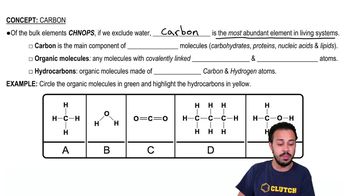
    Carbon is the most abundant element in living systems when water is excluded.
  • What are the four main classes of organic molecules in living organisms?

    The four main classes are carbohydrates, proteins, nucleic acids, and lipids.
  • What defines an organic molecule?

    An organic molecule contains covalently linked carbon and hydrogen atoms.
  • What is a hydrocarbon?

    A hydrocarbon is an organic molecule made exclusively of carbon and hydrogen atoms.
  • Why is carbon considered a versatile atomic building block?

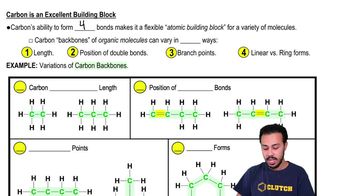
    Carbon can form four covalent bonds, allowing it to create a variety of molecular structures.
  • List one way carbon backbones can vary in organic molecules.

    Carbon backbones can vary in length, position of double bonds, branch points, or whether they are linear or ring-formed.
  • What makes methane a hydrocarbon?

    Methane is made only of carbon and hydrogen atoms, fitting the definition of a hydrocarbon.
  • Why is water (H2O) not considered an organic molecule?

    Water lacks covalently linked carbon and hydrogen atoms, so it is not organic.
  • What is the main component of all organic molecules?

    Carbon is the main component of all organic molecules.
  • How can the position of double bonds affect carbon backbones?

    The position of double bonds can vary within the carbon backbone, changing the molecule's structure.
  • What is a branched carbon backbone?

    A branched carbon backbone has a main chain with one or more side chains branching off.
  • Can carbon backbones form rings, and if so, what is the significance?

    Yes, carbon backbones can form rings, which increases the diversity of possible organic molecules.
  • What elements are present in hydrocarbons?

    Hydrocarbons contain only carbon and hydrogen atoms.
  • Why is carbon essential for biological structures and functions?

    Carbon's bonding versatility allows for the construction of diverse and complex molecules essential for life.
  • What does the acronym CHNOPS stand for?

    CHNOPS stands for Carbon, Hydrogen, Nitrogen, Oxygen, Phosphorus, and Sulfur, the bulk elements in living systems.