Anatomy & Physiology
My Course
Learn
Exam Prep
AI Tutor
Study Guides
Textbook Solutions
Flashcards
Explore
Try the app
My Course
Learn
Exam Prep
AI Tutor
Study Guides
Textbook Solutions
Flashcards
Explore
Try the app
Back
Cell Communication: Surface Receptors & Adhesion Molecules quiz
You can tap to flip the card.
What are surface receptors and where are they located?
You can tap to flip the card.
👆
What are surface receptors and where are they located?
Surface receptors are proteins located on the cell membrane that allow cells to sense and respond to external signals.
Track progress
Control buttons has been changed to "navigation" mode.
1/15
Related flashcards
Recommended videos
Cell Communication: Surface Receptors & Adhesion Molecules definitions
Cell Communication: Surface Receptors & Adhesion Molecules
15 Terms
2:58
Adhesion Molecules
1467
views
22
rank
4:05
Cell Surface Receptors
1703
views
20
rank
Terms in this set (15)
Hide definitions
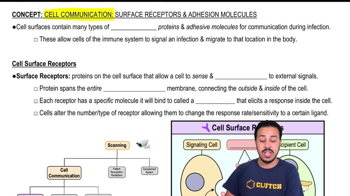
What are surface receptors and where are they located?
Surface receptors are proteins located on the cell membrane that allow cells to sense and respond to external signals.
What is a ligand in the context of cell communication?
A ligand is a specific molecule that binds to a surface receptor, triggering a response inside the cell.
How do surface receptors contribute to the immune response?
Surface receptors allow immune cells to detect signals of infection and respond appropriately, aiding in the immune response.
What happens when a ligand binds to a surface receptor?
The binding triggers a cascade of events inside the cell, ultimately leading to a cellular response.
Can cells change the number and types of surface receptors they have?
Yes, cells can alter the number and types of surface receptors to adjust their sensitivity to specific ligands.
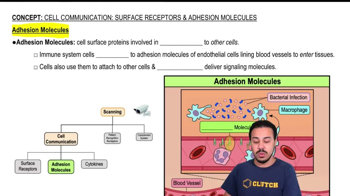
What is the main function of adhesion molecules?
Adhesion molecules are cell surface proteins that facilitate binding between cells, especially during immune responses.
How do adhesion molecules help immune cells during an infection?
They allow immune cells to bind to endothelial cells lining blood vessels, enabling migration into infected tissues.
What role do endothelial cells play in cell communication during infection?
Endothelial cells produce adhesion molecules that help immune cells attach and migrate into infected tissues.
Why is the specificity of surface receptors important?
Specificity ensures that only cells with the correct receptor can respond to a particular ligand, allowing precise communication.
What is the result of immune cells binding to adhesion molecules on endothelial cells?
This binding allows immune cells to exit the bloodstream and enter tissues where they can fight infections.
How do adhesion molecules contribute to direct cell-to-cell signaling?
They enable cells to attach to each other and directly deliver signaling molecules to the bound cell.
What is the significance of the cascade of events triggered by ligand-receptor binding?
The cascade amplifies the signal and leads to a specific cellular response, such as activating immune functions.
How do surface receptors connect the outside and inside of a cell?
They span the cytoplasmic membrane, linking external signals to internal cellular responses.
What allows only certain cells to respond to a specific ligand?
Only cells with the matching surface receptor for that ligand can respond to it.
Why are adhesion molecules vital for the immune system?
They are essential for immune cell migration and communication, enabling effective responses to infections.