Which hormone stimulates gluconeogenesis in the body?
Glucagon is the hormone that stimulates gluconeogenesis, primarily in the liver, to help maintain blood glucose levels during fasting or periods of low carbohydrate intake.
Which three glycolytic reactions require unique enzymes to be reversed during gluconeogenesis?
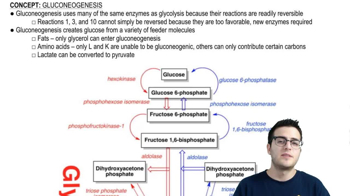
Reactions 1, 3, and 10 of glycolysis require unique enzymes for reversal in gluconeogenesis. These steps are catalyzed by glucose 6-phosphatase, fructose 1,6-bisphosphatase, and the combination of pyruvate carboxylase and PEP carboxykinase, respectively.
Why can't fatty acids contribute carbons to gluconeogenesis?
Fatty acids cannot contribute carbons to gluconeogenesis because only glycerol from fats can enter the pathway. The carbon skeletons of fatty acids are not converted into intermediates that feed into gluconeogenesis.
What is the role of pyruvate carboxylase in gluconeogenesis?
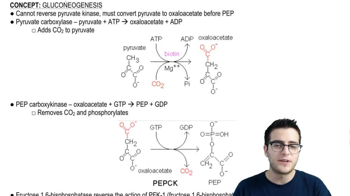
Pyruvate carboxylase converts pyruvate into oxaloacetate using ATP and adds a CO2 group. This is the first step in reversing the pyruvate kinase reaction from glycolysis.
How does PEP carboxykinase contribute to gluconeogenesis?
PEP carboxykinase converts oxaloacetate into phosphoenolpyruvate (PEP) using GTP and removes the CO2 added in the previous step. This reaction is essential for bypassing the irreversible pyruvate kinase step of glycolysis.
Why is gluconeogenesis considered more energy-intensive than glycolysis?
Gluconeogenesis requires 4 ATP, 2 GTP, and 2 NADH to produce one glucose molecule from two pyruvate molecules. This is more energy than is generated by glycolysis, making gluconeogenesis an energy-consuming process.
What is a futile cycle in the context of glycolysis and gluconeogenesis?
A futile cycle occurs when glycolysis and gluconeogenesis run simultaneously, causing energy to be wasted without any net gain. Cells tightly regulate these pathways to prevent such wasteful cycles.
Which enzyme reverses the action of phosphofructokinase in gluconeogenesis?
Fructose 1,6-bisphosphatase reverses the action of phosphofructokinase by removing a phosphate group from fructose 1,6-bisphosphate. This converts it back to fructose 6-phosphate.
Where in the cell do both glycolysis and gluconeogenesis primarily occur?
Both glycolysis and gluconeogenesis primarily occur in the cytosol of the cell. This allows them to share many of the same enzymes and intermediates.
Why is glucose 6-phosphatase only found in liver cells?
Glucose 6-phosphatase is only found in liver cells because the liver is responsible for maintaining blood glucose levels through gluconeogenesis. This enzyme allows the liver to release free glucose into the bloodstream.