What does Mendel's law of segregation state about allele separation during gamete formation?
It states that alleles for a gene separate so each gamete receives only one allele, resulting in haploid gametes.
During which phase of meiosis does independent assortment occur, and what does it result in?
It occurs during metaphase I of meiosis I and results in genetic diversity by allowing random alignment of homologous chromosomes.
How does the law of independent assortment contribute to genetic diversity?
It allows alleles of different genes to segregate independently, creating gametes with all possible combinations of alleles.
What is incomplete dominance, and what phenotype does it produce in heterozygotes?
Incomplete dominance is when heterozygotes show a blended, intermediate phenotype between the two alleles.
How does codominance differ from incomplete dominance in terms of phenotype expression?
In codominance, both alleles are equally and fully expressed in patches, rather than blending into an intermediate phenotype.
Which human trait is a classic example of codominance, and what are the codominant alleles involved?
Human ABO blood type is a classic example, with IA and IB alleles being codominant.
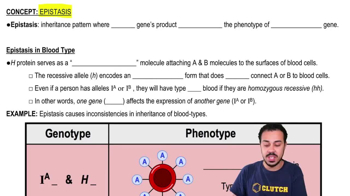
What is epistasis, and how does it affect blood type expression?
Epistasis is when one gene affects the expression of another; for example, a nonfunctional H protein gene prevents A or B molecules from attaching to red blood cells, resulting in type O blood regardless of IA or IB alleles.
What is a polygenic trait, and give an example?
A polygenic trait is a single phenotypic trait affected by multiple genes, such as human height.
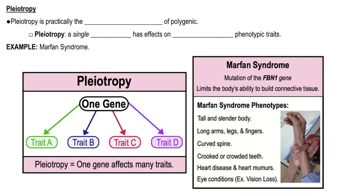
What is pleiotropy, and provide an example?
Pleiotropy is when one gene affects multiple phenotypic traits; Marfan syndrome is an example, where a mutation in one gene affects many body systems.
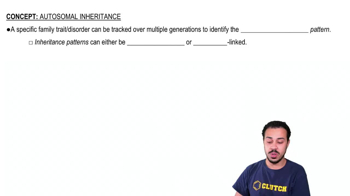
In a pedigree chart, what do circles and squares represent, and what does shading indicate?
Circles represent females, squares represent males, and shading indicates individuals affected by the phenotype of interest.
What is the difference between autosomal and sex-linked inheritance?
Autosomal inheritance involves genes on non-sex chromosomes, while sex-linked inheritance involves genes on the X or Y chromosomes.
Why are X-linked traits more commonly expressed in males than females?
Males have only one X chromosome, so they express whatever allele is present, while females have two X chromosomes and can be carriers without expressing the trait.
What is X inactivation, and what is a Barr body?
X inactivation is the random turning off of one X chromosome in female cells, and the inactive X chromosome is called a Barr body.
How does X inactivation explain the patchy fur color in calico cats?
Random X inactivation in female cats leads to different fur color alleles being expressed in different cells, resulting in color patches.
What is the probability of having a male or female child, and why?
There is a 50% chance for each, because males contribute either an X or Y chromosome, while females always contribute an X.
 Back
Back
 05:37
05:37