 Back
BackA&PII Exam #1 Study Guide – Endocrine System & Hematology
Study Guide - Smart Notes
 Tailored notes based on your materials, expanded with key definitions, examples, and context.
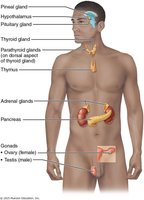
Q1. Study the diagram of the endocrine glands in the human body.
Background
Topic: Endocrine System Anatomy
This question is testing your ability to identify the major endocrine glands in the human body and understand their locations.
Key Terms:
Endocrine glands: Organs that secrete hormones directly into the bloodstream.
Hormones: Chemical messengers that regulate physiological processes.
Step-by-Step Guidance
Examine the diagram and note the labeled glands (e.g., pineal, hypothalamus, pituitary, thyroid, parathyroid, adrenal, pancreas, gonads).
Recall the general location of each gland in the body (e.g., pituitary at the base of the brain, adrenal glands on top of the kidneys).
Associate each gland with its primary function or hormone(s) it secretes.
Try solving on your own before revealing the answer!
Q2. What are the hormones that each of the endocrine glands secrete?
Background
Topic: Endocrine Gland Hormones
This question tests your knowledge of the specific hormones produced by each major endocrine gland.
Key Terms:
Pituitary gland: Secretes hormones like growth hormone (GH), ACTH, TSH, etc.
Thyroid gland: Secretes thyroid hormones (T3, T4).
Adrenal glands: Secrete cortisol, aldosterone, epinephrine, etc.
Step-by-Step Guidance
List each major endocrine gland from the diagram.
Recall or look up the main hormone(s) secreted by each gland.
Consider the function of each hormone to help you remember its source.
Try solving on your own before revealing the answer!
Q3. What are the differences between autocrine and paracrine signaling, and how does this differ from endocrine signaling?
Background
Topic: Types of Cell Signaling
This question tests your understanding of how cells communicate using chemical signals and the differences between local and systemic signaling.
Key Terms:
Autocrine signaling: Cells respond to signals they themselves secrete.
Paracrine signaling: Signals affect nearby cells.
Endocrine signaling: Hormones travel through the bloodstream to distant targets.
Step-by-Step Guidance
Define autocrine, paracrine, and endocrine signaling.
Compare the distance over which each type of signal acts.
Think of examples for each type (e.g., immune cells for autocrine/paracrine, insulin for endocrine).
Try solving on your own before revealing the answer!
Q4. What are the two types of hormones based on their composition?
Background
Topic: Hormone Classification
This question tests your knowledge of the chemical nature of hormones and how this affects their function.
Key Terms:
Amino acid-based hormones: Derived from amino acids, peptides, or proteins.
Steroid hormones: Derived from cholesterol.
Step-by-Step Guidance
Recall the two main categories of hormones based on their chemical structure.
Think about examples of each type (e.g., insulin for amino acid-based, cortisol for steroid-based).
Consider how their structure affects their solubility and mechanism of action.
Try solving on your own before revealing the answer!
Q5. What are eicosanoids? Give examples.
Background
Topic: Local Hormones
This question tests your understanding of a special class of signaling molecules derived from fatty acids.
Key Terms:
Eicosanoids: Lipid-derived signaling molecules, often involved in inflammation and immunity.
Examples: Prostaglandins, leukotrienes, thromboxanes.
Step-by-Step Guidance
Define what eicosanoids are and their general function.
List at least two examples of eicosanoids.
Consider where in the body these molecules are active.
Try solving on your own before revealing the answer!
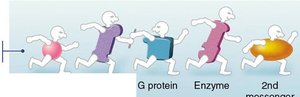
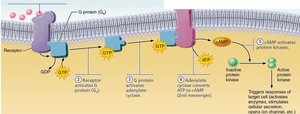
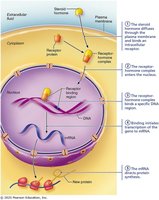
Q6. What are the mechanisms by which hormones take effect in the target cell?
Background
Topic: Hormone Action Mechanisms
This question tests your understanding of how hormones interact with target cells, focusing on water-soluble (second messenger system) and lipid-soluble (direct gene activation) hormones.
Key Terms and Formulas:
Second messenger system: Used by water-soluble hormones; involves G proteins, enzymes, and molecules like cAMP.
Direct gene activation: Used by steroid and thyroid hormones; hormone-receptor complex binds DNA to regulate gene expression.
Step-by-Step Guidance
Identify whether the hormone is water-soluble or lipid-soluble.
For water-soluble hormones, outline the steps of the second messenger pathway (e.g., hormone binds receptor, activates G protein, etc.).
For lipid-soluble hormones, describe how the hormone enters the cell and influences gene expression directly.
Try solving on your own before revealing the answer!
Q7. How are hormones secreted? What is the hypothalamic-hypophyseal tract and the hypothalamic-hypophyseal portal system?
Background
Topic: Hormone Secretion and Hypothalamic-Pituitary Connections
This question tests your understanding of how hormones are released and the anatomical pathways connecting the hypothalamus and pituitary gland.
Key Terms:
Hormone secretion: Can be triggered by neural, hormonal, or humoral stimuli.
Hypothalamic-hypophyseal tract: Nerve fibers connecting hypothalamus to posterior pituitary.
Hypothalamic-hypophyseal portal system: Blood vessels connecting hypothalamus to anterior pituitary.
Step-by-Step Guidance
Describe the three main types of stimuli for hormone secretion.
Explain the difference between the tract (neural) and portal system (vascular) connections.
Relate these pathways to the release of specific hormones (e.g., ADH, oxytocin, releasing hormones).
Try solving on your own before revealing the answer!
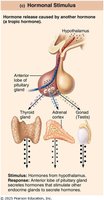
Q8. Study the image depicting an example of a hormonal stimulus.
Background
Topic: Hormonal Stimuli
This question is about understanding how one hormone can trigger the release of another hormone (tropic hormones).
Key Terms:
Tropic hormone: A hormone that stimulates another endocrine gland to secrete its hormone.
Step-by-Step Guidance
Examine the image and identify the sequence of hormone release (e.g., hypothalamus to pituitary to target gland).
Understand the concept of hormonal stimulus and how it regulates endocrine function.
Think of examples (e.g., TSH stimulates thyroid hormone release).
Try solving on your own before revealing the answer!
Q9. Study hormone mechanisms and their interaction with each other (permissiveness, synergism, antagonism; particularly for insulin and glucagon, calcitonin and parathyroid hormone).
Background
Topic: Hormone Interactions
This question tests your understanding of how hormones can influence each other's effects in the body.
Key Terms:
Permissiveness: One hormone enables another to act.
Synergism: Two hormones amplify each other's effects.
Antagonism: Two hormones have opposing effects.
Step-by-Step Guidance
Define each type of hormone interaction.
Identify examples from the question (e.g., insulin vs. glucagon for antagonism).
Explain why these interactions are important for homeostasis.
Try solving on your own before revealing the answer!
Q10. Study the components of blood.
Background
Topic: Blood Composition
This question tests your knowledge of the different components that make up blood.
Key Terms:
Plasma: The liquid portion of blood.
Formed elements: The cellular components (erythrocytes, leukocytes, platelets).
Step-by-Step Guidance
List the main components of blood.
Describe the function of each component.
Consider the relative proportions of each component in whole blood.
Try solving on your own before revealing the answer!
Q11. What are the formed elements of blood?
Background
Topic: Blood Cells
This question tests your ability to identify and describe the cellular elements of blood.
Key Terms:
Erythrocytes: Red blood cells.
Leukocytes: White blood cells.
Platelets: Cell fragments involved in clotting.
Step-by-Step Guidance
List the three main formed elements.
Describe the primary function of each.
Recall where each is produced in the body.
Try solving on your own before revealing the answer!
Q12. How do erythrocytes develop/form?
Background
Topic: Erythropoiesis
This question tests your understanding of the process by which red blood cells are produced.
Key Terms:
Erythropoiesis: The process of red blood cell formation.
Hematopoietic stem cells: The origin of all blood cells.
Step-by-Step Guidance
Outline the stages of erythrocyte development from stem cell to mature RBC.
Identify the role of erythropoietin in this process.
Consider where in the body erythropoiesis occurs.
Try solving on your own before revealing the answer!
Q13. What are the functions of erythrocytes?
Background
Topic: Red Blood Cell Function
This question tests your knowledge of the main roles of red blood cells in the body.
Key Terms:
Oxygen transport: Main function of erythrocytes.
Hemoglobin: Protein that binds oxygen.
Step-by-Step Guidance
Describe the primary function of erythrocytes.
Explain how hemoglobin enables this function.
Consider the importance of erythrocytes in carbon dioxide transport as well.
Try solving on your own before revealing the answer!
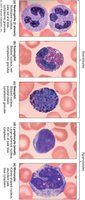
Q14. What are leukocytes? What are the different types of leukocytes?
Background
Topic: White Blood Cells
This question tests your ability to identify and describe the different types of white blood cells.
Key Terms:
Leukocytes: White blood cells involved in immune defense.
Types: Neutrophils, lymphocytes, monocytes, eosinophils, basophils.
Step-by-Step Guidance
List the five main types of leukocytes.
Describe the general function of each type.
Recall which are granulocytes and which are agranulocytes.
Try solving on your own before revealing the answer!
Q15. How does blood typing work? What is the importance of blood typing?
Background
Topic: Blood Groups
This question tests your understanding of blood group antigens and why matching blood types is important for transfusions.
Key Terms:
Antigens: Surface markers on red blood cells (e.g., A, B, Rh).
Antibodies: Proteins that recognize and bind foreign antigens.
Step-by-Step Guidance
Explain how blood types are determined by antigens on RBCs.
Describe what happens if incompatible blood is transfused.
Discuss the importance of blood typing in medicine.
Try solving on your own before revealing the answer!
Q16. What is the Rh factor? What is hemolytic disease of the newborn?
Background
Topic: Rh Blood Group System
This question tests your understanding of the Rh antigen and its clinical significance, especially in pregnancy.
Key Terms:
Rh factor: An antigen present (+) or absent (−) on RBCs.
Hemolytic disease of the newborn: Condition caused by Rh incompatibility between mother and fetus.
Step-by-Step Guidance
Define the Rh factor and its inheritance.
Explain how Rh incompatibility can lead to hemolytic disease in newborns.
Discuss prevention strategies (e.g., RhoGAM).
Try solving on your own before revealing the answer!
