 Back
BackAdaptive Immunity: Cell-Mediated Immunity and T Cell Function
Study Guide - Smart Notes
 Tailored notes based on your materials, expanded with key definitions, examples, and context.
Adaptive Immunity: Cell-Mediated Immunity
Introduction to Adaptive Immunity
Adaptive immunity is a highly specific defense mechanism that involves the recognition and elimination of pathogens, abnormal cells, and foreign tissues. The cell-mediated arm of adaptive immunity primarily involves T cells, which are subdivided into Helper T (TH) cells (CD4+) and Cytotoxic T (TC) cells (CD8+). These cells are essential for targeting intracellular pathogens, cancer cells, and foreign cells from transplants.
Helper T (TH) cells: Activate and regulate other immune cells.
Cytotoxic T (TC) cells: Directly kill infected or abnormal cells.
CD: Stands for "cluster of differentiation," a marker used to identify cell types.
T Cell Development and Maturation
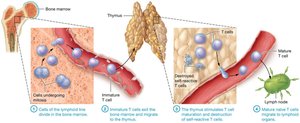
T cells originate in the bone marrow and migrate to the thymus for maturation. During this process, gene rearrangements produce a diverse population of T cells, each capable of recognizing a specific antigen. The thymus screens T cells for their ability to recognize antigens, ensuring immunocompetence and self-tolerance.
Clone: A population of T cells specific to a particular antigen.
Immunocompetence: Ability to mount a normal immune response.
Self-tolerance: Destruction of self-reactive T cells to prevent autoimmunity.
Naïve T cells: Mature T cells that have not yet encountered their specific antigen.
Antigens and Immunogens
An antigen is any substance recognized by B or T cells, often peptides but can include carbohydrates, lipids, and metals. Only certain antigens, called immunogens, elicit an immune response. Haptens are small antigens that become immunogenic only when attached to a protein carrier.
Antigenic determinant: The specific region of an antigen recognized by a T cell receptor.
Self antigens: Antigens present on one's own cells, not immunogenic in the host.
Example: Urushiol from poison ivy acts as a hapten when it binds to skin proteins.
Major Histocompatibility Complex (MHC) Molecules
T cells recognize antigens only when they are presented by MHC molecules on cell surfaces. MHC molecules are critical for tissue compatibility and immune recognition.
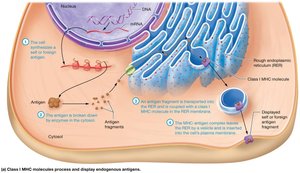
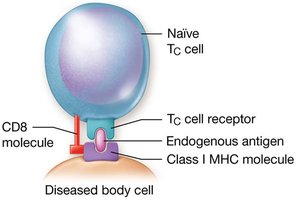
Class I MHC: Found on nearly all nucleated cells; present endogenous antigens.
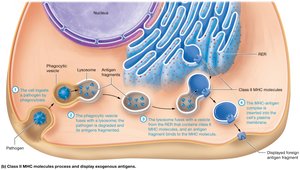
Class II MHC: Found only on antigen-presenting cells (APCs); present exogenous antigens.
Endogenous antigens: Originating inside the cell (e.g., viral proteins, mutated cancer antigens).
Exogenous antigens: Originating outside the cell, taken in by phagocytosis.
Antigen Processing and Presentation
Antigen processing involves breaking down antigens and displaying their fragments on MHC molecules. The process differs for endogenous and exogenous antigens:
Class I MHC: Processes and displays endogenous antigens synthesized within the cell.
Class II MHC: Processes and displays exogenous antigens taken up by phagocytosis.
Role of MHC Molecules in T Cell Activation
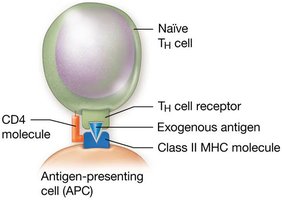
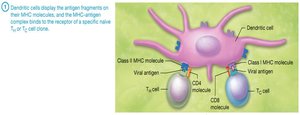
The distinction between class I and class II MHC molecules is crucial for proper immune function. Helper T cells (TH) interact with class II MHC on APCs, while cytotoxic T cells (TC) interact with class I MHC on diseased cells. This prevents inappropriate destruction of healthy cells.
TH cells: Activated by APCs presenting exogenous antigens on class II MHC.
TC cells: Activated by diseased cells presenting endogenous antigens on class I MHC.
T Cell Activation, Clonal Selection, and Differentiation
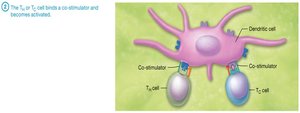
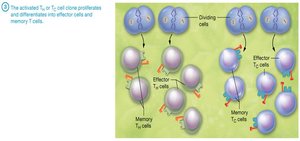
T cell activation involves antigen presentation, co-stimulation, and proliferation. Dendritic cells can cross-present antigens on both MHC classes, activating both TH and TC cells. Activated T cells proliferate and differentiate into effector and memory cells.
Clonal selection: Antigen selects a specific T cell clone for activation.
Co-stimulator: Additional molecules required for full T cell activation.
Effector cells: Cause immediate immune effects.
Memory T cells: Provide rapid response upon subsequent antigen exposure.
Effects of T Cells
Helper T (TH) Cell Functions
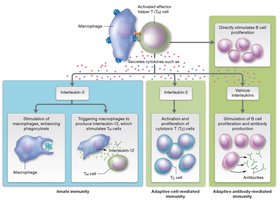
Helper T cells coordinate immune responses by secreting cytokines that activate macrophages, cytotoxic T cells, and B cells. They are essential for both innate and adaptive immunity.
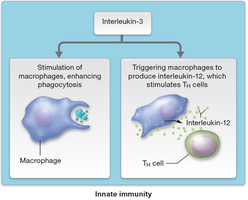
Innate immunity: TH cells secrete interleukin-3, stimulating macrophages and enhancing phagocytosis.
Feedback loop: Macrophages produce interleukin-12, which further stimulates TH cells.
Activation of Cytotoxic T (TC) Cells
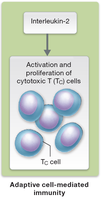
TH cells secrete interleukin-2 (IL-2), which is required for the activation and proliferation of cytotoxic T cells. Without IL-2, TC cells fail to activate.
IL-2: Key cytokine for TC cell activation.
Stimulation of B Cells
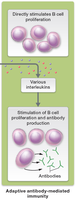
TH cells directly bind to B cells and secrete interleukins, stimulating B cell proliferation and antibody production. This is crucial for adaptive antibody-mediated immunity.
Interleukins: Cytokines that promote B cell proliferation and antibody synthesis.
Cytotoxic T (TC) Cell Functions
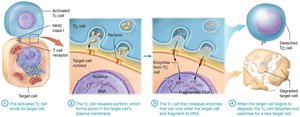
Cytotoxic T cells kill infected, cancerous, or foreign cells by recognizing antigens bound to class I MHC molecules. They release perforin and enzymes to induce cell death, and can also trigger apoptosis.
Perforin: Protein that forms pores in target cell membranes.
Apoptosis: Programmed cell death induced by TC cells.
Organ and Tissue Transplantation and Rejection
Types of Transplants (Grafts)
Transplants are classified based on the genetic relationship between donor and recipient:
Type | Description | Immune Response |
|---|---|---|
Autograft | Tissue from same individual | No response |
Isograft | Tissue from genetically identical individual | No response |
Allograft | Tissue from nonidentical individual of same species | Possible rejection |
Xenograft | Tissue from different species | High risk of rejection |
Graft Rejection and Prevention
Allografts and xenografts contain foreign antigens that can trigger immune rejection, leading to necrosis and organ failure. Prevention involves matching antigens (especially MHC/HLA genes) and immunosuppressive therapy.
Necrosis: Death of transplanted tissue due to immune attack.
Immunosuppressive therapy: Medications to suppress immune response and prevent rejection.
Bone Marrow Transplantation
Bone marrow transplants, also known as hematopoietic stem cell transplants (HSCT), are commonly performed to treat various diseases and require careful matching to prevent rejection.
