 Back
BackAnatomy & Physiology Study Notes: Chapters 1–8
Study Guide - Smart Notes
 Tailored notes based on your materials, expanded with key definitions, examples, and context.
Introduction to Anatomy and Physiology
Definitions and Scope
Anatomy and physiology are foundational sciences for understanding the human body. Anatomy is the study of body structures and their relationships, while physiology focuses on the functions of those structures.
Anatomy: Study of structures and relationships among structures.
Physiology: Study of functions of anatomical structures.
Subdivisions of Anatomy
Gross Anatomy: Study without a microscope.
Microscopic Anatomy: Requires a microscope (light, electron).
Regional Anatomy: Focuses on specific regions (e.g., head, neck).
Systemic Anatomy: Study of body systems (e.g., digestive, reproductive).
Radiographic Anatomy: Uses X-rays for structural study.
Cytoology: Study of cells.
Histology: Study of tissues.
Embryological Anatomy: Study of prenatal development.
Non-Invasive Imaging: MRI, CAT scan, PET scan.
Pathological Anatomy: Study of structural changes due to disease.
Subdivisions of Physiology
Systemic Physiology: Function of body systems.
Cell Physiology: Function of cells.
Neurophysiology: Function of nerve cells.
Endocrinology: Study of hormones and their effects.
Immunology: Study of body defense mechanisms.
Homeostasis
Homeostasis is the maintenance of internal stability despite external changes. It is regulated by coordinated actions of organs and tissues, mainly under nervous and endocrine control.
Disruption leads to illness or death.
Stress: Disrupts homeostasis; stressors include heat, cold, viruses, mental disturbances, hormones.
Feedback Systems: Negative feedback opposes the stimulus; positive feedback reinforces it (rare, e.g., childbirth).
Levels of Organization in the Human Body
Hierarchy of Structural Organization
Atoms: Basic units of matter.
Elements: Types of atoms (e.g., O, H, N, S, C).
Molecules: Combinations of atoms; compounds contain more than one element.
Cells: Smallest independent units of life.
Tissues: Groups of similar cells performing specific functions.
Organs: Groups of two or more tissues forming structures (e.g., stomach, liver).
Systems: Groups of organs working together (e.g., skeletal, muscular, nervous).
Organism: The complete human.
Types of Tissues
Epithelial: Protection, secretion, absorption (skin, organ linings).
Connective: Support, repair (tendons, ligaments, fat, cartilage, blood, bone).
Muscle: Movement (skeletal—voluntary, smooth—involuntary, cardiac—involuntary).
Nerve: Responds to stimuli, transmits impulses (brain, spinal cord, nerves).
Anatomical Position, Planes, and Directional Terms
Anatomical Position
Body standing erect, facing forward, feet together, arms at sides, palms forward.
Planes
Midsagittal: Divides body into equal left and right halves.
Sagittal: Divides body into unequal left and right parts.
Frontal (Coronal): Divides body into anterior and posterior sections.
Transverse (Horizontal): Divides body into superior and inferior sections.
Directional Terms
Cranial/Cephalic: Toward the head.
Caudal: Toward the tail.
Superior: Above.
Inferior: Below.
Anterior (Ventral): Toward the front.
Posterior (Dorsal): Toward the back.
Medial: Toward the midline.
Lateral: Away from the midline.
Proximal: Nearer to the trunk.
Distal: Farther from the trunk.
Superficial (External): Near the surface.
Deep (Internal): Farther from the surface.
Body Cavities and Regions
Main Body Cavities
Ventral (Anterior): Thoracic (heart, lungs), abdominopelvic (digestive, urinary, reproductive organs).
Dorsal (Posterior): Cranial (brain), vertebral (spinal cord).
Abdominopelvic Regions and Quadrants
Four quadrants: right upper, left upper, right lower, left lower.
Nine regions: right/left hypochondriac, epigastric, right/left lumbar, umbilical, right/left iliac, hypogastric.
Characteristics of Living Forms
Metabolism: Sum of all chemical processes. Catabolism breaks down molecules; Anabolism builds up molecules.
Responsiveness: Reacting to changes.
Movement: Motion of body, organs, or cells.
Growth: Increase in size and complexity.
Differentiation: Specialization of cells.
Reproduction: Formation of new cells or individuals.
Adaptation: Adjusting to environmental changes.
Chemistry in Anatomy & Physiology
Basic Concepts
Chemistry: Study of matter composition.
Matter: Anything with mass and volume; exists as solid, liquid, gas.
Element: Substance that cannot be broken down chemically.
Atom: Smallest unit retaining element properties.
Energy: Ability to do work; potential (stored) and kinetic (motion).
Atomic Structure
Subatomic particles: protons (+), neutrons (0), electrons (-).
Atomic number = number of protons.
Mass number = protons + neutrons.
Electron shells: first holds 2, second and third hold 8.
Valence electrons: electrons in outermost shell, determine chemical behavior.
Isotopes and Radioactivity
Isotopes: Same element, different neutrons.
Radioactive isotopes: Emit radiation, used in medicine (e.g., Iodine-131).
Half-life: Time for half of isotope to decay.
Chemical Bonds
Covalent: Atoms share electrons (nonpolar = equal sharing, polar = unequal).
Ionic: Transfer of electrons; cations (+), anions (-).
Hydrogen: Weak bond between hydrogen and electronegative atom.
Chemical Reactions
Synthesis (Anabolism): Building complex molecules.
Decomposition (Catabolism): Breaking down molecules.
Redox: Oxidation (loss of electrons), reduction (gain of electrons).
Dehydration: Bond formation by removing water.
Hydrolysis: Bond breaking by adding water.
Water and Solutions
Water is main regulator of homeostasis, most abundant inorganic compound.
Properties: solvent, temperature regulator, transporter, lubricant, cushion.
Hydrophilic: Water-loving; Hydrophobic: Water-fearing.
Polarity leads to hydrogen bonding and high surface tension.
Solution: Homogeneous mixture; Solvent: Dissolving agent; Solute: Dissolved substance.
Acids, Bases, Salts, and pH
Acid: Releases H+ ions; Base: Accepts H+ or releases OH-.
Salt: Releases cation other than H+ and anion other than OH-.
pH: Negative log of H+ concentration; scale 0–14.
Buffer: Regulates pH changes, maintains homeostasis.
Organic Molecules: Carbohydrates, Lipids, Proteins, Nucleic Acids
Carbohydrates
Major energy source; composed of C, H, O.
Types: monosaccharides (simple sugars), disaccharides (double sugars), polysaccharides (complex).
Examples: glucose, fructose, sucrose, starch, glycogen, cellulose.
Lipids
Hydrophobic; composed of C, H, O (different ratios).
Types: triglycerides (fats), phospholipids (cell membranes), steroids (hormones), eicosanoids (messengers).
Examples: cholesterol, bile salts, testosterone, estrogen.
Proteins
Composed of C, H, O, N; built from amino acids.
Levels of structure: primary (sequence), secondary (folding), tertiary (3D shape), quaternary (multiple chains).
Functions: antibodies, hemoglobin, enzymes.
Denaturation: loss of function due to temperature or pH changes.
Nucleic Acids
Composed of nucleotides (phosphate, sugar, nitrogenous base).
DNA: double helix, hereditary information, controls protein synthesis.
RNA: single strand, involved in protein synthesis.
ATP: energy molecule for cells.
Example: Structure of ATP (Adenosine Triphosphate):
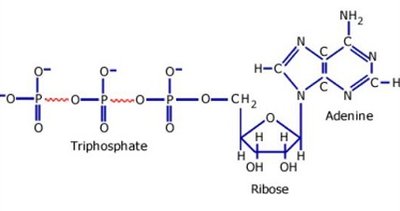
ATP consists of adenine (a nitrogenous base), ribose (a five-carbon sugar), and three phosphate groups. The high-energy bonds between phosphate groups are the source of cellular energy.
Cell Structure and Function
Parts of the Cell
Plasma Membrane: Selectively permeable, maintains electrochemical gradients, contains proteins and carbohydrates.
Cytoplasm: Fluid phase (cytosol) and particulate phase (organelles).
Nucleus: Stores genetic material, controls heredity and protein synthesis.
Movement Across Membranes
Passive: Diffusion, facilitated diffusion, osmosis, filtration, dialysis.
Active: Active transport, exocytosis, endocytosis (pinocytosis, receptor-mediated, phagocytosis).
Organelles
Endoplasmic Reticulum: SER (steroid synthesis), RER (protein synthesis).
Ribosomes: Protein synthesis.
Golgi Apparatus: Processing, storing, packaging proteins.
Lysosomes: Digestive enzymes.
Peroxisomes: Detoxification.
Mitochondria: ATP production, cellular respiration.
Cytoskeleton: Support, movement.
Centrioles: Cell division.
Cilia/Flagella: Movement.
Cell Cycle
Somatic Cell Division: Interphase (DNA replication), mitosis (prophase, metaphase, anaphase, telophase), cytokinesis.
Meiosis: Formation of gametes, two divisions, results in haploid cells.
Tissues and Body Membranes
Classification of Tissues
Epithelial: Covers surfaces, lines cavities, forms glands.
Connective: Supports, binds, protects, stores energy.
Muscle: Contracts for movement (skeletal, cardiac, smooth).
Nervous: Conducts impulses, supports neurons.
Body Membranes
Epithelial Membranes: Cutaneous (skin), mucous (lines cavities open to exterior), serous (lines closed cavities).
Synovial Membrane: Lines joint cavities, secretes lubricating fluid.
The Integumentary System
Functions
Insulates, cushions, protects from damage and invasion.
Excretes waste, assembles vitamin D, sensory organ.
Structure
Epidermis: Stratum corneum (dead, keratinized), lucidum (clear, thick skin), granulosum (dying cells), spinosum (alive, pigment), basale (cell division).
Dermis: Papillary layer (fingerprints, touch), reticular layer (blood vessels, glands, pressure receptors).
Skin Color
Determined by melanin, carotene, blood oxygenation.
Diagnostic tool (e.g., cyanosis, jaundice).
Appendages
Hair, nails, glands (derivatives of epidermis, reside in dermis).
Body Temperature Regulation
Negative feedback system; thermoreceptors, sweat glands, hypothalamus.
Mechanisms: conduction, convection, radiation, evaporation.
The Skeletal System
Functions
Movement (lever system), protection, support, storage, hematopoiesis.
Composition
Water, proteins, mineral salts (calcium, phosphorus, magnesium, hydroxyapatite), vitamins, hormones.
Cells: osteoprogenitor, osteoblasts, osteocytes, osteoclasts.
Bone Development
Intramembranous: Directly in connective tissue (skull, mandible, clavicle).
Endochondral: In hyaline cartilage (most bones).
Bone Structure
Diaphysis (shaft), periosteum, epiphysis (ends), articular cartilage, epiphyseal plate/line, marrow cavity, endosteum, metaphysis.
Bone Classification
Long, short, flat, sesamoid, irregular, sutural bones.
Axial and Appendicular Skeleton
Axial: skull, hyoid, vertebral column, ribs, sternum.
Appendicular: upper/lower extremities, girdles.
The Muscular System
Muscle Anatomy
Skeletal muscle: epimysium, perimysium, endomysium, sarcolemma, sarcoplasm, T-tubules, myofibrils, sarcomere (A band, I band, Z line, M line).
Cardiac muscle: striated, one nucleus, intercalated discs, pacemaker cells.
Smooth muscle: one nucleus, tapered, no striations, actin/myosin attached to dense bodies.
Muscle Physiology
Functions: movement, posture, sphincter control, heat production.
Contraction: motor unit, neurotransmitter (acetylcholine), action potential, calcium release, cross-bridge formation, ATP use.
Relaxation: acetylcholinesterase breaks down acetylcholine.
Types: twitch, summation, tetanus, tone, treppe, isometric, isotonic, hypertrophy, atrophy.
Energy: aerobic (fatty acids, oxygen), anaerobic (glycolysis, lactic acid), creatine phosphate.
Muscle fiber types: slow (red, aerobic, fatigue-resistant), fast (white, anaerobic, fatigues quickly).
The Nervous System
Functions and Structure
Control, coordinate, integrate body activities.
CNS: brain, spinal cord. PNS: cranial/spinal nerves.
Neuroglial cells: astrocytes, oligodendrocytes, ependymal, microglia.
Neurons: cell body, dendrites, axon, myelin sheath, nodes of Ranvier, synapse.
Neuron Classification
Functional: motor (efferent), sensory (afferent), interneurons.
Structural: multipolar, bipolar, unipolar.
Receptors
Exteroceptors (external), interoceptors (internal), proprioceptors (position/movement).
Nerve Impulse
Polarization (resting), depolarization (stimulation), repolarization (return to rest).
Action potential, refractory period, all-or-none response, saltatory conduction.
Spinal Cord and Protection
White matter (myelinated), gray matter (cell bodies).
Meninges: dura mater, arachnoid, pia mater.
Cerebrospinal fluid (CSF): shock absorption, waste removal, homeostasis.
Brain Structure
Development: forebrain, midbrain, hindbrain.
Cerebrum: frontal, parietal, temporal, occipital lobes.
Diencephalon: thalamus, hypothalamus.
Mesencephalon: midbrain, corpora quadrigemina.
Metencephalon: pons, cerebellum.
Myelencephalon: medulla oblongata.
Peripheral Nervous System
Spinal nerves (31 pairs), cranial nerves (12 pairs).
Plexuses: cervical, brachial, lumbar, sacral.
Autonomic Nervous System
Sympathetic: fight-or-flight, expends energy.
Parasympathetic: rest-and-digest, conserves energy.
Neurotransmitters
Acetylcholine, amino acids, biogenic amines, neuropeptides.
The Special Senses
Sensory Receptors
Exteroceptors, proprioceptors, interoceptors.
Types: thermoreceptors, nocireceptors, chemoreceptors, mechanoreceptors, photoreceptors.
The Eye
Protection: bones, eyelids, eyelashes, glands, conjunctiva.
Layers: fibrous (sclera, cornea), vascular (choroid, ciliary body, iris), neural (retina).
Photoreceptors: rods (dim light), cones (color).
Cavities: anterior (aqueous humor), posterior (vitreous humor).
Focusing: accommodation, ciliary muscle, lens shape.
The Ear
External: pinna, auditory meatus, tympanic membrane.
Middle: ossicles (malleus, incus, stapes), Eustachian tube.
Inner: bony and membranous labyrinth, cochlea, vestibule, semicircular canals.
Hearing: organ of Corti, cochlear nerve.
Equilibrium: utricle, saccule, semicircular ducts.
Taste and Smell
Taste: taste buds (papillae), cranial nerves VII, IX, X.
Smell: olfactory organs, olfactory nerve pathway.
