 Back
BackANP College Exam Review: Blood, Heart, Vessels, Lymph, and Immunity
Study Guide - Smart Notes
 Tailored notes based on your materials, expanded with key definitions, examples, and context.
Q1. What are the lines of defense in the immune system, and how are they categorized?
Background
Topic: Immune System Organization
This question tests your understanding of the body's defense mechanisms against pathogens, including both innate and adaptive immunity.
Key Terms:
Innate defenses: Non-specific, immediate responses (e.g., skin, phagocytes).
Adaptive defenses: Specific responses involving lymphocytes (B and T cells).
Humoral immunity: B cell-mediated, targets extracellular pathogens.
Cellular immunity: T cell-mediated, targets infected cells.
Step-by-Step Guidance
Identify the two main categories of immune defenses: innate and adaptive.
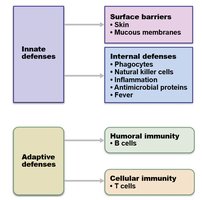
List the components of innate defenses, including surface barriers and internal defenses.
Describe the adaptive defenses, focusing on humoral and cellular immunity.
Explain how each line of defense responds to pathogens and the order in which they are activated.
Try solving on your own before revealing the answer!
Final Answer:
The immune system is organized into three lines of defense: (1) physical barriers (skin, mucous membranes), (2) internal defenses (phagocytes, NK cells, inflammation, antimicrobial proteins, fever), and (3) adaptive defenses (humoral immunity by B cells and cellular immunity by T cells). Innate defenses are non-specific and immediate, while adaptive defenses are specific and slower but provide memory.
Q2. What is the difference between the action potential in autorhythmic cardiac cells and contractile cardiac muscle cells?
Background
Topic: Cardiac Electrophysiology
This question tests your understanding of the electrical activity in the heart, specifically the differences between pacemaker cells and contractile cells.
Key Terms and Formulas:
Autorhythmic cells: Generate spontaneous action potentials (pacemaker potential).
Contractile cells: Respond to action potentials and contract to pump blood.
Key ions: Na+, Ca2+, K+
Action potential phases: Depolarization, plateau, repolarization.
Step-by-Step Guidance
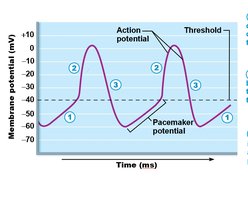
Examine the action potential graph for autorhythmic cells (image_1) and note the pacemaker potential, threshold, and action potential phases.
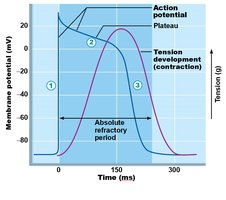
Compare this to the action potential graph for contractile cells (image_2), focusing on the plateau phase and absolute refractory period.
Identify the ions involved in each phase for both cell types (Na+ influx, Ca2+ influx, K+ efflux).
Describe how the pacemaker potential in autorhythmic cells leads to spontaneous depolarization, while contractile cells require stimulation.
Try solving on your own before revealing the answer!
Final Answer:
Autorhythmic cells have a pacemaker potential that gradually depolarizes to threshold, leading to spontaneous action potentials. Contractile cells have a rapid depolarization, a plateau phase due to Ca2+ influx, and a repolarization phase. The plateau phase in contractile cells ensures sustained contraction, while autorhythmic cells set the heart rate.
