 Back
BackANP Endocrine System Study Guide: Step-by-Step Guidance
Study Guide - Smart Notes
 Tailored notes based on your materials, expanded with key definitions, examples, and context.
Q1. What are the two main types of chemical messengers used by the endocrine system?
Background
Topic: Introduction to the Endocrine System
This question tests your understanding of how the endocrine system communicates using chemical messengers, and how these differ from nervous system messengers.
Key Terms:
Chemical messenger: A molecule that transmits signals between cells.
Receptor: A protein that binds to a messenger and triggers a response.
Step-by-Step Guidance
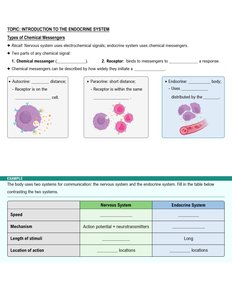
Recall that the endocrine system uses hormones as its main chemical messengers.
Think about how these hormones travel: Are they released locally or distributed throughout the body?
Compare this to neurotransmitters, which are used by the nervous system and act over short distances.
Identify the two main types of chemical messengers: one acts locally, the other acts over long distances.
Try solving on your own before revealing the answer!
Final Answer: Hormones and neurotransmitters
Hormones are distributed throughout the body via the bloodstream, while neurotransmitters act locally at synapses.
Q2. For a nerve impulse to travel from one neuron to another, the signal must be transmitted across a synapse. At the synapse, the neuron releases a neurotransmitter that then diffuses across the synapse and activates receptors on the adjacent neuron. Is the action of a neurotransmitter at a synapse also considered an example of what other type of signaling?
Background
Topic: Types of Chemical Signaling
This question is about the classification of cell signaling based on the distance and method of messenger delivery.
Key Terms:
Synapse: The junction between two neurons.
Neurotransmitter: Chemical messenger released by neurons.
Paracrine signaling: Signaling to nearby cells.
Step-by-Step Guidance
Review the definition of paracrine signaling: it involves messengers acting on nearby cells.
Consider the distance a neurotransmitter travels at a synapse—is it local or systemic?
Compare this to endocrine signaling, which involves hormones traveling through the bloodstream.
Think about whether neurotransmitter action at a synapse fits the definition of paracrine signaling.
Try solving on your own before revealing the answer!
Final Answer: Paracrine signaling
Neurotransmitters act locally at synapses, which is characteristic of paracrine signaling.
Q3. Endocrine glands release hormones that circulate in the bloodstream and affect target cells. What are the main components of the endocrine system?
Background
Topic: Components of the Endocrine System
This question tests your knowledge of the organs and cells involved in hormone production and action.
Key Terms:
Endocrine gland: Organ that releases hormones into the bloodstream.
Target cell: Cell with a specific receptor for a hormone.
Step-by-Step Guidance
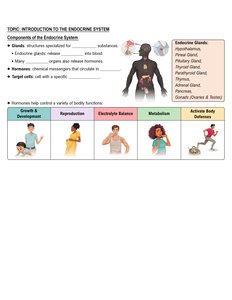
Recall the major endocrine glands (e.g., pituitary, thyroid, adrenal, pancreas, gonads).
Think about the role of hormones and how they are transported in the body.
Identify the target cells and their receptors for hormones.
Consider how hormones help regulate bodily functions such as growth, metabolism, and defense.
Try solving on your own before revealing the answer!
Final Answer: Endocrine glands, hormones, target cells
The endocrine system consists of glands that release hormones, which act on target cells throughout the body.
Q4. Hormones can be grouped by their structure. What are the two main types of hormones based on their structure?
Background
Topic: Hormone Classification
This question tests your understanding of the structural differences between hormone types and their solubility.
Key Terms:
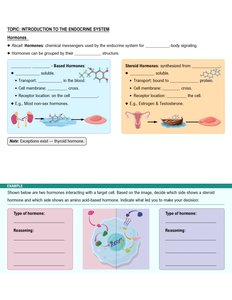
Amino acid-based hormones: Water-soluble, act on cell surface receptors.
Steroid hormones: Lipid-soluble, act on intracellular receptors.
Step-by-Step Guidance
Recall the structural differences between amino acid-based and steroid hormones.
Think about how solubility affects hormone transport and receptor location.
Identify which hormones are synthesized from cholesterol and which are derived from amino acids.
Consider the exceptions to these classifications.
Try solving on your own before revealing the answer!
Final Answer: Amino acid-based hormones and steroid hormones
Amino acid-based hormones are water-soluble, while steroid hormones are lipid-soluble.
Q5. Why do steroid hormones use a transport protein?
Background
Topic: Hormone Transport
This question tests your understanding of how hormone solubility affects their transport in the bloodstream.
Key Terms:
Transport protein: Protein that binds and carries hormones in the blood.
Steroid hormone: Lipid-soluble hormone that requires a carrier in aqueous environments.
Step-by-Step Guidance
Recall that steroid hormones are not water-soluble and cannot travel freely in the blood.
Think about the role of transport proteins in hormone stability and delivery.
Consider how transport proteins affect hormone half-life and activity.
Identify the main reason why steroid hormones need transport proteins.
Try solving on your own before revealing the answer!
Final Answer: Because steroid hormones are not water-soluble
Transport proteins allow steroid hormones to travel in the aqueous environment of the blood.
Q6. What is the primary function of the hypothalamic-hypophyseal portal system in hormone transport?
Background
Topic: Hypothalamus & Pituitary Gland
This question tests your understanding of how hormones are transported between the hypothalamus and pituitary gland.
Key Terms:
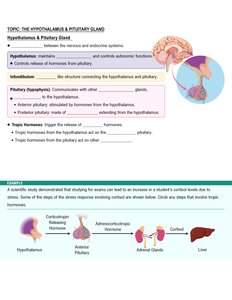
Hypothalamic-hypophyseal portal system: Blood vessel network connecting hypothalamus and anterior pituitary.
Hormone transport: Movement of hormones from one gland to another.
Step-by-Step Guidance
Recall the anatomical connection between the hypothalamus and anterior pituitary.
Think about the direction of hormone movement in this portal system.
Identify which hormones are transported and their target locations.
Consider the importance of direct hormone delivery for rapid and specific signaling.
Try solving on your own before revealing the answer!
Final Answer: Carries hormones from hypothalamus to anterior pituitary
This system allows hypothalamic hormones to directly regulate anterior pituitary function.
