 Back
BackAtoms, Molecules, and the Chemistry of Life: Study Notes
Study Guide - Smart Notes
 Tailored notes based on your materials, expanded with key definitions, examples, and context.
Atoms and the Chemistry of Life
Atoms: The Building Blocks of Matter
Atoms are the fundamental units of matter, forming the basis of all substances in the universe. Each atom consists of a nucleus containing protons and neutrons, surrounded by electrons in orbitals.
Atoms are composed of protons (positively charged), neutrons (neutral), and electrons (negatively charged).
The number of protons in an atom determines its element.
Atoms with different numbers of neutrons are called isotopes.
Example: Hydrogen, Deuterium, and Tritium are isotopes of hydrogen, differing in their number of neutrons.
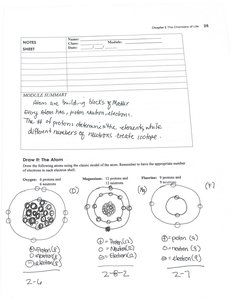
Atomic Structure and Electron Arrangement
The arrangement of electrons in shells around the nucleus determines how atoms interact and bond with each other. The first shell holds up to 2 electrons, the second up to 8, and so on.
Protons and neutrons are located in the nucleus.
Electrons orbit the nucleus in defined energy levels or shells.
The number of electrons in the outermost shell (valence electrons) influences chemical reactivity.
Example: The diagrams show atoms with different numbers of protons, neutrons, and electrons, illustrating their structure and electron arrangement.
Key Terms and Definitions
Important Chemical Terms
Understanding the following terms is essential for grasping the basics of chemistry in anatomy and physiology:
Term | Definition |
|---|---|
Atom | The smallest unit of a chemical element that retains its properties. |
Molecule | Two or more atoms bonded together. |
Ion | An atom or molecule with a net electric charge due to the loss or gain of electrons. |
Peptide | A short chain of amino acids linked by peptide bonds. |
Adenosine Triphosphate (ATP) | The main energy currency of the cell, used to power cellular processes. |
Enzyme | A protein that speeds up chemical reactions in the body. |
Outline: Note Taking and Study Strategies
Effective Study Techniques for Chemistry of Life
To master the chemistry of life, students should use active note-taking and practice techniques such as drawing structures, summarizing key points, and applying concepts to real-life examples.
Practice drawing atoms, molecules, and chemical bonds to reinforce understanding.
Summarize definitions and processes in your own words.
Apply knowledge by relating chemical concepts to physiological processes (e.g., how ATP provides energy for muscle contraction).
Next Steps: Applying Chemistry Concepts
Active Learning and Practice
After studying the basics of atoms and molecules, continue to reinforce your understanding by:
Practicing drawing and labeling atomic structures.
Using flashcards for key terms and definitions.
Explaining concepts to peers or teaching them to someone else.
Connecting chemical principles to topics in anatomy and physiology, such as cellular respiration and enzyme function.
Additional info: These strategies help solidify foundational chemistry knowledge, which is essential for success in anatomy and physiology courses.
