 Back
BackBasic Chemistry for Anatomy & Physiology: Matter, Energy, and Atomic Structure
Study Guide - Smart Notes
 Tailored notes based on your materials, expanded with key definitions, examples, and context.
Basic Chemistry
Matter and Energy
Chemistry forms the foundation for understanding biological processes in anatomy and physiology. Matter is anything that occupies space and has mass, while energy is the ability to do work. Both are essential concepts for understanding the structure and function of the human body.
Matter: Exists in three states within the human body: solid (e.g., bone), liquid (e.g., plasma), and gas (e.g., oxygen).
Physical changes: Do not alter the basic nature of a substance (e.g., melting ice).
Chemical changes: Alter the composition of a substance (e.g., digestion).
Energy: Has no mass and does not take up space. It is classified as:
Kinetic energy: Energy in action, performing work.
Potential energy: Stored energy, available to do work.
Forms of energy: Chemical (stored in bonds), electrical (movement of charged particles), mechanical (moving matter), and radiant (travels in waves).
ATP (Adenosine Triphosphate): The molecule that traps chemical energy from food and makes it available for cellular work.
Composition of Matter
Elements are the fundamental units of matter. The human body is primarily composed of four elements: hydrogen, oxygen, nitrogen, and carbon. Each element is represented by a unique atomic symbol.
Elements: Pure substances that cannot be broken down by ordinary chemical means.
Periodic Table: Lists all known elements.
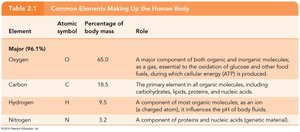
Major elements in the body: Oxygen (O), Carbon (C), Hydrogen (H), Nitrogen (N).
Element | Atomic Symbol | Percentage of Body Mass | Role |
|---|---|---|---|
Oxygen | O | 65.0 | A major component of both organic and inorganic molecules; essential for cellular respiration. |
Carbon | C | 18.5 | The primary element in all organic molecules. |
Hydrogen | H | 9.5 | A component of most organic molecules; influences pH. |
Nitrogen | N | 3.2 | A component of proteins and nucleic acids. |
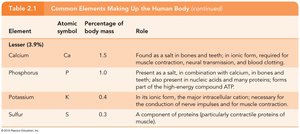
Element | Atomic Symbol | Percentage of Body Mass | Role |
|---|---|---|---|
Calcium | Ca | 1.5 | Found in bones and teeth; required for muscle contraction, nerve transmission, and blood clotting. |
Phosphorus | P | 1.0 | Present in bones and teeth; part of ATP and nucleic acids. |
Potassium | K | 0.4 | Major intracellular cation; necessary for nerve impulses and muscle contraction. |
Sulfur | S | 0.3 | Component of proteins, especially contractile proteins of muscle. |
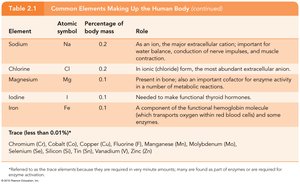
Element | Atomic Symbol | Percentage of Body Mass | Role |
|---|---|---|---|
Sodium | Na | 0.2 | Major extracellular cation; important for water balance, nerve impulses, and muscle contraction. |
Chlorine | Cl | 0.2 | Most abundant extracellular anion; important for water balance. |
Magnesium | Mg | 0.1 | Present in bones; important for enzyme activity. |
Iodine | I | 0.1 | Needed to make thyroid hormones. |
Iron | Fe | 0.1 | Component of hemoglobin; transports oxygen. |
Atomic Structure
Atoms are the building blocks of elements. Each atom consists of a nucleus containing protons and neutrons, with electrons orbiting the nucleus. Atoms are electrically neutral when the number of protons equals the number of electrons.
Protons (p+): Positively charged particles in the nucleus.
Neutrons (n0): Uncharged particles in the nucleus.
Electrons (e–): Negatively charged particles orbiting the nucleus.
Atomic number: Equal to the number of protons; unique for each element.
Ions: Atoms that have lost or gained electrons, resulting in a net charge.
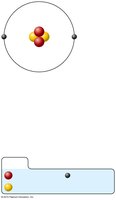
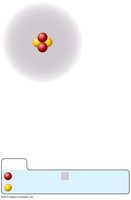
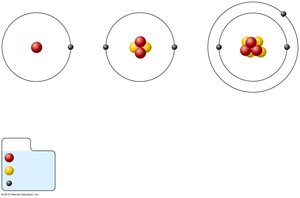
Example: Hydrogen has 1 proton, 0 neutrons, and 1 electron; Helium has 2 protons, 2 neutrons, and 2 electrons; Lithium has 3 protons, 4 neutrons, and 3 electrons.
Molecules and Compounds
Molecules are formed when two or more atoms of the same element combine chemically. Compounds are formed when atoms of different elements combine chemically, resulting in new substances with properties distinct from their constituent atoms.
Molecule: Two or more atoms of the same element (e.g., H2).
Compound: Two or more different atoms combined (e.g., NaCl).
Chemical reaction: Atoms combine or separate, forming new molecules or compounds.
Example: Sodium (Na+) + Chlorine (Cl–) → Sodium chloride (NaCl, table salt).
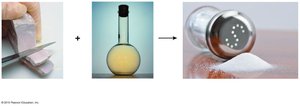
Additional info: The properties of compounds are often very different from the properties of the individual elements that compose them. For example, sodium is a reactive metal, chlorine is a poisonous gas, but sodium chloride is a safe, edible salt.
Key Equations
Formation of a molecule:
Formation of a compound:
