 Back
BackBlood: Structure, Function, and Clinical Significance
Study Guide - Smart Notes
 Tailored notes based on your materials, expanded with key definitions, examples, and context.
Blood: Structure, Function, and Clinical Significance
Overview of the Cardiovascular System
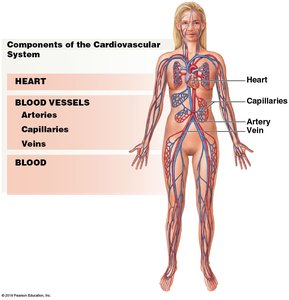
The cardiovascular system is essential for transporting substances throughout the body and maintaining homeostasis. It consists of the heart, blood vessels, and blood, each playing a critical role in sustaining life.
Heart: Pumps blood and maintains blood pressure.
Blood Vessels: Include arteries (carry blood away from the heart), capillaries (permit exchange between blood and interstitial fluids), and veins (return blood to the heart).
Blood: The fluid connective tissue responsible for transport and regulation.
Functions of Blood
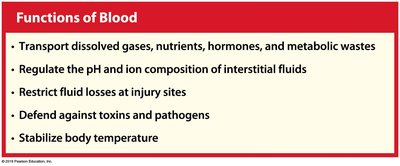
Blood performs several vital functions necessary for survival and homeostasis:
Transport: Carries dissolved gases (O2, CO2), nutrients, hormones, and metabolic wastes.
Regulation: Maintains pH and ion composition of interstitial fluids.
Restriction of Fluid Loss: Initiates clotting to prevent blood loss at injury sites.
Defense: Transports white blood cells and antibodies to fight infection.
Stabilization of Body Temperature: Distributes heat throughout the body.
Composition of Blood
Major Components
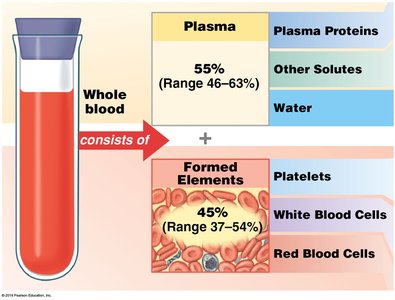
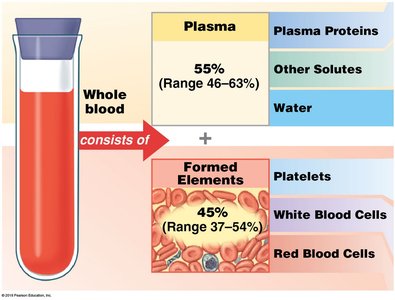
Blood is a fluid connective tissue composed of plasma and formed elements. The average adult has 4–6 liters of blood, with males typically having more than females.
Plasma: The liquid matrix, making up about 55% of blood volume.
Formed Elements: Cells and cell fragments, about 45% of blood volume.
Plasma
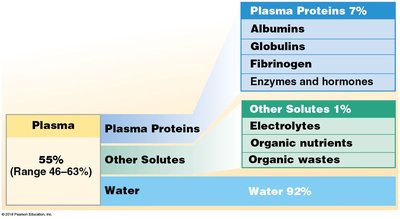
Plasma is primarily water (92%) and contains proteins, electrolytes, nutrients, and wastes. It is similar to interstitial fluid but contains higher concentrations of dissolved proteins.
Plasma Proteins (7%): Include albumins (osmotic pressure), globulins (antibodies and transport), and fibrinogen (clotting).
Other Solutes (1%): Electrolytes, organic nutrients, and wastes.
Formed Elements
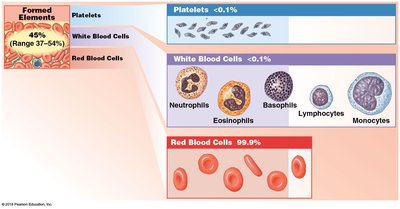
Formed elements include red blood cells (RBCs), white blood cells (WBCs), and platelets. RBCs are the most abundant, making up 99.9% of formed elements.
Red Blood Cells (Erythrocytes): Transport oxygen and carbon dioxide.
White Blood Cells (Leukocytes): Defend against pathogens; five types exist.
Platelets: Cell fragments involved in clotting.
Hematocrit
Hematocrit is the percentage of whole blood volume occupied by RBCs. It is determined by centrifuging blood and measuring the proportion of RBCs.
Normal Range: 37–54% (males average 47%, females 42%).
Clinical Significance: Used to assess anemia and other blood disorders.
Production and Differentiation of Formed Elements
Hemopoiesis (Hematopoiesis)
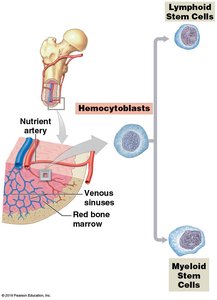
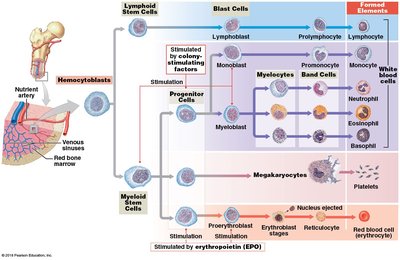
Hemopoiesis is the process of blood cell formation, occurring primarily in red bone marrow. Hemocytoblasts (hematopoietic stem cells) give rise to all formed elements.
Lymphoid Stem Cells: Produce lymphocytes.
Myeloid Stem Cells: Produce all other formed elements (RBCs, platelets, other WBCs).
Clinical Assessment of Blood
Hematology and Complete Blood Count (CBC)
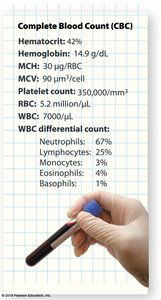
Hematology is the study of blood and blood-forming tissues. The CBC is a common diagnostic test that measures the numbers and types of blood cells, hemoglobin content, and other indices.
RBC Count: Number of red blood cells per microliter.
WBC Count: Number of white blood cells per microliter.
Platelet Count: Number of platelets per microliter.
Hematocrit and Hemoglobin: Assess oxygen-carrying capacity.
WBC Differential: Percentage of each type of WBC.
Red Blood Cells and Hemoglobin
Structure and Function of RBCs
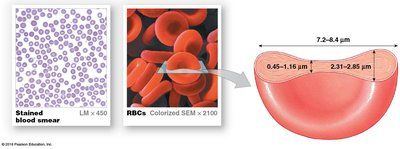
Red blood cells are biconcave discs that lack nuclei and most organelles, maximizing their ability to transport gases. Their shape increases surface area for gas exchange and allows flexibility in capillaries.
Life Span: Less than 120 days.
Hemoglobin Content: 14–18 g/dL in males, 12–16 g/dL in females.
Hemoglobin Structure and Function
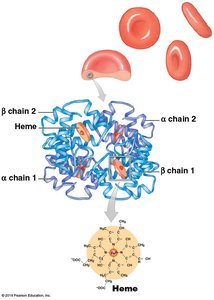
Hemoglobin is a protein composed of four polypeptide chains (two alpha, two beta), each with a heme group containing iron. Hemoglobin binds oxygen reversibly, forming oxyhemoglobin (bright red) or deoxyhemoglobin (dark red).
Oxygen Transport: Each RBC contains ~280 million Hb molecules, each binding four oxygen molecules.
Clinical Relevance: Hemoglobin levels are critical for diagnosing anemia and other disorders.
Blood Typing and Compatibility
ABO and Rh Blood Groups
Blood type is determined by the presence or absence of specific antigens (A, B, Rh) on RBC membranes. The ABO system classifies blood into four types: A, B, AB, and O. The Rh system adds a positive or negative designation based on the presence of the Rh antigen.
Antibodies: Plasma contains antibodies against foreign antigens, leading to agglutination if incompatible blood is transfused.
Clinical Importance: Blood typing is essential before transfusions to prevent dangerous reactions.
White Blood Cells (Leukocytes)
Types and Functions
White blood cells are crucial for immune defense. There are five main types, classified as granulocytes or agranulocytes based on the presence of cytoplasmic granules.
Granulocytes: Neutrophils, eosinophils, basophils.
Agranulocytes: Lymphocytes, monocytes.
Functions: Phagocytosis, antibody production, inflammation, and allergic responses.
Hemostasis and Blood Clotting
Phases of Hemostasis
Hemostasis is the process of stopping blood loss after vessel injury. It involves three phases:
Vascular Phase: Vasoconstriction and endothelial response.
Platelet Phase: Platelet adhesion and aggregation at the injury site.
Coagulation Phase: Cascade of clotting factors leading to fibrin formation and clot stabilization.
Fibrinolysis: The process of dissolving the clot after repair.
Anticoagulants: Substances that inhibit clotting, used therapeutically or can cause bleeding disorders.
Blood Disorders
Common Blood Disorders
Anemias: Iron deficiency (microcytic RBCs), pernicious anemia (vitamin B12 deficiency), thalassemias, sickle cell disease.
Hemophilia: Inherited bleeding disorder due to missing clotting factors.
Leukemias: Cancers of blood-forming tissues, classified as myeloid or lymphoid.
Infections: Bacteremia, viremia, sepsis, malaria.
Degenerative Disorders: Disseminated intravascular coagulation (DIC).
Summary Table: Composition of Whole Blood
Component | Percentage | Main Constituents |
|---|---|---|
Plasma | ~55% | Water (92%), proteins (albumins, globulins, fibrinogen), electrolytes, nutrients, wastes |
Formed Elements | ~45% | RBCs (99.9%), WBCs, platelets |
Additional info: These notes integrate foundational concepts from anatomy and physiology, focusing on blood as a connective tissue, its cellular components, and clinical relevance for health sciences students.
