 Back
Bone Tissue: Structure, Function, and Physiology CH 7
Study Guide - Smart Notes
 Tailored notes based on your materials, expanded with key definitions, examples, and context.
Bone Tissue: Structure, Function, and Physiology
Tissues and Organs of the Skeletal System
The skeletal system is composed of bones, cartilages, and ligaments, forming the framework of the body. Osteology is the study of bone. Cartilage acts as the precursor to most bones and covers joint surfaces, while ligaments connect bones at joints and tendons attach muscles to bones.
Bones as Organs: Each bone is an organ consisting of bone tissue, bone marrow, cartilage, adipose tissue, nervous tissue, and fibrous connective tissue.
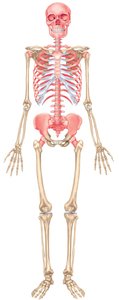
Functions of the Skeleton: Support, protection, movement, electrolyte balance, acid–base balance, blood formation, and hormone secretion.
Bone (Osseous Tissue): A connective tissue with a matrix hardened by calcium phosphate and other minerals. Mineralization or calcification is the hardening process.
General Features of Bones
Bones are classified by shape and structure, each adapted for specific functions.
Flat Bones: Thin, curved plates that protect soft organs (e.g., parietal bones, sternum, scapula).
Long Bones: Longer than wide, crucial for movement (e.g., humerus, femur).
Short Bones: Nearly equal in length and width (e.g., wrist, ankle bones).
Irregular Bones: Elaborate shapes (e.g., vertebrae, some skull bones).
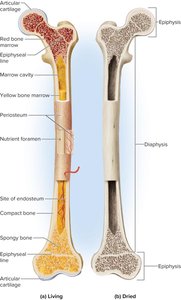
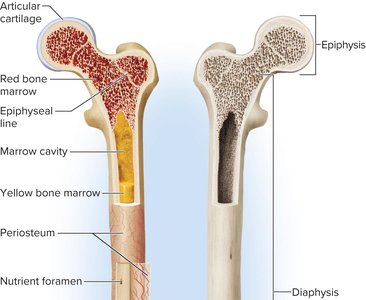
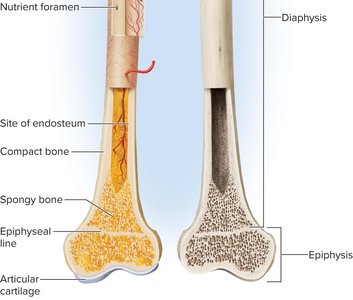
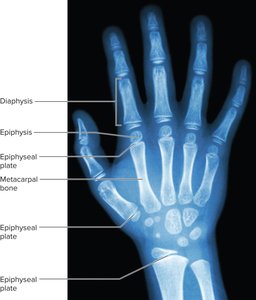
Long bones have a shaft (diaphysis) for leverage and enlarged ends (epiphyses) for joint strength and attachment. The epiphyseal line is a remnant of the growth zone.
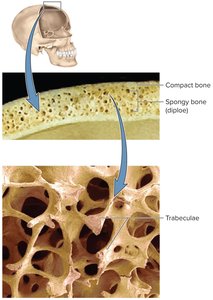
Compact Bone: Dense outer shell.
Spongy Bone: Loosely organized tissue found in bone ends and shafts.
Articular Cartilage: Hyaline cartilage covering joint surfaces.
Periosteum: External sheath covering most of the bone.
Endosteum: Thin layer lining marrow cavity and internal surfaces.
Histology of Osseous Tissue
Bone tissue consists of specialized cells, fibers, and ground substance, each contributing to bone structure and function.
Osteogenic Cells: Stem cells in endosteum and periosteum, give rise to osteoblasts.
Osteoblasts: Bone-forming cells, synthesize matrix and promote mineralization.
Osteocytes: Former osteoblasts trapped in matrix, reside in lacunae, act as strain sensors.
Osteoclasts: Bone-dissolving cells, large and multinucleated, perform bone resorption.
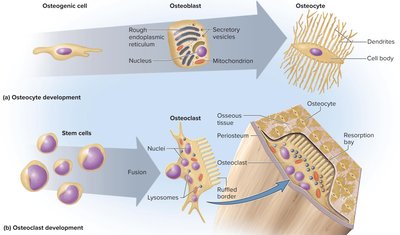
The Matrix of Bone Tissue
The matrix is composed of one-third organic (collagen, glycosaminoglycans, proteoglycans, glycoproteins) and two-thirds inorganic matter (hydroxyapatite, calcium carbonate, other ions). This composite provides flexibility and strength.
Mineral Portion: Supports body weight.
Protein Portion: Provides flexibility; defects cause diseases like osteogenesis imperfecta.
Compact Bone Structure
Compact bone is organized into concentric lamellae around central (haversian) canals, forming osteons. Collagen fibers are arranged helically, enhancing strength. Osteons are separated by cement lines, and circumferential lamellae encircle dense bone.
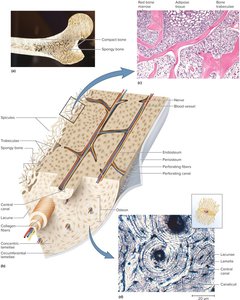
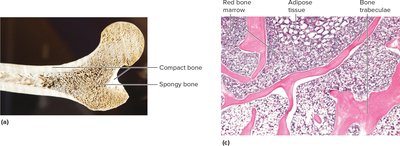
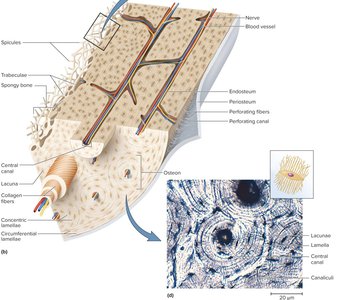
Spongy Bone Structure
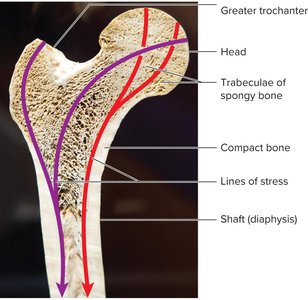
Spongy bone consists of a lattice of spicules and trabeculae, covered with endosteum. Spaces are filled with red bone marrow. The arrangement provides strength with minimal weight, and trabeculae develop along lines of stress.
Bone Marrow
Bone marrow is the soft tissue in marrow cavities and spongy bone spaces.
Red Bone Marrow: Hematopoietic tissue producing blood cells; found in most bones in children, limited in adults.
Yellow Bone Marrow: Fatty marrow, does not produce blood; can revert to red marrow in chronic anemia.
Bone Development
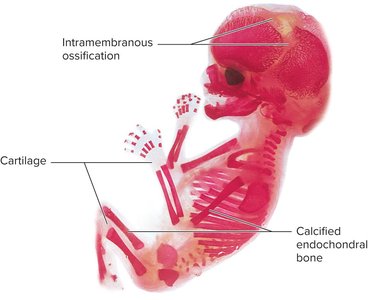
Bone formation (ossification or osteogenesis) occurs by two mechanisms, both starting from embryonic mesenchyme.
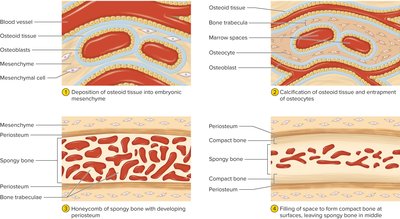
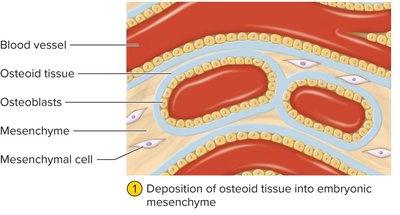
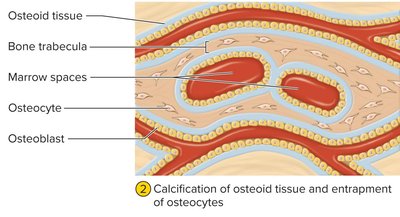
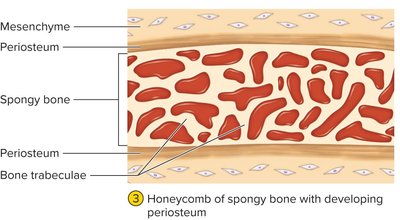
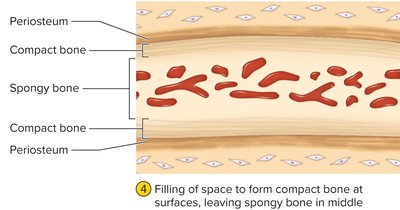
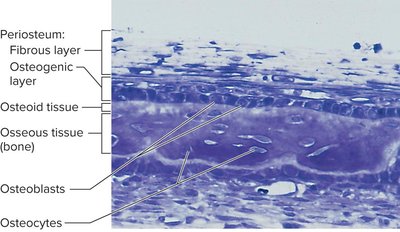
Intramembranous Ossification: Produces flat bones of the skull, clavicle, and part of the mandible. Stages include deposition of osteoid tissue, calcification, formation of spongy bone, and development of compact bone at surfaces.
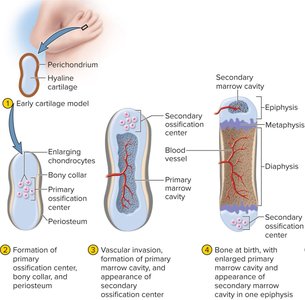
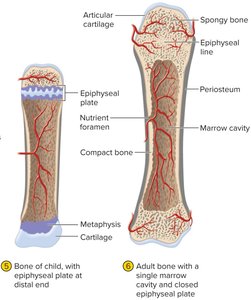
Endochondral Ossification: Bone develops from a hyaline cartilage model, producing most bones of the body. Stages include formation of cartilage model, primary ossification center, vascular invasion, formation of marrow cavities, and development of epiphyseal plate.
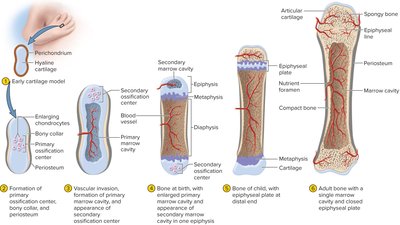
Bone Growth and Remodeling
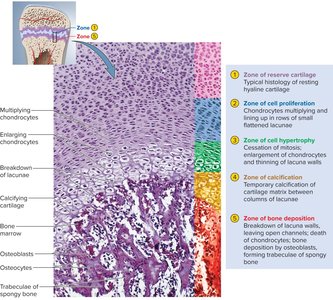
Bone elongation occurs at the epiphyseal plate, with zones of reserve cartilage, cell proliferation, hypertrophy, calcification, and bone deposition. Bone growth in diameter involves appositional growth at the bone surface. Bone remodeling is a continuous process, adapting bone structure to mechanical stress (Wolff's law).
Physiology of Osseous Tissue
Minerals are added to bone by mineral deposition and removed by resorption. Bone plays a key role in regulating blood calcium and phosphate levels, controlled by hormones.
Mineral Deposition: Osteoblasts produce collagen fibers, which become encrusted with minerals.
Mineral Resorption: Osteoclasts dissolve bone, releasing minerals into blood.
Calcium Homeostasis
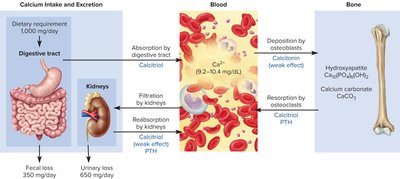
Calcium is essential for bone structure, neuron communication, muscle contraction, blood clotting, and exocytosis. Homeostasis is regulated by dietary intake, losses, and exchanges with bone, controlled by three hormones:
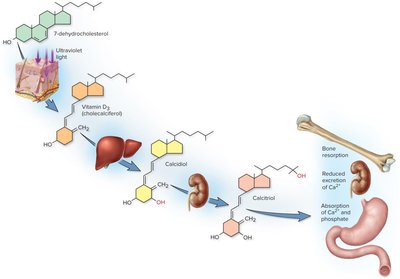
Calcitriol: Form of vitamin D, raises blood calcium by increasing absorption, resorption, and reabsorption.
Calcitonin: Lowers blood calcium by inhibiting osteoclasts and stimulating osteoblasts.
Parathyroid Hormone (PTH): Raises blood calcium by stimulating osteoclasts, promoting reabsorption, and inhibiting bone deposition.
Phosphate Homeostasis
Phosphate is needed for DNA, RNA, ATP, and phospholipids. Calcitriol raises phosphate levels by promoting absorption, while PTH lowers levels by promoting excretion.
Other Factors Affecting Bone
Bone growth is influenced by hormones, vitamins, and growth factors. Puberty and adolescence see rapid growth due to surges in growth hormone, estrogen, and testosterone. Anabolic steroids can prematurely close the epiphyseal plate.
Bone Disorders
Orthopedics is the branch of medicine dealing with bone, joint, and muscle disorders. Bone fractures are classified as stress or pathological, and by structural characteristics (nondisplaced, displaced, comminuted, greenstick).
Fracture Repair
Fracture healing involves four stages: hematoma formation, soft callus formation, hard callus formation, and bone remodeling.
Treatment of Fractures
Closed Reduction: Manipulation without surgery.
Open Reduction and Internal Fixation (ORIF): Surgical realignment with plates, screws, or pins.
Electrical Stimulation: Used for fractures taking longer to heal.
Other Bone Disorders
Osteopenia is a decline in bone density, which may progress to osteoporosis, a severe loss of bone density. Osteoporosis is assessed by bone densitometry (DEXA scan) and treated with drugs and weight-bearing exercise.
Bone Cell Type | Function | Location |
|---|---|---|
Osteogenic cell | Stem cell, gives rise to osteoblasts | Endosteum, periosteum |
Osteoblast | Bone formation, matrix synthesis | Endosteum, periosteum |
Osteocyte | Maintenance, strain sensor | Lacunae in matrix |
Osteoclast | Bone resorption | Bone surface |
Hormone | Effect on Calcium | Source |
|---|---|---|
Calcitriol | Raises blood calcium | Skin, liver, kidneys |
Calcitonin | Lowers blood calcium | Thyroid gland |
Parathyroid hormone | Raises blood calcium | Parathyroid glands |
Example: Orthodontic appliances reposition teeth by stimulating bone resorption and deposition, demonstrating the dynamic nature of bone tissue.
