 Back
BackBones and Bone Structure: Study Notes for Anatomy & Physiology
Study Guide - Smart Notes
 Tailored notes based on your materials, expanded with key definitions, examples, and context.
Bones and Bone Structure
Overview of the Skeletal System
The skeletal system is a complex organ system that provides the framework for the human body. It consists of bones, cartilages, ligaments, and other connective tissues, each contributing to the body's structure, movement, and homeostasis.
Support: Bones provide structural support for the entire body and serve as attachment points for muscles.
Protection: Skeletal elements protect vital organs (e.g., skull protects the brain, ribs protect the heart and lungs).
Leverage: Bones act as levers, enabling movement when muscles contract.
Mineral Storage: Bones store minerals such as calcium and phosphate, essential for metabolic processes.
Fat Storage: Yellow bone marrow stores lipids as an energy reserve.
Hematopoiesis: Red bone marrow produces blood cells, supporting oxygen transport, immunity, and clotting.
Classification of Bones
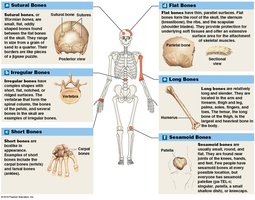
Bones are classified based on their shapes and structures, which relate to their functions and locations in the body.
Long Bones: Longer than they are wide (e.g., femur, humerus).
Short Bones: Approximately equal in length and width (e.g., carpal bones).
Flat Bones: Thin, parallel surfaces (e.g., parietal bone of the skull).
Irregular Bones: Complex shapes (e.g., vertebrae).
Sesamoid Bones: Small, round, and develop within tendons (e.g., patella).
Sutural Bones: Small bones located within the sutures of the skull.
Bone Structure
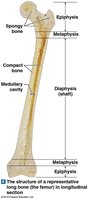
Bones have distinct anatomical features that reflect their functions. The structure of a typical long bone includes:
Diaphysis: The shaft, composed mainly of compact bone.
Epiphysis: The expanded ends, containing spongy bone.
Metaphysis: The region where diaphysis and epiphysis meet.
Medullary Cavity: Central cavity containing bone marrow.
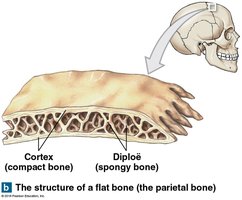
Flat bones, such as those in the skull, have a sandwich-like structure with two layers of compact bone enclosing a layer of spongy bone (diploë).
Bone Tissue Composition
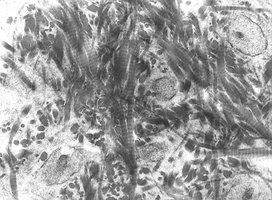
Bone is a specialized connective tissue with a solid, calcified matrix. It is a composite material with two main phases:
Inorganic (Mineral) Phase: Primarily calcium phosphate crystals (hydroxylapatite: ), providing strength and rigidity.
Organic Phase: Mainly collagen fibers, glycoproteins, proteoglycans, and bone cells, contributing flexibility and resilience.
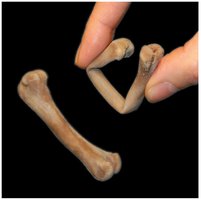
A bone lacking a calcified matrix is flexible, as demonstrated by a bone soaked in vinegar (which removes minerals).
Types of Bone Cells
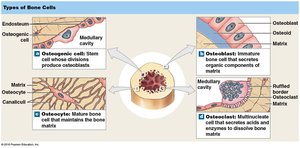
Bone tissue contains four main types of cells, each with specialized functions:
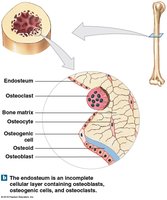
Osteogenic (Osteoprogenitor) Cells: Stem cells that divide to produce osteoblasts; found in the periosteum and endosteum.
Osteoblasts: Bone-forming cells that synthesize new bone matrix (osteoid); become osteocytes when surrounded by matrix.
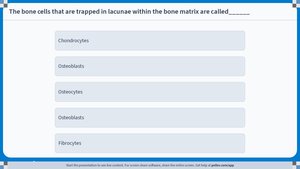
Osteocytes: Mature bone cells trapped in lacunae; maintain bone matrix and act as mechanosensors.
Osteoclasts: Large, multinucleated cells that resorb bone matrix, releasing minerals (bone remodeling).
Bone Matrix and Microstructure
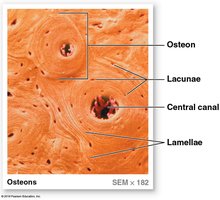
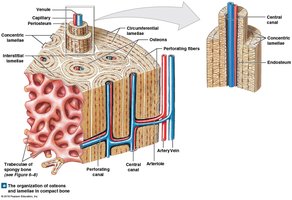
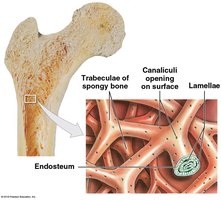
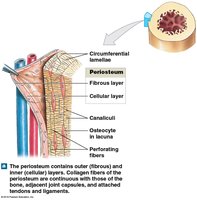
The bone matrix is dense due to deposits of calcium-phosphate salts. Osteocytes reside in lacunae and are interconnected by canaliculi, which allow for nutrient and waste exchange. The periosteum covers the outer surface of bones, while the endosteum lines internal cavities.
Osteon Structure (Compact Bone)
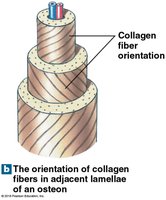
The osteon is the functional unit of compact bone. It consists of concentric lamellae arranged around a central canal containing blood vessels. Perforating canals connect osteons and facilitate vascular and neural supply.
Spongy (Trabecular) Bone
Spongy bone lacks osteons and is composed of a network of trabeculae. Spaces between trabeculae are filled with red bone marrow (site of hematopoiesis) or yellow bone marrow (fat storage). Nutrients reach osteocytes by diffusion through canaliculi.
Periosteum and Endosteum
The periosteum is a double-layered membrane covering the outer surface of bones (except at joints). It isolates bone, provides a route for blood vessels and nerves, and participates in growth and repair. The endosteum is a thin membrane lining internal bone surfaces, containing osteogenic cells, osteoblasts, and osteoclasts.
Summary Table: Types of Bone Cells
Cell Type | Location | Function |
|---|---|---|
Osteogenic Cell | Periosteum, Endosteum | Stem cell; produces osteoblasts |
Osteoblast | Bone surfaces | Forms new bone matrix |
Osteocyte | Lacunae within matrix | Maintains bone matrix; mechanosensor |
Osteoclast | Bone surfaces | Resorbs bone matrix |
Key Equations
Hydroxylapatite formation:
Additional info: Bone remodeling is a dynamic process involving the coordinated activity of osteoblasts and osteoclasts, essential for growth, repair, and calcium homeostasis.
