 Back
Bones and Bone Tissue: Structure, Function, and Clinical Relevance
Study Guide - Smart Notes
 Tailored notes based on your materials, expanded with key definitions, examples, and context.
Chap 6 - part 1 - Bones and Bone Tissue
The Skeletal System: Overview
The skeletal system is composed of bones, joints, and supporting tissues. Bones are the main organs of this system, with adults typically having 206 bones. Each bone contains several tissue types, including bone (osseous) tissue, dense regular collagenous tissue, dense irregular connective tissue, and bone marrow.
Functions of the Skeletal System
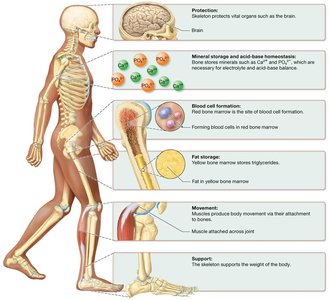
The skeletal system performs several critical functions necessary for survival and homeostasis:
Protection: Bones such as the skull, sternum, and ribs protect vital organs (e.g., the brain, heart, and lungs).
Mineral Storage and Acid-Base Homeostasis: Bones store minerals like calcium, phosphorus, and magnesium salts, which are essential electrolytes for maintaining acid-base balance in the blood.
Blood Cell Formation: Red bone marrow is the site of hematopoiesis, the formation of blood cells.
Fat Storage: Yellow bone marrow stores triglycerides in adipocytes, serving as an energy reserve.
Movement: Bones serve as attachment sites for skeletal muscles. Muscle contraction pulls on bones, generating movement at joints.
Support: The skeleton provides structural support and bears the weight of the body.
Bone Structure
Classification of Bones by Shape
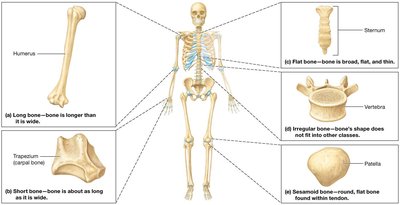
Bones are classified based on their shapes, which relate to their functions:
Long Bones: Longer than they are wide (e.g., humerus, femur).
Short Bones: Roughly cube-shaped, about as long as they are wide (e.g., wrist and ankle bones).
Flat Bones: Thin and broad (e.g., most skull bones, sternum, pelvis).
Irregular Bones: Complex shapes that do not fit other categories (e.g., vertebrae).
Sesamoid Bones: Small, flat, oval-shaped bones within tendons (e.g., patella).
Structure of a Long Bone
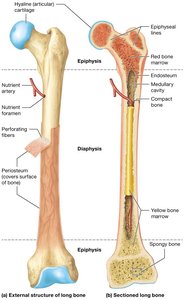
Long bones have a specialized structure that supports their function:
Periosteum: Outer membrane of dense irregular connective tissue containing blood vessels and nerves.
Perforating Fibers: Collagen fibers that anchor the periosteum to the bone matrix.
Diaphysis: The shaft of the bone, containing the medullary (marrow) cavity lined by endosteum and filled with marrow.
Epiphyses: The ends of the bone, filled with red marrow and covered by articular (hyaline) cartilage.
Compact Bone: Dense outer layer that resists compression and twisting.
Spongy (Cancellous) Bone: Inner honeycomb-like structure that houses bone marrow and resists forces from multiple directions.
Epiphyseal Lines: Remnants of the epiphyseal (growth) plate, a region of hyaline cartilage active in children and adolescents.
Structure of Short, Flat, Irregular, and Sesamoid Bones
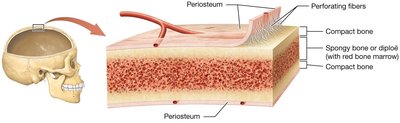
These bones share some structural similarities with long bones but have fewer distinct regions. In flat bones, the spongy bone is called diploë. Some flat and irregular bones of the skull contain air-filled spaces called sinuses to reduce weight.
Blood and Nerve Supply to Bone
Bones are highly vascularized and innervated:
Short, flat, irregular, and sesamoid bones receive blood from vessels in the periosteum.
Long bones are supplied by the periosteum and one or two nutrient arteries that enter through the nutrient foramen in the diaphysis.
Red and Yellow Bone Marrow
Bone marrow exists in two forms:
Red Bone Marrow: Contains reticular fibers and hematopoietic cells; predominant in infants and children due to rapid growth. In adults, red marrow is mainly found in the pelvis, proximal femur and humerus, vertebrae, ribs, sternum, clavicles, and scapulae.
Yellow Bone Marrow: Composed mostly of adipocytes and blood vessels; increases with age as red marrow is replaced.
Bone Marrow Transplantation
Bone marrow transplantation is a clinical procedure used to treat diseases such as leukemia, sickle-cell anemia, and aplastic anemia, where hematopoietic cells are dysfunctional.
A needle is inserted into the pelvic bone of a donor to harvest red marrow.
The recipient's marrow is destroyed by chemotherapy/radiation, and donor marrow is infused intravenously.
New blood cells are produced in 2–4 weeks if successful, but risks include infection and transplant rejection.

Peripheral Blood Stem Cell (PBSC) Donation
PBSC donation is an alternative to traditional bone marrow transplantation:
The donor receives a drug to stimulate hematopoietic cell release into the blood.
Blood is drawn, stem cells are filtered out, and the remaining blood is returned to the donor.
This process is similar to plasma donation.

The Extracellular Matrix of Bone (Bone Matrix)
Inorganic Matrix
The inorganic matrix makes up about 65% of bone's total weight and is primarily responsible for bone's strength and resistance to compression.
Composed mainly of hydroxyapatite crystals (calcium and phosphate salts):
Also contains bicarbonate, potassium, magnesium, and sodium salts.
Organic Matrix (Osteoid)
The organic matrix accounts for about 35% of bone's weight and provides flexibility and tensile strength.
Composed of protein fibers (mainly collagen), proteoglycans, glycosaminoglycans, glycoproteins, and bone-specific proteins such as osteocalcin.
Collagen resists torsion and tensile forces, aligning with hydroxyapatite crystals to enhance bone hardness.
Osteocalcin binds calcium and hydroxyapatite, organizing the inorganic matrix.
Glycosaminoglycans and proteoglycans draw water to resist compression.
Glycoproteins bind hydroxyapatite crystals and bone cells together.
Importance of Bone Matrices
The balance between the inorganic and organic matrices is essential for normal bone function:
Without the organic matrix (collagen), bone becomes brittle and shatters easily.
Without the inorganic matrix (minerals), bone cannot resist compression and becomes too flexible.
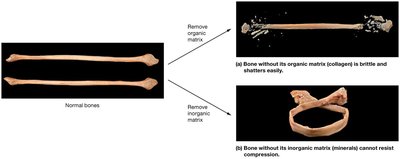
Additional info: The interplay between the organic and inorganic components of bone matrix is crucial for maintaining both the strength and flexibility of bones, preventing fractures and deformities under physiological stress.
