 Back
BackCare, Structure, and Function of the Compound Microscope
Study Guide - Smart Notes
 Tailored notes based on your materials, expanded with key definitions, examples, and context.
Care and Structure of the Compound Microscope
Proper Handling and Maintenance
The compound microscope is a delicate and precise instrument essential for studying cells and tissues in anatomy and physiology. Proper care ensures accurate results and extends the microscope's lifespan.
Transport: Always carry the microscope upright, with one hand on the arm and the other supporting the base. Avoid swinging or jarring the instrument.
Cleaning: Use only grit-free lens paper in a circular motion to clean all lenses before and after use. Never use regular tissues or cloths, as they may scratch the lenses.
Focusing: Begin with the scanning objective lens (lowest power) and use the coarse adjustment knob only with this lens. Switch to higher-power lenses as needed, using the fine adjustment knob for precise focusing.
Wet Mounts: Always use a coverslip when preparing wet mounts to protect both the specimen and the objective lens.
Storage: Before storing, remove the slide, rotate the scanning objective into position, wrap the cord neatly, and cover the microscope with a dust cover or return it to its storage area.
Repairs: Never attempt to remove or repair microscope parts yourself. Report any issues to your instructor.
Magnification and Resolution
Principles of Image Formation
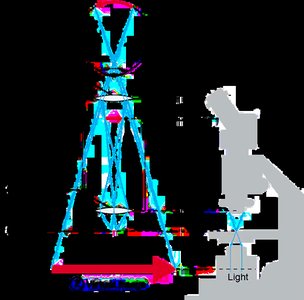
The compound microscope uses two sets of lenses to magnify specimens: the objective lens and the ocular lens (eyepiece). This dual-lens system allows for high levels of magnification and detailed observation of microscopic structures.
Objective Lens: Magnifies the specimen to create a real image.
Ocular Lens: Further magnifies the real image to produce the virtual image seen by the eye.
Image Pathway: Light passes through the specimen, is focused by the objective lens, then magnified by the ocular lens, and finally projected onto the retina.
Total Magnification
Total magnification (TM) is calculated by multiplying the power of the ocular lens by the power of the objective lens in use:
Example: If the ocular lens is 10× and the objective lens is 45×, then .
Record the total magnification for each objective lens on your microscope for reference.
Resolution (Resolving Power)
Resolution is the ability of the microscope to distinguish two points as separate entities. It is a critical factor in observing fine details in cells and tissues.
Human Eye: Can resolve objects about 100 μm apart.
Compound Microscope: Can resolve objects as close as 0.2 μm under ideal conditions.
Limitation: Objects closer than 0.2 μm appear as a single fused image.
Factors Affecting Resolution: The amount and quality of visible light entering the microscope. Higher magnification lenses have smaller apertures, allowing less light and requiring increased light intensity for optimal resolution.
Summary Table: Magnification and Resolution
Lens | Magnification | Total Magnification (Example) | Resolution Limit |
|---|---|---|---|
Ocular | 10× | Depends on objective | — |
Scanning Objective | 4× | 40× | 0.2 μm |
Low Power Objective | 10× | 100× | 0.2 μm |
High Power Objective | 40× | 400× | 0.2 μm |
Oil Immersion Objective | 100× | 1000× | 0.2 μm |
Additional info: The oil immersion lens (100×) is used with a drop of immersion oil to increase resolution by reducing light refraction.
