Back
BackCell Biology and Physiology Study Guide – ANP Exam Preparation
Study Guide - Smart Notes
 Tailored notes based on your materials, expanded with key definitions, examples, and context.
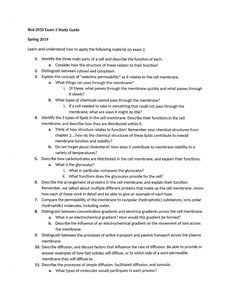
Q1. Identify the three main parts of a cell and describe the function of each.
Background
Topic: Cell Structure and Function
This question tests your understanding of the basic organization of cells and the role of each major component.
Key Terms:
Plasma membrane
Cytoplasm
Nucleus
Step-by-Step Guidance
List the three main parts of a typical eukaryotic cell.
For each part, briefly describe its primary function in the cell.
Think about how these structures interact to maintain cell homeostasis.
Try solving on your own before revealing the answer!
Q2. Compare how the structure of these relates to their function.
Background
Topic: Structure-Function Relationship in Cell Biology
This question asks you to connect the physical characteristics of cell parts to their roles.
Key Concepts:
Structure-function relationship
Examples: selective permeability of the plasma membrane, compartmentalization by the nucleus
Step-by-Step Guidance
For each cell part, identify a structural feature (e.g., double membrane, presence of pores).
Explain how this feature supports the cell part’s function.
Consider why these features are necessary for cell survival.
Try solving on your own before revealing the answer!
Q3. Explain the concept of "selective permeability" as it relates to the cell membrane.
Background
Topic: Plasma Membrane Function
This question focuses on how the cell membrane controls the movement of substances in and out of the cell.
Key Terms:
Selective permeability
Lipid bilayer
Transport proteins
Step-by-Step Guidance
Define selective permeability in your own words.
Describe how the structure of the plasma membrane enables selective permeability.
Give examples of substances that can and cannot pass through easily.
Try solving on your own before revealing the answer!
Q4. What types of chemicals cannot pass through the membrane?
Background
Topic: Membrane Transport
This question tests your knowledge of which molecules are restricted by the cell membrane’s structure.
Key Concepts:
Hydrophobic vs. hydrophilic molecules
Size and charge of molecules
Step-by-Step Guidance
Recall the composition of the lipid bilayer (hydrophobic tails, hydrophilic heads).
Think about which types of molecules (e.g., large, charged, polar) would have difficulty crossing this barrier.
List examples of such molecules.
Try solving on your own before revealing the answer!
Q5. What types of chemicals can pass through the membrane?
Background
Topic: Membrane Transport
This question is about which molecules can diffuse freely across the cell membrane.
Key Concepts:
Small, nonpolar molecules
Role of lipid solubility
Step-by-Step Guidance
Consider the properties of the lipid bilayer and what it allows to pass.
Identify examples of molecules that can diffuse freely (e.g., gases, small lipids).
Explain why these molecules can pass through without assistance.
Try solving on your own before revealing the answer!