 Back
BackCells: Protein Synthesis and Cellular Division
Study Guide - Smart Notes
 Tailored notes based on your materials, expanded with key definitions, examples, and context.
Protein Synthesis in Cells
Overview of Protein Synthesis
Protein synthesis is a fundamental cellular process by which cells produce proteins, the molecules responsible for most cellular functions. Proteins are continually synthesized and degraded, with lifespans typically ranging from 3 to 10 days. The synthesis of proteins is directed by genetic information stored in DNA and transmitted via RNA.
Proteins are essential for cellular structure, function, and regulation.
New proteins must be produced regularly to replace those that are degraded.
DNA & RNA: Structure and Function
DNA and RNA are nucleic acids involved in the storage and transmission of genetic information necessary for protein synthesis. DNA is the master blueprint, while RNA acts as the messenger and translator.
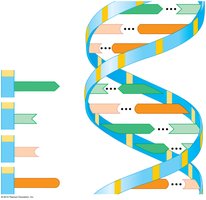
DNA is composed of two polynucleotide strands forming a double helix.
RNA is typically single-stranded and is synthesized from DNA during transcription.
Nitrogenous base pairing rules: Adenine (A) pairs with Thymine (T) in DNA, and with Uracil (U) in RNA; Cytosine (C) pairs with Guanine (G).
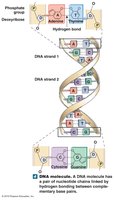
Genes and the Triplet Code
A gene is a segment of DNA that codes for a specific protein. The sequence of bases in DNA determines the sequence of amino acids in a protein, which is the primary structure of the protein.
Each amino acid is coded by a set of three DNA bases, known as a triplet or codon.
Example: The codon GGC codes for proline; GCC codes for arginine.
Role of RNA in Protein Synthesis
Although DNA contains the instructions for protein synthesis, it does not directly interact with ribosomes. RNA transmits genetic information from DNA to ribosomes, facilitating protein production.
Types of RNA Used in Protein Synthesis
Multiple types of RNA exist in cells, but two are directly involved in protein synthesis:
Messenger RNA (mRNA): Single-stranded RNA transcribed from DNA; carries genetic information to ribosomes.
Transfer RNA (tRNA): Carries amino acids to the ribosome; contains an anticodon that pairs with the mRNA codon.
Steps in Protein Synthesis
Transcription and Translation
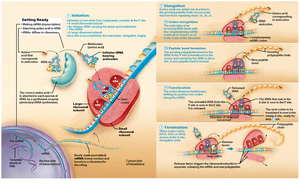
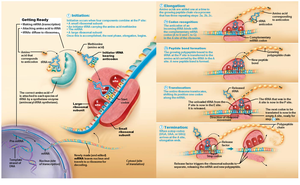
Protein synthesis occurs in two major steps: transcription and translation. Transcription takes place in the nucleus, while translation occurs in the cytoplasm at the ribosomes.
Transcription: DNA is used as a template to synthesize mRNA.
Translation: mRNA is decoded by ribosomes to assemble a polypeptide chain.
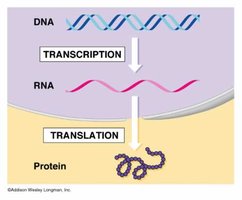
Transcription: Phases and Mechanism
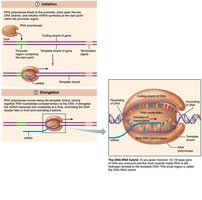
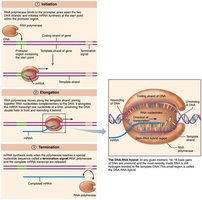
Transcription is divided into three phases: initiation, elongation, and termination.
Initiation: RNA polymerase binds to the promoter region of DNA and separates the strands.
Elongation: RNA polymerase adds complementary nucleotides to the growing mRNA strand.
Termination: Transcription ends when RNA polymerase encounters a termination signal.
Translation: Phases and Mechanism
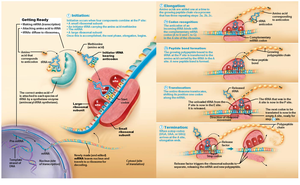
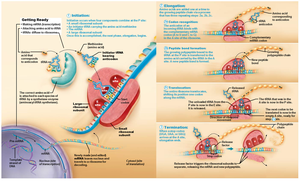
Translation also consists of three phases: initiation, elongation, and termination. This process requires ATP, protein factors, and enzymes.
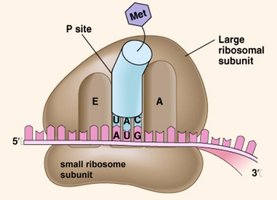
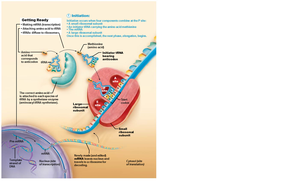
Initiation: mRNA binds to the ribosome; the start codon attracts the initiator tRNA carrying methionine, which binds to the P site.
Elongation: Involves codon recognition, peptide bond formation, and translocation.
Termination: Occurs when a stop codon enters the A site; the polypeptide is released and processed into a functional protein.
Cellular Division: Mitosis and Meiosis
Overview of Cellular Division
Cellular division is the process by which cells reproduce. There are two main types: mitosis and meiosis. Mitosis produces identical daughter cells, while meiosis produces genetically unique gametes.
Mitosis: Occurs in most body cells; results in two identical diploid cells.
Meiosis: Occurs only in gonads; results in four unique haploid cells (gametes).
Somatic Cells and Gametes
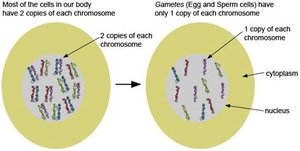
Somatic cells are all body cells except gametes and are diploid, containing two sets of chromosomes. Gametes (sperm and egg) are haploid, containing one set of chromosomes.
Diploid (2n): 46 chromosomes (23 pairs)
Haploid (n): 23 chromosomes
Passing Genetic Material During Cell Division
Genetic material is stored in the nucleus as chromatin or chromosomes. During cell division, this material is passed from parent to daughter cells.
Mitosis: Daughter cells have identical genetic material to the parent cell.
Meiosis: Daughter cells have half the genetic material and are genetically unique.
Mitosis: Mechanism and Significance
Mitosis is the division of diploid cells, resulting in identical diploid daughter cells. It is essential for growth, repair, and maintenance of tissues.
Occurs throughout the body except in nervous and muscle tissue.
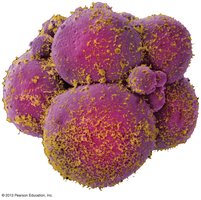
Allows a single-cell zygote to develop into a multicellular organism.
Millions of cells divide every second to replace damaged or worn-out cells.
Phases of Mitosis
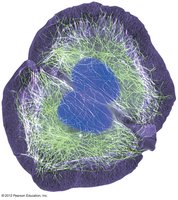
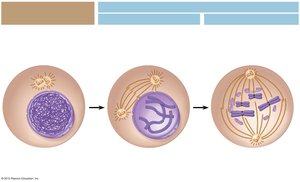
Genetic material duplicates and then separates through a series of phases: prophase, metaphase, anaphase, telophase, and cytokinesis. After mitosis, two identical daughter cells are produced.
Prophase: Chromosomes condense and spindle fibers form.
Metaphase: Chromosomes align at the cell's equator.
Anaphase: Sister chromatids separate.
Telophase: Nuclear membranes reform.
Cytokinesis: Cytoplasm divides, completing cell division.
Meiosis: Mechanism and Significance
Meiosis is the process by which gametes are produced. It involves two consecutive cell divisions, resulting in four haploid cells, each genetically unique.
Occurs only in reproductive organs (testes and ovaries).
Ensures genetic diversity in offspring.
Comparison of Mitosis and Meiosis
Mitosis and meiosis differ in their outcomes and mechanisms. Mitosis produces two diploid cells, while meiosis produces four haploid cells.
Process | Number of Divisions | Number of Daughter Cells | Chromosome Number | Genetic Identity |
|---|---|---|---|---|
Mitosis | 1 | 2 | Diploid (2n) | Identical |
Meiosis | 2 | 4 | Haploid (n) | Unique |
Additional info: Mitosis is essential for somatic cell maintenance, while meiosis is crucial for sexual reproduction and genetic variation.
