 Back
BackCellular Level of Organization: ANP Study Guide
Study Guide - Smart Notes
 Tailored notes based on your materials, expanded with key definitions, examples, and context.
Cellular Level of Organization
Introduction to Cells
The cell is the fundamental unit of life in all organisms. Understanding cell structure and function is essential for grasping the basics of anatomy and physiology.
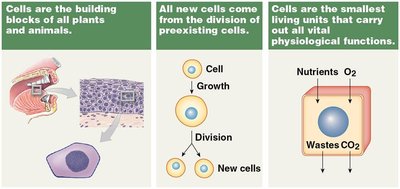
Cell Theory: States that cells are the building blocks of all plants and animals, all new cells arise from the division of preexisting cells, and cells are the smallest living units that perform all vital physiological functions.
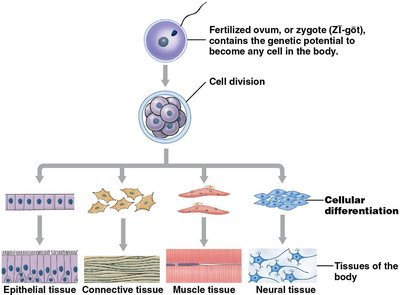
Cellular Differentiation: After fertilization, the zygote divides and differentiates into specialized cells (muscle, nerve, skin, etc.), which then form tissues.
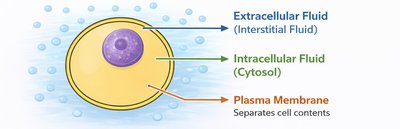
Cell Environment: Cells are surrounded by extracellular fluid (interstitial fluid), while the fluid inside the cell is called cytosol. The plasma membrane separates the cell contents from the extracellular environment.
Basic Cell Structure
Cells share common structural features that enable their functions.
Plasma Membrane: Surrounds the cell and regulates entry and exit of substances.
Nuclear Membrane: Encloses the nucleus, separating it from the cytoplasm.
Cytoplasm: Contains cytosol and organelles.

Cytoplasm and Organelles
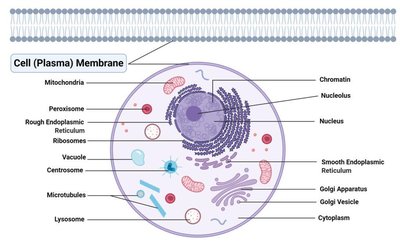
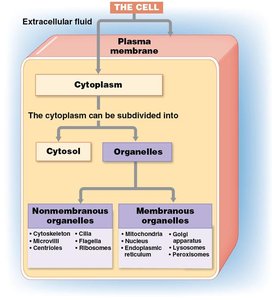
The cytoplasm is divided into cytosol and organelles, which are further classified as membranous or non-membranous.
Cytosol: The fluid portion of the cytoplasm.
Organelles: Specialized structures performing distinct functions.
Non-membranous Organelles: Include cytoskeleton, cilia, flagella, centrioles, and ribosomes.
Membranous Organelles: Include mitochondria, endoplasmic reticulum, Golgi apparatus, lysosomes, and peroxisomes.

Plasma Membrane Structure
The plasma membrane is a selectively permeable barrier composed of a phospholipid bilayer, proteins, and carbohydrates.
Phospholipid Bilayer: Hydrophilic heads face outward, hydrophobic tails face inward; cholesterol molecules interspersed for membrane stability.
Proteins: Integral proteins span the membrane; peripheral proteins are attached to the surface. Glycocalyx (carbohydrate layer) aids in cell recognition.



Non-membranous Organelles
These organelles are not enclosed by membranes and are directly involved in cell structure and movement.
Cytoskeleton: Provides structural support and flexibility.
Microfilaments: Smallest cytoskeletal elements, often found at the cell periphery.
Microvilli: Increase surface area for absorption.
Intermediate Filaments: Provide strength.
Microtubules: Largest cytoskeletal elements, involved in cell division and transport.
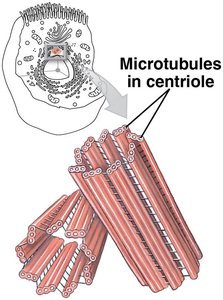
Centrioles: Essential for cell division.
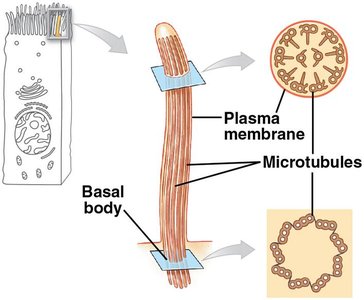
Cilia: Move fluids and secretions across cell surfaces.
Ribosomes: Sites of protein synthesis; can be free or bound to rough ER.


Membranous Organelles
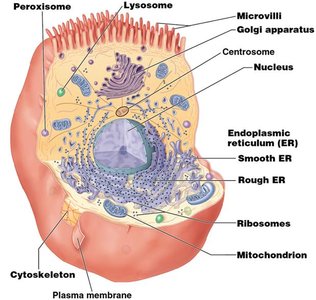
Membranous organelles are enclosed by phospholipid membranes and perform specialized functions.
Endoplasmic Reticulum (ER): Rough ER synthesizes proteins; smooth ER produces lipids and detoxifies substances.
Golgi Apparatus: Modifies, packages, and sorts proteins and lipids for secretion or use within the cell.
Mitochondria: Site of ATP production via aerobic metabolism.
Peroxisomes: Neutralize toxic compounds.
Lysosomes: Digest organic compounds and damaged organelles.
Nucleus: Structure and Function
The nucleus is the control center of the cell, responsible for storing genetic information and directing cellular activities.
Nuclear Envelope: Double membrane separating nucleus from cytoplasm.
Nuclear Pores: Allow communication between nucleus and cytoplasm.
Nucleoplasm: Fluid inside the nucleus.
Nucleolus: Produces ribosomal RNA and assembles ribosome subunits.
Nucleic Acids: DNA and RNA
Nucleic acids are essential for storing and transferring genetic information.
DNA: Double helix structure; stores instructions for protein synthesis.
RNA: Single-stranded; three types (mRNA, tRNA, rRNA) involved in protein synthesis.
Nucleotides: Composed of a phosphate group, five-carbon sugar, and nitrogenous base.
Protein Synthesis
Protein synthesis is the process by which cells produce proteins, essential for cellular function and homeostasis.
Gene: Segment of DNA coding for a specific protein.
Triplet: Three-base sequence in DNA coding for one amino acid.
Steps: Gene activation, transcription (DNA to mRNA), translation (mRNA to protein).
Transcription
Occurs in the nucleus; RNA polymerase synthesizes mRNA from DNA template.
Base pairing: A-U, T-A, G-C, C-G.
Translation
Occurs in cytoplasm on ribosomes; mRNA codons are matched with tRNA anticodons.
Three phases: Initiation, elongation, termination.
Membrane Transport
The plasma membrane regulates the movement of substances into and out of the cell.
Permeability: Selectively permeable membranes allow some substances to pass while restricting others.
Passive Transport: Includes diffusion and facilitated diffusion; does not require ATP.
Active Transport: Requires ATP; includes carrier-mediated transport and vesicular transport.
Diffusion
Movement from high to low concentration; influenced by distance, size, temperature, concentration gradient, and electrical forces.
Osmosis
Diffusion of water across a selectively permeable membrane.
Tonicity: Isotonic (cell stays same size), hypotonic (cell swells), hypertonic (cell shrinks).
Carrier-Mediated Transport
Facilitated Diffusion: Passive, no ATP required.
Active Transport: Requires ATP; e.g., sodium-potassium pump.
Secondary Active Transport: Uses ion gradients to move substances.
Vesicular Transport
Endocytosis: Importing substances into the cell.
Exocytosis: Exporting substances out of the cell.
Cell Life Cycle
Cells undergo a life cycle that includes growth, division, and death.
Cell Division: Mitosis produces two identical daughter cells; meiosis produces four non-identical sex cells.
Interphase: Cell performs normal functions and prepares for division (G1, S, G2 phases).
Mitosis: Four stages: prophase, metaphase, anaphase, telophase; followed by cytokinesis.
Clinical Module: Cancer and Tumors
Cancer is characterized by abnormal cell division and mutations. Tumors can be benign (localized) or malignant (spread and disrupt function).
Benign Tumor: Cells remain within original tissue.
Malignant Tumor: Cells divide rapidly, invade surrounding tissue, and can metastasize.
Summary Table: Membranous vs. Non-membranous Organelles
Type | Examples | Main Functions |
|---|---|---|
Non-membranous | Cytoskeleton, Centrioles, Ribosomes, Cilia, Microvilli | Structural support, movement, protein synthesis |
Membranous | Mitochondria, ER, Golgi apparatus, Lysosomes, Peroxisomes | Energy production, synthesis, packaging, digestion |
