 Back
BackCellular Membrane Structure and Transport Mechanisms
Study Guide - Smart Notes
 Tailored notes based on your materials, expanded with key definitions, examples, and context.
The Cell and Its Membrane
Fluid Compartments of the Body
The body is composed of various fluid compartments, primarily the extracellular fluid (ECF) and the cytosol (intracellular fluid). These compartments are separated by the plasma membrane, which regulates the movement of substances between them.
Chemical Bonds and Properties
Chemical bonds are essential for cellular structure and function:
Ionic Bonds: Formed between charged ions (e.g., Na+ and Cl-).
Covalent Bonds: Formed by sharing electrons (e.g., H2).
Polar vs. Nonpolar: Polar bonds (e.g., O-H in water) have unequal electron sharing, leading to hydrophilic properties; nonpolar bonds are hydrophobic.
Hydrophilic substances are attracted to water, while hydrophobic substances repel water.
Structure of the Plasma Membrane
Phospholipid Bilayer
The plasma membrane consists of a phospholipid bilayer, which acts as a barrier between the ECF and cytosol. Embedded within this bilayer are proteins, cholesterol, and carbohydrates.
Proteins: Function as channels, receptors, and carriers.
Cholesterol: Stabilizes the membrane during temperature changes.
Carbohydrates: Glycolipids and glycoproteins aid in cell recognition.
The membrane is selectively permeable, allowing certain substances to pass while restricting others.
Membrane Structures and Functions
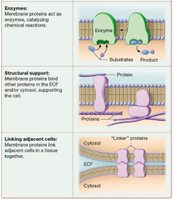
Membrane proteins play diverse roles, including enzymatic activity, structural support, and linking adjacent cells.
Transport Across the Plasma Membrane
Types of Transport
Substances move across the membrane via passive (no energy required) or active (energy required, usually ATP) transport mechanisms.
Concentration Gradient
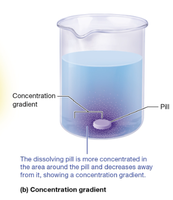
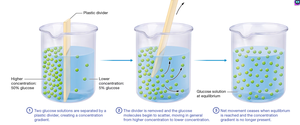
A concentration gradient is the difference in concentration of a solute between two regions. It drives the movement of substances across membranes.
Diffusion
Diffusion is the movement of solute from an area of higher concentration to lower concentration. It is a passive process.
Simple vs. Facilitated Diffusion
Simple Diffusion: Nonpolar solutes penetrate the bilayer without assistance.
Facilitated Diffusion: Charged or polar solutes require membrane proteins to cross the bilayer.
Osmosis
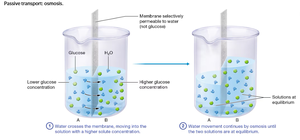
Osmosis is the movement of solvent (usually water) across a selectively permeable membrane from a solution with lower solute concentration to one with higher solute concentration.
ATP and Cellular Energy
Adenosine triphosphate (ATP) is the energy currency of the cell. Its bonds store significant energy, which is released and recycled during cellular processes.
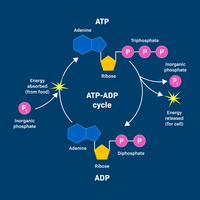
Primary Active Transport
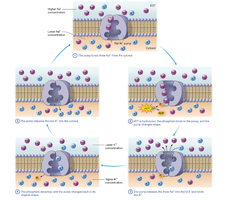
Primary active transport uses energy from ATP hydrolysis to move solutes against their concentration gradient. The sodium-potassium ATPase is a primary pump.
Na+ and K+ are transported across the membrane.
ATP is hydrolyzed to provide energy.
Secondary Active Transport
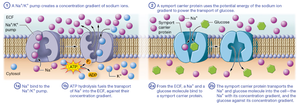
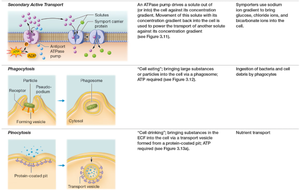
Secondary active transport uses energy indirectly from ATP. It often involves symport or antiport mechanisms, where the movement of one solute down its gradient drives the transport of another solute against its gradient.
Electrophysiology
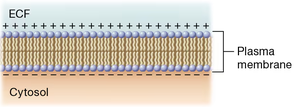
The movement of ions across the plasma membrane creates unequal concentrations, generating an electrical potential. The resting membrane potential is the value when a cell is at rest.
Vesicular Transport
Phagocytosis: Uptake of particles.
Pinocytosis: Uptake of fluid droplets.
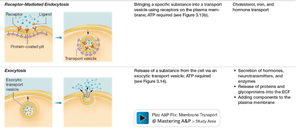
Endocytosis: Uptake of whole cells or large substances.
Exocytosis: Release of substances from the cell (e.g., hormones, neurotransmitters).
Transcytosis: Substances pass through the cell via endocytosis and exocytosis (e.g., kidney filtration, intestinal absorption).
Medicines and Membrane Receptors
Agonists and Antagonists
Agonists: Bind to receptors and mimic ligand actions (e.g., morphine mimics endorphins).
Antagonists: Bind to receptors and inhibit ligand actions (e.g., antihistamines block histamine effects).
Clinical Application: Intravenous Solutions and Cell Response
Effects of IV Solutions on Red Blood Cells
If a patient is given intravenous sterile water, the red blood cells will swell due to osmosis, as water moves into the cells where solute concentration is higher. The normal IV solution is isotonic saline, which prevents net movement of water and maintains cell size.
Sports Drinks and Dehydration
Dehydration and Cellular Effects
Dehydration: Loss of water from the ECF.
Effect on ECF: ECF becomes hypertonic, causing water to leave cells.
Effect on Cells: Cells shrink as water exits.
Sports Drinks: Contain electrolytes and carbohydrates to restore fluid and solute balance.
Summary Table: Types of Membrane Transport
Transport Type | Energy Required? | Direction | Example |
|---|---|---|---|
Simple Diffusion | No | High to Low | O2 across membrane |
Facilitated Diffusion | No | High to Low | Glucose via carrier protein |
Osmosis | No | Low to High solute | Water movement |
Primary Active Transport | Yes (ATP) | Low to High | Na+/K+ pump |
Secondary Active Transport | Indirect (ATP) | Varies | Na+-glucose symport |
Vesicular Transport | Yes (ATP) | Varies | Endocytosis, Exocytosis |
Key Equations
Diffusion Rate:
Osmosis: (Osmotic pressure)
ATP Hydrolysis:
