Back
BackCellular Respiration and Metabolism: Study Notes for ANP College
Study Guide - Smart Notes
 Tailored notes based on your materials, expanded with key definitions, examples, and context.
Cellular Respiration and Metabolism
Overview of Cellular Respiration
Cellular respiration is the process by which cells convert glucose and other nutrients into energy (ATP), water, and carbon dioxide. This process is essential for maintaining cellular functions and supporting life.
Cellular Respiration: The breakdown of glucose to produce ATP.
ATP (Adenosine Triphosphate): The main energy currency of the cell.
Stages: Glycolysis, Krebs Cycle (Citric Acid Cycle), Electron Transport Chain.
Glycolysis
Glycolysis is the first stage of cellular respiration, occurring in the cytoplasm. It breaks down glucose into pyruvate, producing a small amount of ATP and NADH.
Location: Cytoplasm
Reactants: Glucose
Products: 2 Pyruvate, 2 ATP, 2 NADH
Key Steps: Glucose is split into two 3-carbon molecules (pyruvate).
Krebs Cycle (Citric Acid Cycle)
The Krebs Cycle occurs in the mitochondria and further breaks down pyruvate, generating NADH, FADH2, and ATP.
Location: Mitochondrial matrix
Reactants: Acetyl-CoA (derived from pyruvate)
Products: CO2, NADH, FADH2, ATP
Key Steps: Acetyl-CoA enters the cycle, producing high-energy electron carriers.
Electron Transport Chain (ETC)
The Electron Transport Chain is the final stage, located in the inner mitochondrial membrane. It uses NADH and FADH2 to generate a large amount of ATP.
Location: Inner mitochondrial membrane
Reactants: NADH, FADH2, O2
Products: ATP, H2O
Key Steps: Electrons are transferred through protein complexes, creating a proton gradient that powers ATP synthesis.
Fermentation
Fermentation occurs when oxygen is not available. It allows glycolysis to continue by regenerating NAD+, producing lactic acid or ethanol.
Types: Lactic acid fermentation (in muscles), Alcohol fermentation (in yeast)
Products: Lactic acid or ethanol, CO2
Purpose: Regenerate NAD+ for glycolysis
ATP Yield from Cellular Respiration
The total ATP yield from one molecule of glucose is approximately 36-38 ATP, depending on the cell type and conditions.
Glycolysis: 2 ATP
Krebs Cycle: 2 ATP
Electron Transport Chain: 32-34 ATP
Metabolism: Anabolic and Catabolic Pathways
Metabolism refers to all chemical reactions in the body. It includes anabolic (building up) and catabolic (breaking down) pathways.
Anabolism: Synthesis of complex molecules from simpler ones (e.g., protein synthesis).
Catabolism: Breakdown of complex molecules into simpler ones (e.g., cellular respiration).
Example: Glucose catabolism provides energy; amino acid anabolism builds proteins.
Enzymes in Metabolism
Enzymes are biological catalysts that speed up metabolic reactions without being consumed.
Function: Lower activation energy for reactions.
Specificity: Each enzyme acts on a specific substrate.
Example: Hexokinase catalyzes the first step of glycolysis.
Summary Table: Cellular Respiration Stages
Stage | Location | Main Reactants | Main Products | ATP Yield |
|---|---|---|---|---|
Glycolysis | Cytoplasm | Glucose | Pyruvate, NADH | 2 |
Krebs Cycle | Mitochondrial matrix | Acetyl-CoA | CO2, NADH, FADH2 | 2 |
Electron Transport Chain | Inner mitochondrial membrane | NADH, FADH2, O2 | ATP, H2O | 32-34 |
Key Equations
Overall Cellular Respiration Equation:
ATP Hydrolysis:
Regulation of Metabolism
Metabolic pathways are regulated by hormones, feedback mechanisms, and enzyme activity.
Hormonal Regulation: Insulin promotes glucose uptake; glucagon stimulates glucose release.
Feedback Inhibition: End products inhibit pathway enzymes to prevent overproduction.
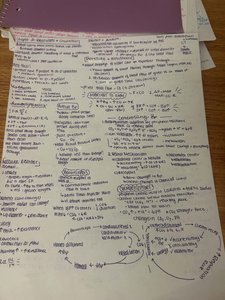
Diagram: Metabolic Pathways and Regulation
The following image illustrates the flow of substrates and products in cellular respiration and the regulation of metabolic pathways.