 Back
BackChapter 1: The Human Body—An Orientation (Study Notes)
Study Guide - Smart Notes
 Tailored notes based on your materials, expanded with key definitions, examples, and context.
Form (Anatomy) Determines Function (Physiology)
Definitions and Principles
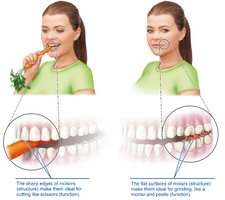
The study of the human body is divided into two closely related sciences: anatomy and physiology. Anatomy focuses on the structure of body parts and their relationships, while physiology examines how these parts function to sustain life. The principle of complementarity of structure and function states that what a structure can do depends on its specific form.
Anatomy: Study of body structures and their relationships.
Physiology: Study of body functions and how parts work together.
Reference Standards: Textbook values often refer to a healthy young male (70 kg) or female (57 kg).
Anatomical Variability: Most humans match textbook anatomy, but minor variations exist (e.g., nerve or vessel positions).
Sex vs. Gender: Sex is biological (chromosomes, hormones, reproductive anatomy); gender is a psychosocial construct (identity, expression).
Studying Anatomy
Methods and Tools
Understanding anatomy requires knowledge of terminology and the use of various observational and technological tools.
Observation, Manipulation, Palpation: Feeling organs with hands.
Auscultation: Listening to body sounds (e.g., heart, lungs) with a stethoscope.
Medical Imaging: Non-invasive techniques such as X-ray, MRI, CT, and ultrasound.
Subdivisions of Anatomy
Gross (Macroscopic) Anatomy: Structures visible to the naked eye.
Regional Anatomy: All structures in a specific area.
System Anatomy: Structures of a single organ system.
Surface Anatomy: Internal structures as related to the skin surface.
Microscopic Anatomy: Structures too small to see unaided (cytology—cells; histology—tissues).
Developmental Anatomy: Structural changes throughout life (embryology—before birth).
Subdivisions of Physiology
Renal Physiology: Kidney function.
Neurophysiology: Nervous system function.
Cardiovascular Physiology: Heart and blood vessel function.
Physiology often focuses on cellular/molecular events and requires understanding of chemistry and physics.
The Body’s Organization: Levels of Structural Organization
Hierarchy from Atoms to Organism
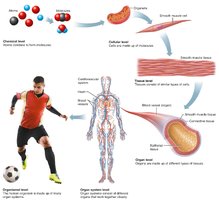
The human body is organized into a hierarchy of structural levels, each building on the previous one:
Chemical Level: Atoms combine to form molecules.
Cellular Level: Cells are made of molecules and organelles.
Tissue Level: Groups of similar cells form tissues.
Organ Level: Organs consist of two or more tissue types.
Organ System Level: Organs work together for a common purpose.
Organismal Level: All organ systems combine to form the living organism.
The Body’s Organ Systems and Their Major Functions
Overview of the 11 Organ Systems
The human body contains 11 organ systems, each with specific functions essential for survival.
System | Main Functions |
|---|---|
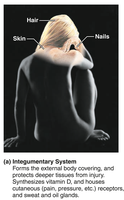
Integumentary | Protection, vitamin D synthesis, sensory reception |
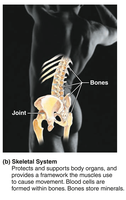
Skeletal | Support, movement, blood cell formation, mineral storage |
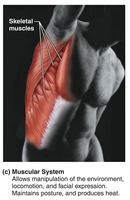
Muscular | Movement, posture, heat production |
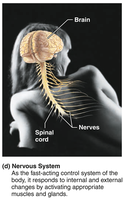
Nervous | Control system, response to stimuli |
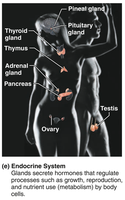
Endocrine | Hormone secretion, regulation of growth, metabolism, reproduction |
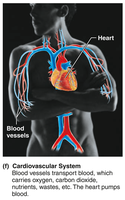
Cardiovascular | Transport of blood, nutrients, wastes, gases |
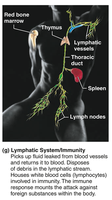
Lymphatic/Immunity | Fluid return, immune response |
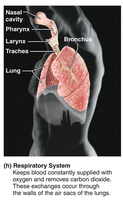
Respiratory | Gas exchange (O2/CO2) |
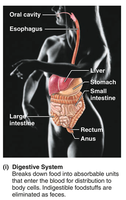
Digestive | Breakdown and absorption of food, waste elimination |
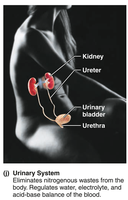
Urinary | Elimination of nitrogenous wastes, water/electrolyte balance |
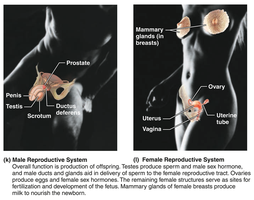
Reproductive | Production of offspring |
Requirements for Life
Necessary Life Functions
Maintaining Boundaries: Separation of internal and external environments (e.g., skin, plasma membranes).
Movement: Of body parts (muscles), substances (blood, food), and cells.
Responsiveness: Ability to sense and respond to stimuli (e.g., withdrawal reflex, breathing rate).
Digestion: Breakdown and absorption of food.
Metabolism: All chemical reactions in the body, including catabolism (breakdown) and anabolism (synthesis).
Excretion: Removal of metabolic wastes (urea, CO2, feces).
Reproduction: Cellular division for growth/repair; organismal production of offspring.
Growth: Increase in size of body part or organism.
Survival Needs
Nutrients: Carbohydrates (energy), proteins (structure/chemistry), fats (energy storage), vitamins/minerals (chemical reactions/structure).
Oxygen: Required for energy production (cellular respiration).
Water: Most abundant chemical; solvent for reactions, fluid base for secretions/excretions.
Normal Body Temperature: Necessary for proper metabolic reactions.
Appropriate Atmospheric Pressure: Required for breathing and gas exchange.
Homeostasis
Definition and Importance
Homeostasis is the maintenance of stable internal conditions despite external changes. It is a dynamic equilibrium, maintained by all organ systems, and is essential for health and survival.
Law of Mass Balance: Input of substances must equal output to maintain steady state.
Homeostatic Control Mechanisms
Variable: The factor being regulated (e.g., temperature, blood sugar).
Receptor: Detects changes (stimuli) and sends information to the control center.
Control Center: Determines set point, analyzes input, and sends output to effector.
Effector: Carries out the response to restore homeostasis.
Types of Feedback
Negative Feedback: Most common; response reduces or shuts off the original stimulus (e.g., body temperature, blood glucose regulation).
Positive Feedback: Response enhances the original stimulus; usually controls infrequent events (e.g., labor contractions, blood clotting).
Feedforward Response: Anticipatory response before a change occurs (e.g., salivation before eating).
Homeostatic Imbalance
Disturbance of homeostasis increases risk of disease and contributes to aging.
If negative feedback is overwhelmed, harmful positive feedback may occur (e.g., heart failure).
*Additional info: Homeostatic mechanisms are crucial for adaptation and survival in changing environments. Understanding these principles is foundational for all health sciences.*
