 Back
BackChapter 11: The Cardiovascular System – Blood
Study Guide - Smart Notes
 Tailored notes based on your materials, expanded with key definitions, examples, and context.
The Cardiovascular System: Blood
Introduction to the Cardiovascular System
The cardiovascular system is a circulating transport system essential for maintaining homeostasis. It consists of three main components: a pump (the heart), a conducting system (blood vessels), and a fluid tissue medium (blood). Blood is a specialized fluid connective tissue containing cells suspended in a fluid matrix called plasma.
Hematology: The study of blood, its functions, and disorders.
Functions of Blood:
Transport of dissolved substances (O2, CO2, nutrients, hormones, immune components, waste products)
Regulation of pH, ions, and electrolytes
Restriction of fluid losses at injury sites (clotting)
Defense against toxins and pathogens
Stabilization of body temperature and heat distribution
Composition of Blood
Whole Blood Components
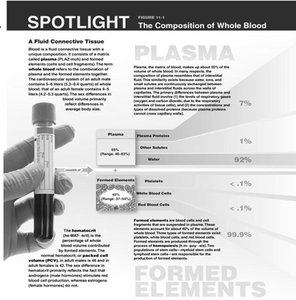
Whole blood consists of two main parts: plasma and formed elements. Plasma is the watery, fluid component, while formed elements include all blood cells and cell fragments.
Plasma: Water, dissolved plasma proteins, and other solutes (electrolytes, nutrients, waste products).
Formed Elements: Erythrocytes (red blood cells), leukocytes (white blood cells), and thrombocytes (platelets).
Blood Volume and Physical Characteristics
Blood volume is about 7% of body weight (5–6 L in males, 4–5 L in females).
Normal blood temperature: 38°C (100.4°F).
High viscosity and slightly alkaline pH (7.35–7.45).
Plasma and Plasma Proteins
Plasma makes up 46–63% of blood volume, with more than 90% being water. Plasma proteins are primarily synthesized in the liver and include:
Albumins (60%): Maintain blood volume and transport substances.
Globulins (35%): Include antibodies (immunoglobulins) and transport proteins.
Fibrinogen (4%): Involved in clot formation.
Serum: Plasma without fibrinogen.
Formed Elements of Blood
Red Blood Cells (Erythrocytes)
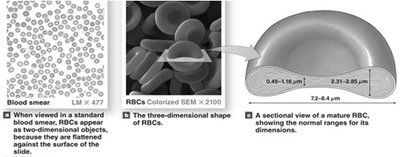
Red blood cells (RBCs) are the most abundant formed elements, making up 99.9% of all blood cells. They are specialized for oxygen transport and lack nuclei, mitochondria, and ribosomes when mature.
Hemoglobin (Hb): The protein responsible for oxygen and carbon dioxide transport. Each Hb molecule contains iron, which binds O2 (oxyhemoglobin) or releases it (deoxyhemoglobin).
Normal RBC count: Males: 4.5–6.3 million/μL; Females: 4.2–5.5 million/μL.
Hematocrit: Percentage of RBCs in centrifuged blood (Males: 40–54%, Females: 37–47%).
Structure: Biconcave discs, high surface-to-volume ratio, flexible to pass through capillaries.
White Blood Cells (Leukocytes)
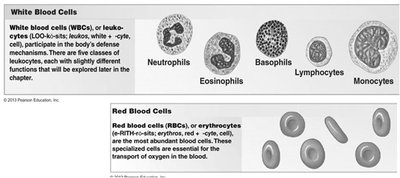
White blood cells (WBCs) are crucial for immune defense. They have nuclei and organelles, and are classified into five types based on structure and function:
Neutrophils: Most abundant; phagocytic, attack bacteria.
Eosinophils: Attack parasites, control inflammation, sensitive to allergens.
Basophils: Release histamine and heparin, promote inflammation.
Monocytes: Become macrophages, engulf pathogens and debris.
Lymphocytes: Specific immunity (T-cells, B-cells, NK cells).
Platelets (Thrombocytes)
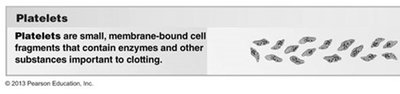
Platelets are small, membrane-bound cell fragments derived from megakaryocytes. They are essential for blood clotting (hemostasis) and circulate for 9–12 days.
Normal count: 150,000–500,000/μL.
Thrombocytopenia: Low platelet count, risk of bleeding.
Thrombocytosis: High platelet count, risk of clotting.
Blood Cell Formation and Turnover
Hemopoiesis (Hematopoiesis)
Hemopoiesis is the process of blood cell formation, occurring in red bone marrow. Hemocytoblasts (stem cells) differentiate into myeloid and lymphoid stem cells, giving rise to all blood cells.
Erythropoiesis: Formation of RBCs, regulated by erythropoietin (EPO) from the kidneys in response to hypoxia.
Leukopoiesis: Formation of WBCs.
Thrombopoiesis: Formation of platelets.
RBC Life Span and Recycling
RBCs live about 120 days; old cells are removed by macrophages in the spleen, liver, and bone marrow.
Hemoglobin is broken down into amino acids, iron (recycled), and heme (converted to biliverdin, then bilirubin).
Iron is transported by transferrin and stored as ferritin or hemosiderin.
Blood Typing
ABO and Rh Blood Groups
Blood types are determined by the presence or absence of antigens (A, B, Rh) on RBC surfaces. The immune system produces antibodies against foreign antigens, which is critical for safe blood transfusions.
ABO System: Types A, B, AB, O based on antigens present.
Rh System: Rh+ (antigen present), Rh– (antigen absent).
Rh incompatibility can cause hemolytic disease of the newborn; treated with Rhogam.
Hemostasis and Blood Clotting
Phases of Hemostasis
Hemostasis is the process of stopping bleeding and involves three phases:
Vascular Phase: Vascular spasm constricts blood vessels after injury.
Platelet Phase: Platelets adhere to exposed surfaces and form a plug.
Coagulation Phase: Cascade of clotting factors converts fibrinogen to fibrin, forming a stable clot.
Clot retraction pulls wound edges together; fibrinolysis dissolves the clot after healing.
Key Terms and Definitions
Albumin: Major plasma protein for osmotic pressure and transport.
Fibrin: Insoluble protein forming the mesh of blood clots.
Hematocrit: Percentage of RBCs in blood.
Embolus: A drifting blood clot or air bubble in the bloodstream.
Plasma: Fluid matrix of blood, containing water, proteins, and solutes.
Hemostasis: The process of stopping bleeding.
Erythrocyte: Red blood cell.
Embolism: Blockage of a vessel by an embolus.
Polycythemia: Excessive RBC production.
Erythropoietin (EPO): Hormone stimulating RBC production.
Hemoglobin: Oxygen-carrying protein in RBCs.
Thrombocyte: Platelet.
Leukocyte: White blood cell.
Thrombus: Stationary blood clot in a vessel.
Hematology: Study of blood.
Thalassemia: Genetic disorder affecting hemoglobin synthesis.
Hemopoiesis (Hematopoiesis): Formation of blood cells.
Summary Table: Composition of Whole Blood
Component | Percentage of Whole Blood | Main Constituents |
|---|---|---|
Plasma | ~55% | Water, plasma proteins (albumin, globulins, fibrinogen), other solutes |
Formed Elements | ~45% | Red blood cells, white blood cells, platelets |
