 Back
BackChapter 14: The Lymphatic System and Immunity – Study Notes
Study Guide - Smart Notes
 Tailored notes based on your materials, expanded with key definitions, examples, and context.
The Lymphatic System and Immunity
Introduction to the Lymphatic System
The lymphatic system is essential for defending the body against infection and disease, as well as for returning tissue fluids to the bloodstream. The fluid transported by lymphatic vessels is called lymph, and its recirculation is vital for maintaining homeostasis.
Pathogens are disease-causing organisms, including viruses, bacteria, fungi, and parasites.
The lymphatic system includes cells, tissues, and organs that defend the body, with lymphocytes as the primary cells.
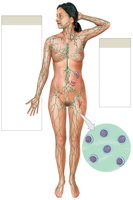
Major Components of the Lymphatic System
Lymphatic vessels (lymphatics): Carry lymph from peripheral tissues to veins.
Lymphocytes: Specialized cells that defend the body.
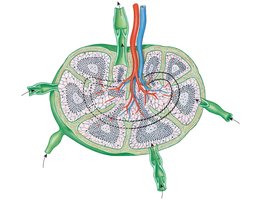
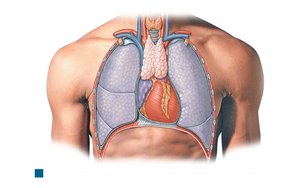
Lymphoid tissues and organs: Include lymph nodes, spleen, thymus, tonsils, and MALT (mucosa-associated lymphoid tissue).
Primary lymphoid tissues (red bone marrow, thymus) are sites of lymphocyte formation and maturation. Secondary lymphoid tissues (lymph nodes, spleen, tonsils, MALT, appendix) are sites where lymphocytes are activated and cloned.
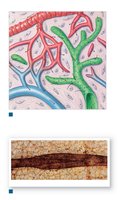
Lymphatic Capillaries and Vessels
Lymphatic capillaries are the smallest lymphatic vessels, beginning as blind pockets in tissues. They are lined by overlapping endothelial cells that act as one-way valves, allowing fluid, solutes, and infectious agents to enter but not return to interstitial fluid. Lymph flows into larger lymphatic vessels, which contain valves to maintain one-way flow. Skeletal muscle contraction aids lymph movement, and lymph eventually empties into the thoracic duct or right lymphatic duct.
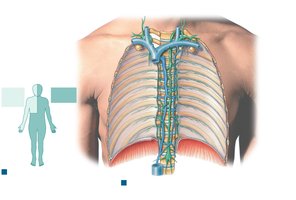
The Two Major Lymphatic Ducts
Thoracic duct: Collects lymph from the lower body and left side of the upper body; drains into the left subclavian vein.
Right lymphatic duct: Collects lymph from the right side of the upper body; drains into the right subclavian vein.
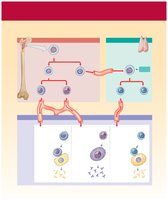
Lymphocyte Types and Production
There are three main classes of lymphocytes:
T cells (thymus-dependent): About 80% of circulating lymphocytes. Types include cytotoxic T cells (cell-mediated immunity), helper T cells, regulatory T cells, and memory T cells.
B cells (bone marrow-derived): About 10–15%. Differentiate into plasma cells that secrete antibodies (antibody-mediated immunity).
NK cells (natural killer): About 5–10%. Provide innate immunity by attacking foreign, virus-infected, or cancer cells.
Lymphocytopoiesis is the production of lymphocytes from hemocytoblasts in red bone marrow. Some stem cells remain in the marrow (producing B and NK cells), while others migrate to the thymus (producing T cells under the influence of thymosins).
Lymphoid Tissues and Organs
Lymphoid tissues: Densely packed lymphocytes in loose connective tissue (e.g., tonsils, MALT).
Lymphoid organs: Separated from surrounding tissue by a capsule (e.g., lymph nodes, thymus, spleen).
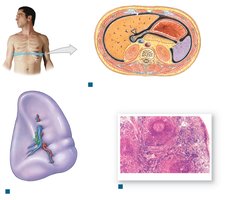
Lymph nodes filter lymph, removing pathogens and activating lymphocytes. The thymus is the site of T cell maturation and produces thymosins. The spleen filters blood, initiates immune responses, and stores iron.
Body Defenses: Innate and Adaptive Immunity
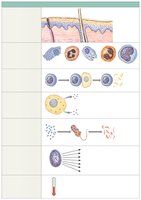
Innate (Nonspecific) Defenses
Innate defenses are present at birth and do not distinguish between threats. They include:
Physical barriers: Skin, hair, secretions, and mucous membranes.
Phagocytes: Neutrophils, eosinophils, and macrophages that engulf pathogens.
Immune surveillance: NK cells monitor and destroy abnormal cells.
Interferons: Cytokines that interfere with viral replication.
Complement system: Plasma proteins that enhance antibody action and destroy pathogens.
Inflammation: Localized response to injury, involving swelling, redness, heat, and pain.
Fever: Elevated body temperature that increases metabolism and defense activity.
Adaptive (Specific) Defenses
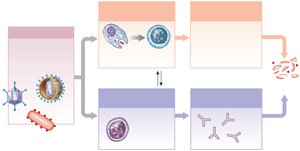
Adaptive immunity is not present at birth and develops in response to exposure to specific antigens. It is provided by T and B lymphocytes and can be classified as:
Cell-mediated immunity: T cells defend against pathogens inside cells.
Antibody-mediated (humoral) immunity: B cells defend against pathogens in body fluids by producing antibodies.

Forms and Properties of Immunity
Active immunity: Develops after exposure to antigens (naturally or through vaccination).
Passive immunity: Produced by transferring antibodies from another source (e.g., maternal antibodies, antibody injections).
Specificity: Each lymphocyte responds to one specific antigen.
Versatility: Millions of lymphocyte populations, each with different antigen receptors.
Memory: Memory cells enable a faster, stronger response upon re-exposure to the same antigen.
Tolerance: Immune system does not respond to self-antigens.
Antibody Structure and Function
Antibodies (immunoglobulins) are Y-shaped proteins produced by plasma cells. They bind to specific antigenic determinant sites (epitopes) on antigens. There are five classes of antibodies: IgG, IgM, IgA, IgE, and IgD, each with distinct roles in immunity.
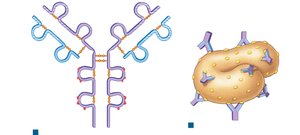
Neutralization: Prevents antigen from attaching to cells.
Precipitation and agglutination: Clumping of antigens for easier removal.
Activation of complement: Enhances pathogen destruction.
Attraction of phagocytes: Promotes phagocytosis.
Enhancement of phagocytosis (opsonization): Coating pathogens for easier engulfment.
Stimulation of inflammation: Mobilizes nonspecific defenses.
Integrated Immune Response
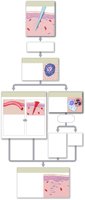
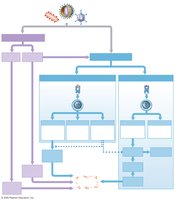
The immune response involves coordination between innate and adaptive defenses. Antigen-presenting cells (APCs) activate T cells, which then help activate B cells. The result is the destruction of pathogens through direct attack (cell-mediated) or antibody production (antibody-mediated).
Summary Table: Classes of Antibodies
Class | Main Function | Notes |
|---|---|---|
IgG | Most abundant, crosses placenta | Provides passive immunity to fetus |
IgM | First antibody produced | Responsible for blood type reactions |
IgA | Found in secretions | Tears, saliva, mucus |
IgE | Allergic and inflammatory responses | Stimulates histamine release |
IgD | Attached to B cells | Aids in sensitization |
Summary Table: Cells That Participate in Tissue Defenses
Cell Type | Main Function |
|---|---|
Neutrophils | Phagocytosis of pathogens |
Eosinophils | Attack parasites, involved in allergies |
Monocytes/Macrophages | Phagocytosis, antigen presentation |
NK Cells | Immune surveillance, destroy abnormal cells |
T Cells | Cell-mediated immunity |
B Cells | Antibody-mediated immunity |
Additional info: These notes provide a comprehensive overview of the lymphatic system and immunity, integrating both innate and adaptive defenses, and are suitable for exam preparation in an Anatomy & Physiology course.
