 Back
BackChapter 2: Chemistry Comes Alive – Foundations for Anatomy & Physiology
Study Guide - Smart Notes
 Tailored notes based on your materials, expanded with key definitions, examples, and context.
2.1 Matter and Energy
Matter
Matter is anything that has mass and occupies space. It can be observed directly or indirectly and exists in three states:
Solid: Definite shape and volume.
Liquid: Changeable shape, definite volume.
Gas: Changeable shape and volume.
Weight is the measure of mass plus the effects of gravity.
Energy
Energy is the capacity to do work or put matter into motion. It exists in two main forms:
Kinetic energy: Energy in action.
Potential energy: Stored (inactive) energy.
Energy can be transformed from one form to another, but some energy is always lost as heat during conversion.
Chemical energy: Stored in bonds of chemical substances.
Electrical energy: Results from movement of charged particles.
Mechanical energy: Directly involved in moving matter.
Radiant (electromagnetic) energy: Travels in waves (e.g., heat, light, X-rays).
2.2 Atoms and Elements
Elements
Elements are substances that cannot be broken down into simpler substances by ordinary chemical methods. Four elements (carbon, oxygen, hydrogen, nitrogen) make up 96% of the human body. Elements are listed in the periodic table and are represented by one- or two-letter symbols (e.g., O for oxygen, Na for sodium).
Atoms
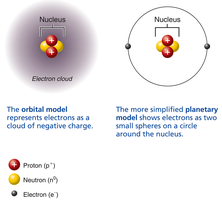
Atoms are the smallest units of elements that retain the properties of that element. They are composed of three subatomic particles:
Protons (p+): Positive charge, 1 atomic mass unit (amu).
Neutrons (n0): No charge, 1 amu.
Electrons (e-): Negative charge, virtually no mass.
Protons and neutrons are located in the nucleus, while electrons orbit the nucleus.
Atomic Number, Mass Number, Isotopes, and Atomic Weight
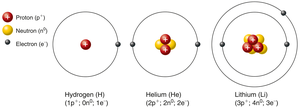
Atomic number: Number of protons in the nucleus.
Mass number: Total number of protons and neutrons.
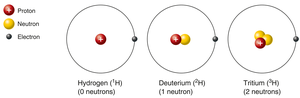
Isotopes: Atoms of the same element with different numbers of neutrons.
Atomic weight: Average of mass numbers of all isotopes of an element.
Radioisotopes
Radioisotopes are unstable isotopes that decompose to more stable forms, releasing energy (radioactivity). They are used in medical diagnosis and treatment but can also damage living tissue.
2.3 Combining Matter
Molecules and Compounds
Molecule: Two or more atoms bonded together.
Compound: Molecule with two or more different kinds of atoms.
Mixtures
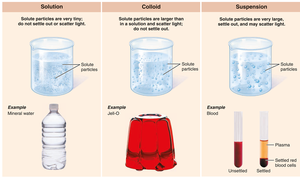
Mixtures are physical combinations of two or more substances. Three main types:
Type | Description | Example |
|---|---|---|
Solution | Homogeneous; solute particles are tiny and do not settle out or scatter light | Mineral water |
Colloid | Heterogeneous; larger solute particles that do not settle out | Jell-O |
Suspension | Heterogeneous; large, visible solutes that settle out | Blood |
2.4 Chemical Bonds
Role of Electrons in Chemical Bonding
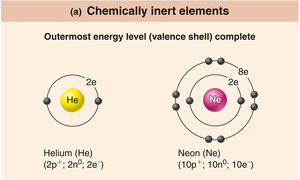
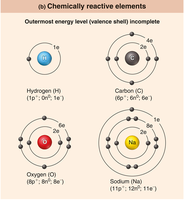
Electrons occupy energy levels called shells. The outermost shell (valence shell) determines chemical reactivity. Atoms tend to fill their valence shell (octet rule), usually with 8 electrons (except H and He).
Chemically Inert and Reactive Elements
Inert elements have full valence shells and are unreactive (e.g., noble gases). Reactive elements have incomplete valence shells and tend to gain, lose, or share electrons to achieve stability.
Types of Chemical Bonds
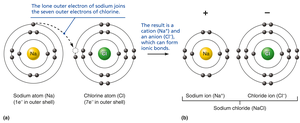
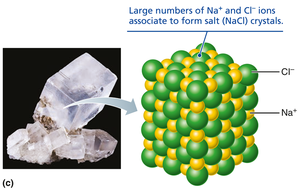
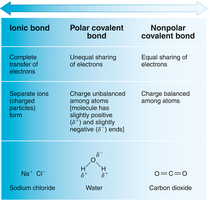
Ionic bonds: Transfer of electrons from one atom to another, forming ions (cations and anions). Opposite charges attract.
Covalent bonds: Sharing of electrons between atoms. Can be single, double, or triple bonds. May be nonpolar (equal sharing) or polar (unequal sharing).
Hydrogen bonds: Weak attractions between a hydrogen atom and an electronegative atom (e.g., between water molecules).
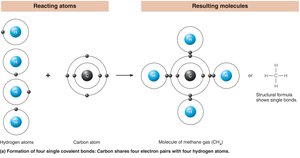
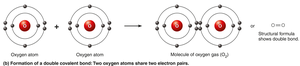
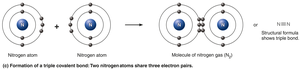
Comparison of Bond Types
Bond Type | Electron Sharing/Transfer | Example |
|---|---|---|
Ionic | Complete transfer of electrons | NaCl (sodium chloride) |
Polar Covalent | Unequal sharing of electrons | H2O (water) |
Nonpolar Covalent | Equal sharing of electrons | CO2 (carbon dioxide) |
2.5 Chemical Reactions
Chemical Equations
Chemical reactions involve the formation, rearrangement, or breaking of chemical bonds. They are represented by chemical equations showing reactants and products.
Types of Chemical Reactions
Synthesis (Combination): Atoms or molecules combine to form a larger molecule. Example:
Decomposition: Molecule is broken down into smaller molecules or atoms. Example:
Exchange (Displacement): Bonds are both made and broken. Example:
Redox (Oxidation-Reduction): Involves electron transfer; one atom is oxidized (loses electrons), another is reduced (gains electrons).
Reactions can be exergonic (release energy) or endergonic (absorb energy).
Factors Affecting Reaction Rate
Temperature (higher = faster)
Concentration (higher = faster)
Particle size (smaller = faster)
Catalysts (increase rate without being consumed; enzymes are biological catalysts)
2.6 Inorganic Compounds
Water
Water is the most abundant inorganic compound in the body, accounting for 60–80% of cell volume. Its properties include:
High heat capacity (absorbs/releases heat with little temperature change)
High heat of vaporization (evaporation cools the body)
Polar solvent (dissolves ionic substances, forms hydration layers)
Reactivity (involved in hydrolysis and dehydration synthesis)
Cushioning (protects organs, e.g., cerebrospinal fluid)
Salts
Salts are ionic compounds that dissociate in water to form electrolytes (conduct electrical currents). Examples include NaCl, KCl, and calcium phosphates. Ionic balance is vital for homeostasis.
Acids and Bases
Acids: Proton donors; release H+ ions (e.g., HCl).
Bases: Proton acceptors; release OH- ions (e.g., NaOH).
The pH scale measures hydrogen ion concentration (0–14). Lower pH = more acidic; higher pH = more basic. Buffers help maintain pH stability in the body.
2.7 Organic Compounds: Synthesis and Hydrolysis
Organic molecules contain carbon and include carbohydrates, lipids, proteins, and nucleic acids. Many are polymers built from monomers by dehydration synthesis and broken down by hydrolysis.
2.8 Carbohydrates
Carbohydrates are sugars and starches containing C, H, and O. They are classified as:
Monosaccharides: Simple sugars (e.g., glucose, ribose).
Disaccharides: Double sugars (e.g., sucrose, lactose).
Polysaccharides: Many sugars (e.g., starch in plants, glycogen in animals).
2.9 Lipids
Lipids are hydrophobic molecules including:
Triglycerides: Energy storage, insulation, protection.
Phospholipids: Major component of cell membranes.
Steroids: Cholesterol, hormones, vitamin D.
Eicosanoids: Signaling molecules (e.g., prostaglandins).
2.10 Proteins
Proteins are polymers of amino acids joined by peptide bonds. They serve structural, enzymatic, and regulatory roles. Protein structure has four levels:
Primary: Sequence of amino acids.
Secondary: Alpha helices and beta sheets.
Tertiary: 3D folding of a single polypeptide.
Quaternary: Arrangement of multiple polypeptides.
Denaturation (loss of structure) can occur with changes in pH or temperature. Enzymes are proteins that catalyze biochemical reactions by lowering activation energy.
2.11 Nucleic Acids
Nucleic acids (DNA and RNA) store and transmit genetic information. They are polymers of nucleotides (nitrogen base, pentose sugar, phosphate group). DNA is double-stranded and stores genetic code; RNA is single-stranded and involved in protein synthesis.
2.12 ATP (Adenosine Triphosphate)
ATP is the primary energy carrier in cells. It consists of an adenine base, ribose sugar, and three phosphate groups. Energy is released when phosphate bonds are broken, powering cellular work.
Additional info: This chapter provides foundational chemistry concepts essential for understanding physiological processes in Anatomy & Physiology, including the structure and function of biomolecules, chemical reactions, and the importance of water, acids, bases, and energy in biological systems.
