 Back
BackChapter 4: Energy and Cellular Metabolism – Structured Study Notes
Study Guide - Smart Notes
 Tailored notes based on your materials, expanded with key definitions, examples, and context.
Energy and Cellular Metabolism
Properties of Living Organisms
Living organisms exhibit several fundamental properties that distinguish them from non-living matter. These properties are essential for maintaining life and ensuring survival in changing environments.
Cellular Organization: The cell is the basic unit of structure and function in all living organisms.
Energy Acquisition and Use: Organisms acquire, transform, store, and utilize energy to perform biological work.
Environmental Response: Ability to sense and respond to internal and external stimuli.
Homeostasis: Maintenance of stable internal conditions through feedback mechanisms.
Information Storage and Transmission: Genetic material is stored, used, and transmitted to offspring.
Reproduction and Development: Organisms reproduce, grow, develop, and eventually die.
Emergent Properties: Complex behaviors and functions arise from interactions among simpler components.
Adaptation and Evolution: Individuals adapt, and species evolve over generations.
Energy in Biological Systems
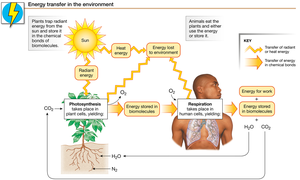
Energy is fundamental to all biological processes. Organisms require energy to perform work, grow, and maintain homeostasis.
Plants: Capture radiant energy from the sun and store it in chemical bonds via photosynthesis.
Animals: Obtain energy by ingesting plants or other animals.
Forms of Energy: Kinetic and Potential
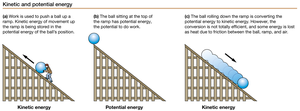
Energy exists in two primary forms: kinetic and potential. Biological systems convert energy between these forms to perform work.
Kinetic Energy: Energy of motion (e.g., movement of molecules, muscle contraction).
Potential Energy: Stored energy (e.g., in concentration gradients, chemical bonds).
Energy Transformation: Energy can be converted from one form to another, though some is lost as heat.
Thermodynamics in Biological Systems
Thermodynamics governs energy use and transformation in living organisms.
First Law: Conservation of energy – total energy in the universe is constant.
Second Law: Entropy – processes move from order to disorder; energy transformations are not 100% efficient.
Chemical Reactions and Bioenergetics
Chemical Reactions
Chemical reactions are the basis of metabolism. Bioenergetics studies the flow of energy through these reactions.
Reactants and Products: Reactants are transformed into products.
Reaction Rate: Speed at which reactants are converted to products.
Free Energy: Energy available to do work.
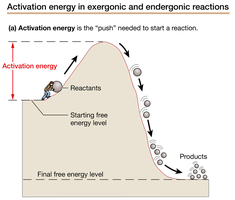
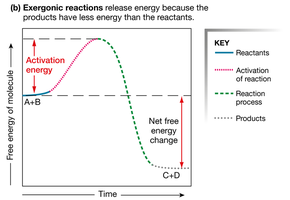
Activation Energy: Minimum energy required to initiate a reaction.
Exergonic and Endergonic Reactions
Reactions can either release or require energy, affecting their direction and reversibility.
Exergonic Reactions: Release energy; products have less energy than reactants.
Endergonic Reactions: Require energy input; products have more energy than reactants.
Coupling: Endergonic and exergonic reactions are often coupled to drive biological processes.
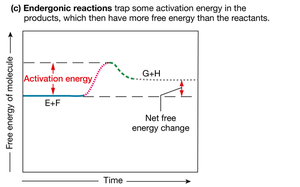
Energy in Biological Reactions
Energy released by exergonic reactions can be captured in high-energy molecules like ATP, NADH, FADH2, or NADPH.
Nucleotides: Capture and transfer energy and electrons.
Heat Energy: Energy not captured is lost as heat.
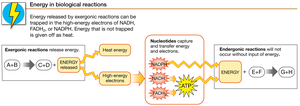
Activation Energy and Reaction Rates
Some reactions require large activation energies, which can limit their rate unless catalyzed.
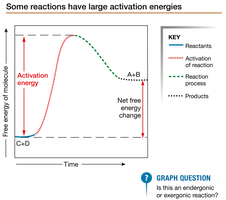
Enzymes and Metabolic Regulation
Enzymes
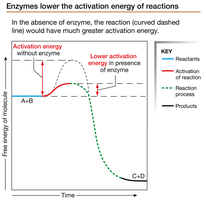
Enzymes are biological catalysts that speed up chemical reactions by lowering activation energy.
Catalysts: Substances that increase reaction rates without being consumed.
Substrates: Reactants acted upon by enzymes.
Isozymes: Enzyme variants that catalyze the same reaction under different conditions or in different tissues.
Enzyme Regulation: Enzymes can be activated, inactivated, or modulated by various factors.
Coenzymes: Organic molecules (often derived from vitamins) required for enzyme function.
Factors Affecting Enzyme Activity
Enzyme activity is influenced by substrate concentration, enzyme concentration, temperature, and pH.
Optimal pH: Most human enzymes function best near pH 7.4.
Temperature: Extreme temperatures can denature enzymes.
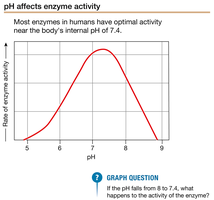
Enzymes Lower Activation Energy
Enzymes facilitate reactions by reducing the activation energy required, making reactions proceed faster.
Types of Enzymatic Reactions
Enzymatic reactions are classified based on the type of chemical change they catalyze.
Oxidation-Reduction: Transfer of electrons; reduction (gain), oxidation (loss).
Hydrolysis-Dehydration: Addition or removal of water.
Addition-Subtraction-Exchange: Addition/removal/exchange of functional groups (e.g., kinases add phosphate groups).
Ligation: Joining two molecules together (e.g., synthetases).
Metabolism and Metabolic Pathways
Metabolism
Metabolism encompasses all chemical reactions in an organism, divided into catabolism and anabolism.
Catabolism: Breakdown of molecules to release energy.
Anabolism: Synthesis of molecules, requiring energy input.
Intermediates: Molecules in metabolic pathways that are transformed stepwise.
Metabolic Pathways
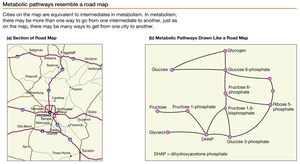
Metabolic pathways are interconnected series of reactions, resembling a road map with multiple routes between intermediates.
Regulation of Metabolic Pathways
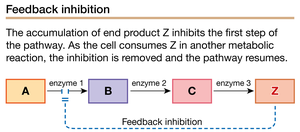
Cells regulate metabolism by controlling enzyme concentrations, using modulators, feedback inhibition, compartmentalization, and maintaining ATP/ADP ratios.
Feedback Inhibition: End product inhibits an earlier step, preventing overproduction.
Compartmentalization: Enzymes are localized within organelles for efficiency.
Reversibility of Metabolic Reactions
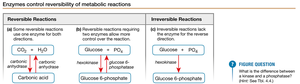
Enzymes determine whether reactions are reversible or irreversible, affecting metabolic control.
Reversible Reactions | Irreversible Reactions |
|---|---|
CO2 + H2O ↔ Carbonic acid (carbonic anhydrase) | Glucose + PO4 → Glucose 6-phosphate (hexokinase) |
Glucose ↔ Glucose 6-phosphate (glucose 6-phosphatase) | Glucose 6-phosphate → Glucose (no reverse enzyme) |
ATP Production and Cellular Metabolism
ATP Transfers Energy Between Reactions
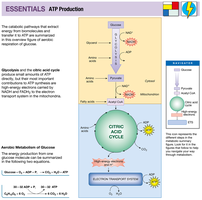
ATP is the primary energy carrier in cells, produced via catabolic pathways such as glycolysis, citric acid cycle, and electron transport system.
Aerobic Metabolism: One glucose yields 30–32 ATP.
Anaerobic Metabolism: One glucose yields 2 ATP.
Glycolysis
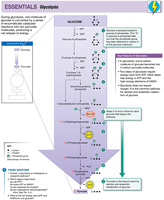
Glycolysis is the first step in glucose metabolism, converting glucose to pyruvate and generating ATP and NADH.
Genetic Code and Protein Synthesis
Proteins and the Genetic Code
Proteins are essential for cell function, composed of 20 amino acids. The sequence and number of amino acids determine protein structure and function.
Codon: Three-base sequence in mRNA encoding one amino acid.
Gene: DNA region coding for RNA.
Transcription: DNA → RNA.
Translation: mRNA → Protein.
Post-translational Modification: Proteins are modified after synthesis for proper function.
Alternative Splicing
Alternative splicing allows a single gene to produce multiple protein variants by rearranging exons and introns.
Exons: Coding regions.
Introns: Noncoding regions.
Clinical Application: Tay-Sachs Disease
Overview of Tay-Sachs Disease
Tay-Sachs disease is a fatal, inherited disorder caused by the absence of the enzyme hexosaminidase A, leading to accumulation of gangliosides in nerve cells.
Symptoms: Loss of muscle control, brain function, and vision.
Inheritance: Recessive; both parents must carry the defective gene for a child to be affected.
Diagnosis: Blood or saliva tests for enzyme activity or genetic mutations.
Genotype | Hexosaminidase A Level | Disease Status |
|---|---|---|
TT | Normal | Unaffected |
Tt | Reduced | Carrier |
tt | Absent | Affected |
Example: If one parent is a carrier (Tt) and the other is not (TT), each child has a 50% chance of being a carrier and 0% chance of being affected.
Additional info: Factors other than defective genes, such as environmental influences or acquired conditions, can alter enzyme levels.
