 Back
BackChemistry and Physiology: Foundations for Anatomy & Physiology
Study Guide - Smart Notes
 Tailored notes based on your materials, expanded with key definitions, examples, and context.
Chemistry and Physiology
Introduction to Chemistry in Physiology
Chemistry forms the foundation for understanding physiological processes in the human body. Atoms, molecules, and chemical bonds are essential for the structure and function of cells, tissues, and organs.
Atoms: Basic Structural Units of Matter
Atomic Structure
Atoms are the smallest units of matter that retain the properties of an element.
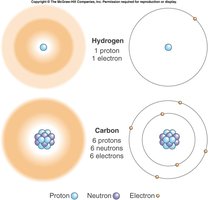
Protons: Positively charged particles located in the nucleus; determine the atomic number and identity of the element.
Neutrons: Neutral particles also found in the nucleus; contribute to atomic mass but not charge.
Electrons: Negatively charged particles that orbit the nucleus in energy levels (shells).
Protons and neutrons contribute to the atomic mass.
Atomic Number and Mass
The atomic number equals the number of protons in an atom and is unique for each element.
The number of neutrons can vary, resulting in different isotopes of an element.
In a neutral atom, the number of electrons equals the number of protons.
Example: Carbon has an atomic number of 6, so it has 6 protons and, in its most common form, 6 neutrons and 6 electrons.
Electron Arrangement and Energy Levels
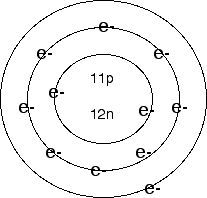
Electrons occupy specific energy levels or shells around the nucleus.
The arrangement of electrons determines an atom's chemical properties and reactivity.
Valence electrons are those in the outermost shell and are involved in chemical bonding.
Ions and the Periodic Table
Formation of Ions
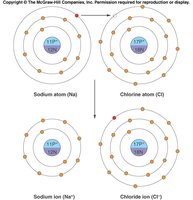
Ions are charged particles formed when atoms gain or lose electrons.
Atoms that lose electrons become cations (positively charged).
Atoms that gain electrons become anions (negatively charged).
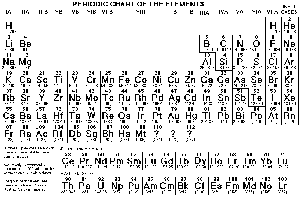
The periodic table can be used to predict the charges of ions formed by different elements.
Periodic Table and Ion Prediction
Groups (columns) on the periodic table indicate the number of valence electrons and typical ionic charges.
For example, Group 1 elements form +1 ions, Group 2 form +2 ions, Group 17 form -1 ions, etc.
Chemical Bonds
Ionic Bonds
Ionic bonds are formed when electrons are transferred from one atom to another, resulting in the formation of oppositely charged ions that attract each other.
Ionic bonds are generally weaker than covalent bonds in aqueous solutions because water can disrupt them by forming hydration spheres around ions.
Example: Sodium chloride (NaCl) dissociates in water into Na+ and Cl- ions.
Covalent Bonds
Covalent bonds occur when atoms share valence electrons. These bonds can be nonpolar or polar depending on the equality of electron sharing.
Nonpolar covalent bonds: Electrons are shared equally (e.g., H2, O2).
Polar covalent bonds: Electrons are shared unequally, creating partial positive and negative poles (e.g., H2O).
Oxygen, nitrogen, and phosphorus often form polar covalent bonds due to their high electronegativity.
Hydrogen Bonds
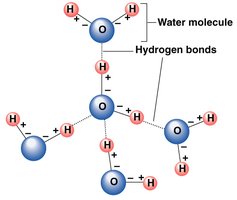
Hydrogen bonds are weak attractions between the slightly positive hydrogen atom of one polar molecule and the slightly negative atom of another polar molecule. They are crucial for the properties of water and the structure of biological molecules.
Hydrogen bonds are responsible for water's surface tension and its role as a universal solvent.
They also stabilize the structures of proteins and nucleic acids.
Hydrophilic vs. Hydrophobic Molecules
Hydrophilic molecules are water-soluble because they can form hydration spheres (e.g., glucose, amino acids).
Hydrophobic molecules are nonpolar and do not dissolve in water (e.g., lipids).
Acids, Bases, and pH
pH Scale
The pH of a solution measures its hydrogen ion (H+) concentration.
The pH scale ranges from 0 (most acidic) to 14 (most basic), with 7 being neutral.
Acids have a pH less than 7; bases have a pH greater than 7.
Acids and Bases
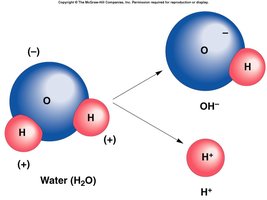
Acids are proton donors; they release H+ ions in solution.
Bases are proton acceptors; they decrease H+ concentration in solution.
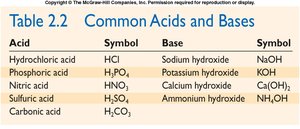
Acid | Symbol | Base | Symbol |
|---|---|---|---|
Hydrochloric acid | HCl | Sodium hydroxide | NaOH |
Phosphoric acid | H3PO4 | Potassium hydroxide | KOH |
Nitric acid | HNO3 | Calcium hydroxide | Ca(OH)2 |
Sulfuric acid | H2SO4 | Ammonium hydroxide | NH4OH |
Carbonic acid | H2CO3 |
Buffers and Blood pH
Buffers are molecules that minimize changes in pH by binding or releasing H+ ions.
The bicarbonate buffer system is crucial for maintaining blood pH:
This reaction can shift to add or remove H+ as needed.
Normal blood pH is 7.35–7.45; deviations can result in acidosis (pH < 7.35) or alkalosis (pH > 7.45).
Summary Table: Key Chemical Concepts in Physiology
Concept | Definition | Example |
|---|---|---|
Atom | Smallest unit of an element | Carbon atom |
Ion | Charged atom or molecule | Na+, Cl- |
Ionic bond | Attraction between oppositely charged ions | NaCl |
Covalent bond | Atoms share electrons | H2O |
Hydrogen bond | Weak attraction between polar molecules | Between water molecules |
Acid | Proton donor | HCl |
Base | Proton acceptor | NaOH |
Buffer | Minimizes pH changes | Bicarbonate system |
