 Back
BackChemistry Foundations for Anatomy & Physiology: Atoms, Bonds, and Chemical Reactions
Study Guide - Smart Notes
 Tailored notes based on your materials, expanded with key definitions, examples, and context.
Chemistry, Energy, and Matter
Introduction to Chemistry
Chemistry is the science that studies the composition, structure, and properties of substances and the transformations they undergo. Understanding chemistry is essential in anatomy and physiology because all physiological processes are based on chemical interactions.
Chemistry: Study of matter and the changes it undergoes.
Energy: The capacity to do work or put matter into motion.
Matter: Anything that has mass and occupies space.
States of Matter:
Solid: Definite shape and volume.
Liquid: Definite volume, changeable shape.
Gas: Changeable shape and volume.
Forms of Energy:
Chemical energy: Stored in bonds of chemical substances.
Electrical energy: Movement of charged particles.
Mechanical energy: Directly involved in moving matter.
Radiant (electromagnetic) energy: Travels in waves (e.g., light, heat).
Energy can be transformed from one form to another, but some energy is always lost as heat during conversion.
Atoms and Elements
Basic Structure of Atoms
All matter is composed of elements, which are substances that cannot be broken down into simpler substances by ordinary chemical methods. Atoms are the smallest units of elements that retain their properties.
Atom: Smallest particle of an element with its properties.
Element: Substance made of only one kind of atom.
Four elements make up 96% of the human body: Oxygen, Carbon, Hydrogen, Nitrogen.
Subatomic Particles
Atoms are composed of three main subatomic particles: protons, neutrons, and electrons.
PARTICLE | CHARGE | MASS (amu = atomic mass unit) | LOCATED IN NUCLEUS? |
|---|---|---|---|
Proton (p+) | +1 | 1 amu | Yes |
Neutron (n0) | 0 | 1 amu | Yes |
Electron (e-) | -1 | ~0 (0.0005) amu | No |
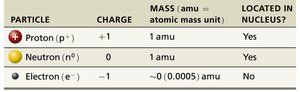
Protons and neutrons are found in the nucleus, while electrons orbit the nucleus in electron shells.
Atomic Number, Mass Number, and Isotopes
Atomic number: Number of protons in the nucleus (also equals number of electrons in a neutral atom).
Mass number: Total number of protons and neutrons in the nucleus.
Isotopes: Atoms of the same element with different numbers of neutrons (same atomic number, different mass number).
Atomic weight: Average of mass numbers of all isotope forms of an atom.
Radioisotopes are unstable isotopes that decay, releasing energy (radioactivity). They are used in medical diagnosis and treatment but can also be harmful to living tissue.
Molecules, Compounds, and Mixtures
Molecules and Compounds
Molecule: Two or more atoms bonded together (e.g., H2, O2).
Compound: Molecule with two or more different kinds of atoms (e.g., C6H12O6).
Mixtures
Solution: Homogeneous mixture; solute particles are evenly distributed (e.g., salt water).
Colloid (emulsion): Heterogeneous mixture; larger particles do not settle out (e.g., cytosol, Jell-O).
Suspension: Heterogeneous mixture; large particles settle out (e.g., blood cells in plasma).
Mixtures can be separated by physical means, while compounds require chemical methods to separate their components.
Chemical Bonds
Role of Electrons in Bonding
Electrons occupy energy levels called shells around the nucleus. The outermost shell is the valence shell, and its electrons determine chemical reactivity. Atoms tend to fill their valence shell (octet rule: 8 electrons for stability, except H and He).
Free radicals: Atoms with unpaired electrons in the valence shell; highly reactive.
Types of Chemical Bonds
Ionic bonds: Transfer of electrons from one atom to another, forming charged ions (cations and anions).
Covalent bonds: Sharing of electrons between atoms. Can be single, double, or triple bonds.
Hydrogen bonds: Weak attraction between a hydrogen atom and an electronegative atom (e.g., between water molecules).
Formation of Covalent Bonds
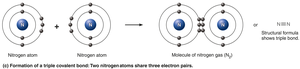
Covalent bonds involve the sharing of valence electrons. A triple covalent bond, as seen in nitrogen gas (N2), involves sharing three pairs of electrons.
Polar vs. Nonpolar Covalent Bonds
Nonpolar covalent bonds: Equal sharing of electrons (e.g., O2, CO2).
Polar covalent bonds: Unequal sharing of electrons, resulting in partial charges (e.g., H2O).
Chemical Reactions
Types of Chemical Reactions
Synthesis (Combination): Atoms/molecules combine to form a larger molecule.
Decomposition: Molecule breaks down into smaller parts.
Exchange (Displacement): Bonds are both made and broken.
Redox (Oxidation-Reduction): Electrons are transferred between reactants.
Dehydration synthesis removes water to build molecules; hydrolysis adds water to break molecules apart.
Energy in Chemical Reactions
Exergonic reactions: Release energy (products have less energy than reactants).
Endergonic reactions: Absorb energy (products have more energy than reactants).
Reversibility and Rate of Reactions
Many reactions are reversible; equilibrium is reached when forward and reverse rates are equal.
Factors affecting reaction rate: temperature, concentration, particle size, and catalysts (e.g., enzymes).
Key Terms and Definitions
Ion: Atom with a net charge due to loss/gain of electrons.
Electrolyte: Substance that conducts electricity when dissolved in water.
Free radical: Atom with unpaired electron(s); highly reactive.
Isotope: Atoms of the same element with different numbers of neutrons.
Radioisotope: Unstable isotope that emits radiation.
Cation: Positively charged ion.
Anion: Negatively charged ion.
Additional info: This summary covers foundational chemistry concepts essential for understanding anatomy and physiology, including atomic structure, chemical bonding, and the nature of chemical reactions in biological systems.
