 Back
BackChemistry of Life: Foundations for Anatomy & Physiology
Study Guide - Smart Notes
 Tailored notes based on your materials, expanded with key definitions, examples, and context.
Chemistry of Life
Introduction to Biochemistry
The study of chemistry is fundamental to understanding anatomy and physiology because all biological processes are based on chemical interactions. Biochemistry is the field that explores the chemical aspects of living organisms, focusing on the molecules and reactions that sustain life.
Levels of Chemical Organization
Atoms and Subatomic Particles
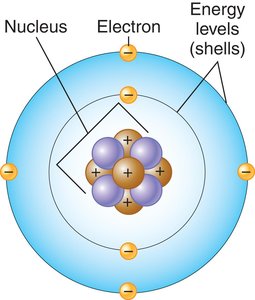
Atoms are the smallest units of matter and are composed of subatomic particles:
Protons: Positively charged particles located in the nucleus.
Neutrons: Uncharged particles also found in the nucleus.
Electrons: Negatively charged particles that orbit the nucleus in energy levels (shells).
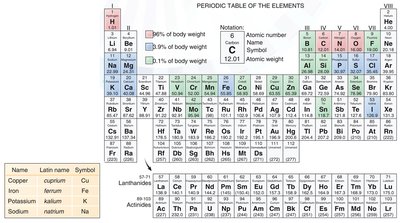
Atomic number: Number of protons in the nucleus.
Atomic mass: Combined number of protons and neutrons.
Energy Levels (Shells)
Electrons occupy energy levels around the nucleus. Each shell can hold a specific number of electrons, with the outermost shell (valence shell) being most important for chemical bonding. The farther the shell is from the nucleus, the higher its energy.
Elements, Molecules, and Compounds
Definitions
Element: A pure substance made of only one kind of atom (e.g., oxygen, carbon).
Molecule: Two or more atoms bonded together (e.g., O2).
Compound: Molecules composed of different kinds of atoms (e.g., H2O).
Chemical Bonding
Overview of Chemical Bonds
Chemical bonds form to make atoms more stable by filling their outermost energy levels. Atoms may share, donate, or borrow electrons to achieve stability.
Ionic Bonds
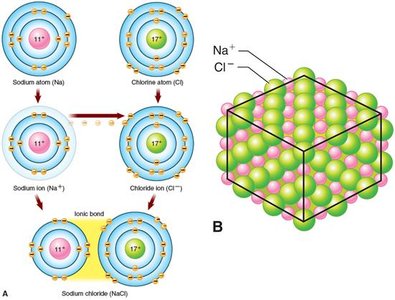
Ionic bonds are formed when atoms transfer electrons, resulting in the creation of ions:
Positive ion (cation): Atom that has lost electrons (e.g., Na+).
Negative ion (anion): Atom that has gained electrons (e.g., Cl−).
Electrolyte: An ionic compound that dissociates in water to form ions.
Covalent Bonds
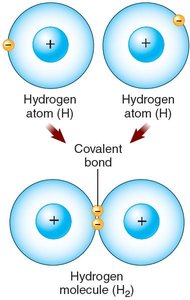
Covalent bonds are formed when atoms share electrons to fill their outer shells. These bonds are strong and do not easily dissociate in water. Covalent bonding is essential for the structure of organic molecules in the body.
Hydrogen Bonds
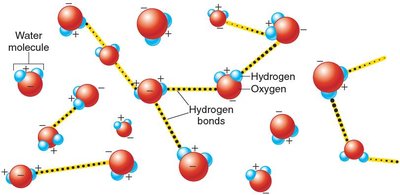
Hydrogen bonds are weak attractions between the positive hydrogen atom of one molecule and a negative atom (often oxygen or nitrogen) of another molecule. They do not form new molecules but are crucial for the structure of water, DNA, and proteins.
Inorganic and Organic Compounds
Classification
Inorganic compounds: Generally do not contain carbon-carbon (C–C) or carbon-hydrogen (C–H) bonds (e.g., water, salts).
Organic compounds: Contain C–C or C–H bonds and are typically larger and more complex (e.g., carbohydrates, proteins).
Water
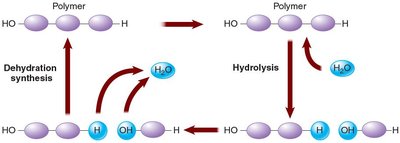
Water is an essential inorganic compound that acts as a solvent, participates in chemical reactions, and helps regulate temperature. It is involved in:
Dehydration synthesis: Removal of water to build larger molecules.
Hydrolysis: Addition of water to break down molecules.
Chemical Equations
Chemical equations represent how reactants interact to form products. A single arrow indicates an irreversible reaction, while double arrows indicate a reversible reaction.
Acids, Bases, and Salts
Definitions and pH
Acid: Substance that increases H+ concentration in solution.
Base (alkaline): Substance that decreases H+ concentration or increases OH−.
Salt: Compound formed from the neutralization of an acid and a base.
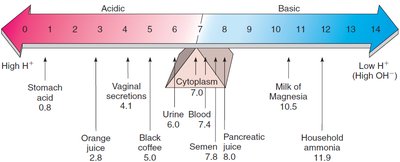
pH: Mathematical expression of H+ concentration; 7 is neutral, <7 is acidic, >7 is basic.
Buffers: Chemical systems that maintain stable pH by absorbing excess acids or bases.
Organic Compounds
Carbohydrates
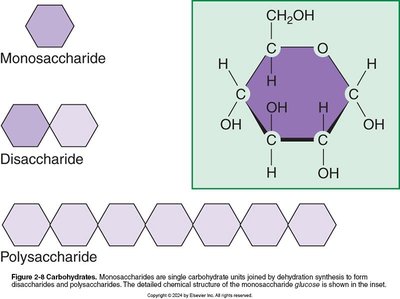
Carbohydrates are organic molecules composed of carbon, hydrogen, and oxygen. They serve as a primary energy source for the body.
Monosaccharides: Simple sugars (e.g., glucose).
Disaccharides: Double sugars (e.g., sucrose, lactose).
Polysaccharides: Complex carbohydrates (e.g., glycogen, starch).
Lipids
Lipids are hydrophobic organic molecules that store energy, form cell membranes, and serve as signaling molecules.
Triglycerides: Composed of glycerol and three fatty acids; main energy storage form.
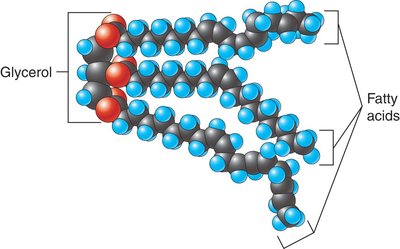
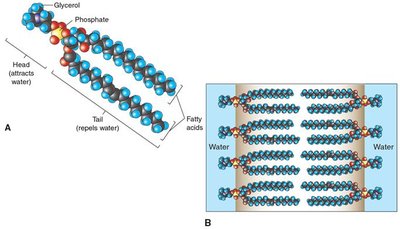
Phospholipids: Similar to triglycerides but contain a phosphate group; form cell membranes due to their hydrophilic heads and hydrophobic tails.
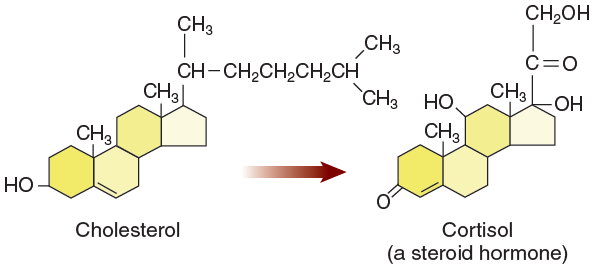
Cholesterol: Steroid molecule that stabilizes cell membranes and is a precursor for steroid hormones.
Proteins
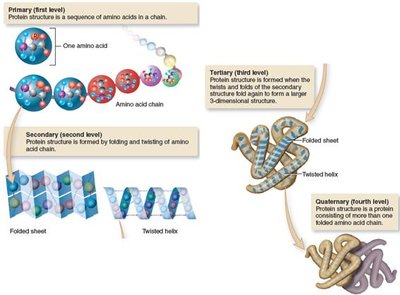
Proteins are large, complex molecules made of amino acids linked by peptide bonds. They serve structural and functional roles in the body.
Structural proteins: Provide support (e.g., collagen, keratin).
Functional proteins: Include enzymes, hormones, and receptors.
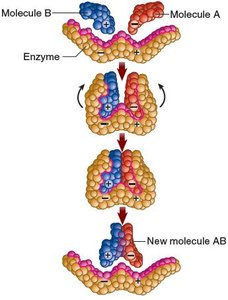
Enzymes: Biological catalysts that speed up chemical reactions, often described by the lock-and-key model.
Nucleic Acids
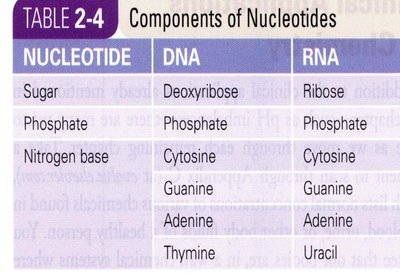
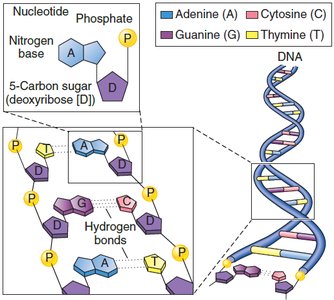
Nucleic acids store and transmit genetic information. They are polymers of nucleotides, each consisting of a phosphate group, a sugar (ribose or deoxyribose), and a nitrogenous base.
DNA (Deoxyribonucleic acid): Double helix structure; contains deoxyribose and bases A, T, C, G; serves as the genetic blueprint.
RNA (Ribonucleic acid): Single-stranded; contains ribose and bases A, U, C, G; acts as a messenger and functional molecule in protein synthesis.
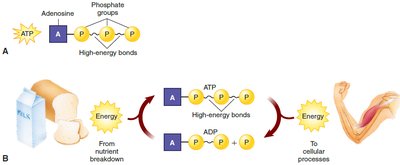
Adenosine Triphosphate (ATP)
ATP is the primary energy carrier in cells. It stores energy in high-energy phosphate bonds and releases it to power cellular processes.
Review Questions
Which of the following are subatomic particles?
Protons, Neutrons, Electrons (All of these are subatomic particles)
Which chemical bond involves the sharing of electrons to satisfy the outermost energy level?
Covalent
Our blood pH typically falls within the range of 7.35 to 7.45. Which of the following describes the pH of the blood?
Slightly alkaline
Which of the following is an inorganic molecule?
Water
_______ is a sterol lipid that performs several important functions in the body.
Cholesterol
Which type of organic molecule is responsible for the structure of enzymes?
Protein
Maintaining a relative constancy of the internal environment is defined as:
Homeostasis
The events that cause rapid increases in uterine contractions before the birth of a baby are controlled by what feedback loop?
Positive feedback
Tables
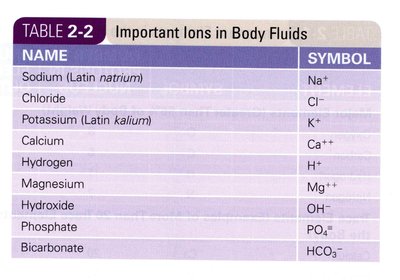
Important Ions in Body Fluids
NAME | SYMBOL |
|---|---|
Sodium (Latin natrium) | Na+ |
Chloride | Cl− |
Potassium (Latin kalium) | K+ |
Calcium | Ca++ |
Hydrogen | H+ |
Magnesium | Mg++ |
Hydroxide | OH− |
Phosphate | PO4−− |
Bicarbonate | HCO3− |
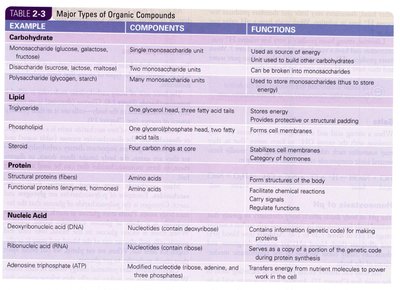
Major Types of Organic Compounds
EXAMPLE | COMPONENTS | FUNCTIONS |
|---|---|---|
Carbohydrate | Single/Many monosaccharide units | Source of energy, storage |
Lipid | Glycerol, fatty acids, phosphate, rings | Energy storage, membrane structure, hormones |
Protein | Amino acids | Structure, catalysis, regulation |
Nucleic Acid | Nucleotides | Genetic information, energy transfer (ATP) |
Components of Nucleotides
NUCLEOTIDE | DNA | RNA |
|---|---|---|
Sugar | Deoxyribose | Ribose |
Phosphate | Phosphate | Phosphate |
Nitrogen base | Cytosine, Guanine, Adenine, Thymine | Cytosine, Guanine, Adenine, Uracil |
