Back
Crash Course in Immunology: Adaptive Immunity and Antibody Response
Study Guide - Smart Notes
 Tailored notes based on your materials, expanded with key definitions, examples, and context.
Adaptive Immunity
Overview of Adaptive Immunity
Adaptive immunity is the specific defense mechanism of the body that targets particular pathogens. It is divided into two main arms: humoral immunity and cellular immunity. These systems work together to eliminate both extracellular and intracellular threats.
Humoral Immunity: Mediated by antibodies produced by B cells; targets extracellular pathogens.
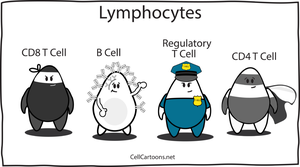
Cellular Immunity: Mediated by T cells (CD4 and CD8); targets intracellular pathogens, foreign tissues, and tumor cells.
Antigens and Antibodies
Definition of Antigen
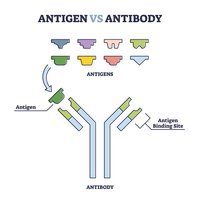
An antigen is any substance that can provoke an immune response by stimulating the production of antibodies. Antigens are typically proteins or polysaccharides found on the surface of pathogens, such as bacteria and viruses.
Antibody Structure and Function
Antibodies (also called immunoglobulins, Ig's) are Y-shaped proteins produced by B cells. Each antibody has two identical antigen-binding sites, allowing it to specifically recognize and bind to antigens.
Composed of two heavy chains and two light chains.
Variable regions form the antigen-binding sites.
Constant region determines the antibody class and function.
Classes of Antibodies
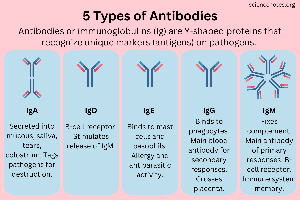
There are five main classes of antibodies, each with distinct structures and functions:
Class | Structure | Main Function |
|---|---|---|
IgG | Monomer | Main antibody in secondary response; crosses placenta; opsonization, neutralization, complement activation |
IgM | Pentamer | First antibody produced in primary response; effective in agglutination and complement activation |
IgA | Dimer | Secreted in mucosal areas (saliva, tears, breast milk); protects mucosal surfaces |
IgE | Monomer | Involved in allergic reactions and defense against parasites |
IgD | Monomer | Functions mainly as a B cell receptor |
Antigen–Antibody Interactions
Major Outcomes of Antigen–Antibody Binding
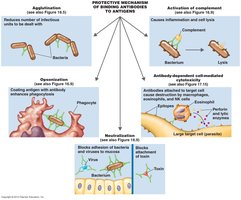
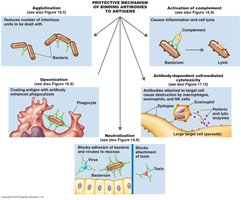
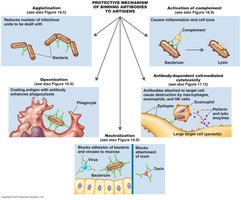
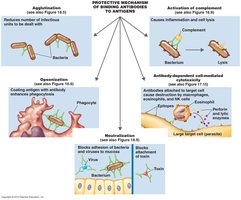
When antibodies bind to antigens, several protective mechanisms are triggered:
Agglutination: Clumping of pathogens, making them easier to eliminate.
Opsonization: Coating of pathogens to enhance phagocytosis by immune cells.
Activation of Complement: Initiates a cascade that leads to pathogen lysis.
Neutralization: Blocks pathogen attachment to host cells and neutralizes toxins.
Primary and Secondary Immune Responses
Antibody Production Over Time
The immune system responds differently to first and subsequent exposures to the same antigen:
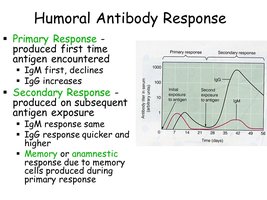
Primary Response: Occurs upon first exposure to an antigen. IgM is produced first, followed by IgG. The response is slower and less robust.
Secondary Response: Occurs upon re-exposure to the same antigen. IgG is produced more rapidly and in greater amounts due to memory cells generated during the primary response.
Cellular Immunity
T Cells and Their Functions
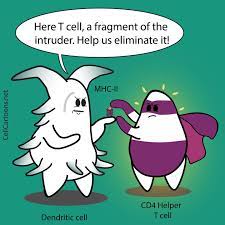
T cells are lymphocytes that recognize antigens presented by antigen-presenting cells (APCs) such as dendritic cells and macrophages. There are two main types of T cells:
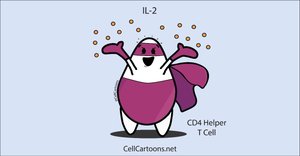
Helper T cells (CD4 T cells): Secrete cytokines to activate other immune cells. Subtypes include:
TH1: Activate macrophages and cytotoxic T cells.
TH2: Stimulate B cells to proliferate and secrete antibodies.
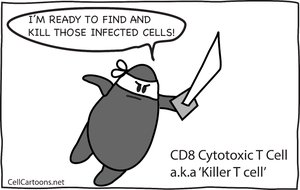
Cytotoxic T cells (CD8 T cells): Destroy infected or abnormal cells by inducing lysis or apoptosis.

Types of Acquired Immunity
Active vs. Passive Immunity
Acquired immunity can be classified based on how immunity is obtained:
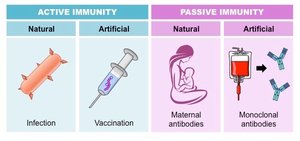
Type | Natural | Artificial |
|---|---|---|
Active Immunity | Infection | Vaccination |
Passive Immunity | Maternal antibodies | Monoclonal antibodies |
Active Immunity: The body produces its own antibodies and memory cells. Provides long-term protection.
Passive Immunity: Antibodies are acquired from another source; no memory cells are produced. Provides short-term protection.