Back
BackCytology & Mitosis: Study Guide for ANP College Students
Study Guide - Smart Notes
 Tailored notes based on your materials, expanded with key definitions, examples, and context.
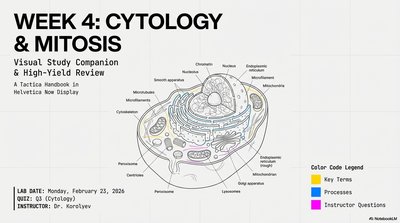
Week 4: Cytology & Mitosis
Introduction
This study guide covers the essential concepts of cytology (the study of cells) and mitosis (cell division), focusing on cell organelles, cell types, and the phases of mitosis. These topics are foundational for understanding the cellular level of organization in anatomy and physiology.
Mission Dashboard: Deliverables & High-Yield Topics
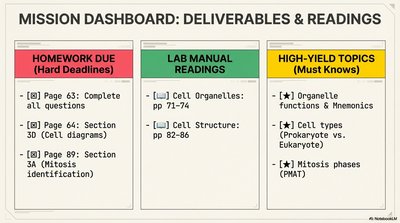
Overview
Homework: Complete all questions and cell diagrams, and identify mitosis phases.
Lab Manual Readings: Focus on cell organelles and cell structure.
High-Yield Topics: Organelle functions, cell types (prokaryote vs. eukaryote), and mitosis phases (PMAT).
The Control Center & Builders
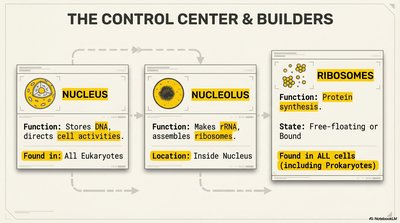
Nucleus, Nucleolus, and Ribosomes
The nucleus, nucleolus, and ribosomes are critical for genetic information storage, processing, and protein synthesis.
Nucleus: Stores DNA and directs cell activities. Found in all eukaryotes.
Nucleolus: Located inside the nucleus; makes rRNA and assembles ribosomes.
Ribosomes: Sites of protein synthesis; found free-floating or bound to rough ER in all cells (including prokaryotes).
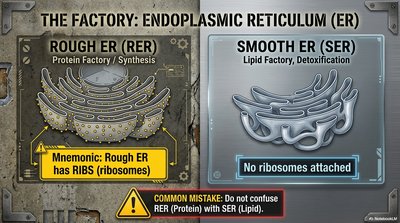
The Factory: Endoplasmic Reticulum (ER)
Rough ER (RER) vs. Smooth ER (SER)
The endoplasmic reticulum is divided into two types, each with distinct functions:
Rough ER (RER): Studded with ribosomes; synthesizes proteins.
Smooth ER (SER): Lacks ribosomes; synthesizes lipids and detoxifies substances.
Mnemonic: Rough ER has "ribs" (ribosomes); Smooth ER does not.
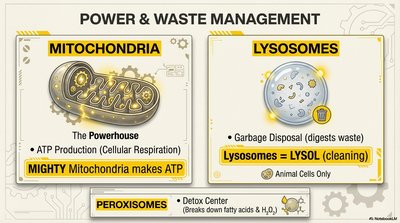
Power & Waste Management
Mitochondria, Lysosomes, and Peroxisomes
These organelles manage energy production and waste disposal in the cell.
Mitochondria: The "powerhouse" of the cell; produces ATP via cellular respiration.
Lysosomes: Digest waste; found only in animal cells. Mnemonic: Lysosomes = Lysol (cleaning).
Peroxisomes: Detox centers; break down fatty acids and hydrogen peroxide.
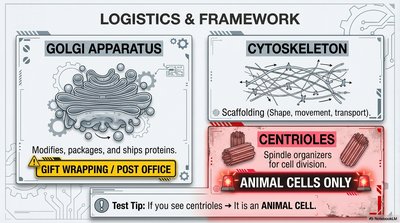
Logistics & Framework
Golgi Apparatus, Cytoskeleton, and Centrioles
These structures are responsible for protein packaging, cell shape, and division.
Golgi Apparatus: Modifies, packages, and ships proteins ("gift wrapping/post office").
Cytoskeleton: Provides scaffolding for shape, movement, and transport.
Centrioles: Organize spindle fibers for cell division; found only in animal cells.
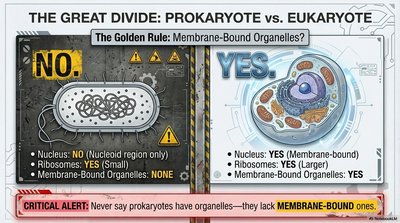
The Great Divide: Prokaryote vs. Eukaryote
Key Differences
Cells are classified as prokaryotic or eukaryotic based on the presence of membrane-bound organelles.
Prokaryotes: No nucleus (nucleoid region only), small ribosomes, no membrane-bound organelles.
Eukaryotes: Membrane-bound nucleus, larger ribosomes, and many membrane-bound organelles.
Critical Alert: Never say prokaryotes have organelles—they lack membrane-bound ones.
Identification Guide: Plant vs. Animal Cells
Major Features
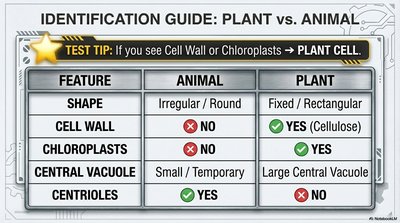
Plant and animal cells can be distinguished by several structural features:
Feature | Animal | Plant |
|---|---|---|
Shape | Irregular / Round | Fixed / Rectangular |
Cell Wall | ❌ NO | ✔ YES (Cellulose) |
Chloroplasts | ❌ NO | ✔ YES |
Central Vacuole | Small / Temporary | Large Central Vacuole |
Centrioles | ✔ YES | ❌ NO |
The Cell Cycle Clock
Phases of the Cell Cycle
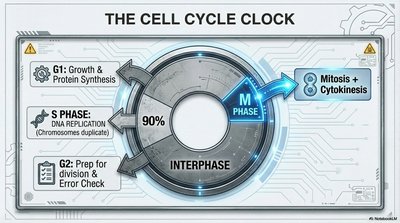
The cell cycle consists of interphase (G1, S, G2) and the M phase (mitosis and cytokinesis).
G1: Growth and protein synthesis.
S Phase: DNA replication (chromosomes duplicate).
G2: Preparation for division and error checking.
M Phase: Mitosis (nuclear division) and cytokinesis (cytoplasmic division).
M-Phase: Mitosis (PMAT)
Overview of Mitosis
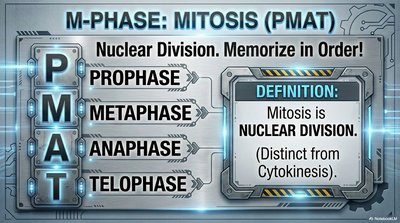
Mitosis is the process of nuclear division, distinct from cytokinesis. The phases of mitosis are:
Prophase
Metaphase
Anaphase
Telophase
PMAT: The Setup & The Lineup
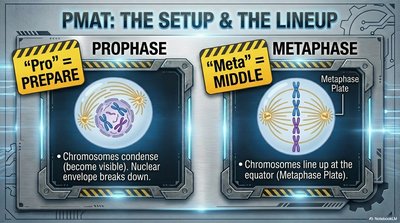
Prophase: Chromosomes condense and become visible; nuclear envelope breaks down.
Metaphase: Chromosomes line up at the cell's equator (metaphase plate).
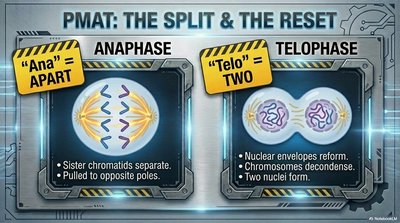
PMAT: The Split & The Reset
Anaphase: Sister chromatids separate and are pulled to opposite poles.
Telophase: Nuclear envelopes reform; chromosomes decondense; two nuclei form.
Cytokinesis: The Physical Split
Animal vs. Plant Cells
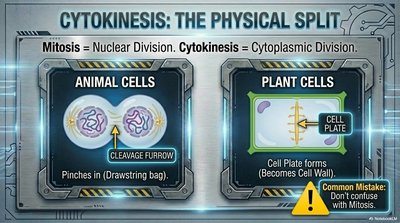
Cytokinesis is the division of the cytoplasm, distinct from mitosis (nuclear division).
Animal Cells: Cleavage furrow pinches the cell in two (like a drawstring bag).
Plant Cells: Cell plate forms, which becomes the new cell wall.
Danger Zone: Common Quiz Mistakes
Frequent Errors & Fixes
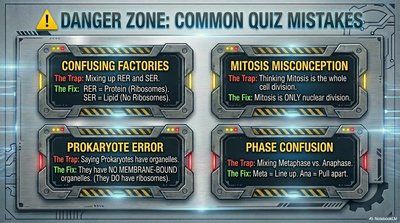
Confusing Factories: Mixing up RER (protein) and SER (lipid).
Mitosis Misconception: Mitosis is only nuclear division, not the whole cell division.
Prokaryote Error: Prokaryotes do not have membrane-bound organelles.
Phase Confusion: Metaphase = line up; Anaphase = pull apart.
High-Yield Review: Organelles
Key Organelle Functions
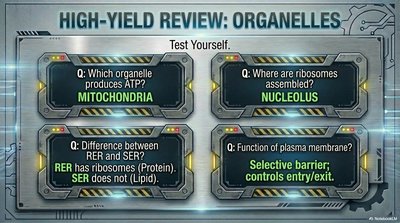
ATP Production: Mitochondria
Ribosome Assembly: Nucleolus
RER vs. SER: RER has ribosomes (protein synthesis); SER does not (lipid synthesis).
Plasma Membrane: Selective barrier; controls entry and exit of substances.
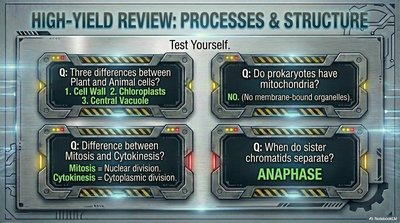
High-Yield Review: Processes & Structure
Key Processes & Differences
Plant vs. Animal Cells: Cell wall, chloroplasts, central vacuole (plant only).
Prokaryotes: No mitochondria or membrane-bound organelles.
Mitosis vs. Cytokinesis: Mitosis = nuclear division; Cytokinesis = cytoplasmic division.
Sister Chromatid Separation: Occurs during anaphase.
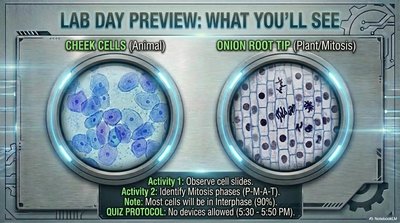
Lab Day Preview: What You'll See
Microscopy Observations
Cheek Cells (Animal): Observe cell slides and identify mitosis phases.
Onion Root Tip (Plant/Mitosis): Most cells will be in interphase (90%).