 Back
BackEndocrine, Respiratory, Digestive, and Metabolic Systems: Study Guide
Study Guide - Smart Notes
 Tailored notes based on your materials, expanded with key definitions, examples, and context.
Endocrine System
Exocrine vs Endocrine Glands
The body uses two main types of glands to secrete substances: exocrine glands and endocrine glands. Exocrine glands release their products through ducts to the body's surface or into body cavities, while endocrine glands secrete hormones directly into the bloodstream.
Exocrine glands: Sweat, salivary, and digestive glands.
Endocrine glands: Pituitary, thyroid, adrenal, pancreas (islets), etc.
Hormones: Types and Mechanisms
Hormones are chemical messengers that regulate physiological processes. They can be classified based on their solubility:
Water-soluble hormones (proteins, peptides, amines): Bind to receptors on the cell membrane; use second messengers like cyclic AMP (cAMP).
Lipid-soluble hormones (steroids, thyroid hormones): Pass through cell membranes and bind to intracellular receptors, directly affecting gene expression.
Target cells must have specific receptors for a hormone to exert its effect.
Mechanisms of Hormone Action
G proteins and cyclic AMP (cAMP): Many water-soluble hormones activate G proteins, which then stimulate or inhibit the production of cAMP, a second messenger that mediates cellular responses.
Regulating gene expression: Lipid-soluble hormones typically alter gene transcription and protein synthesis.
Hormone Secretion and Regulation
Tropic hormones: Hormones that regulate the secretion of other hormones (e.g., TSH, ACTH).
Negative feedback mechanisms: Most hormone secretion is regulated by negative feedback to maintain homeostasis.
Major Endocrine Glands and Hormones
Pituitary gland:
Anterior lobe: Controlled by hypothalamic hormones via the hypophyseal portal system.
Posterior lobe: Stores and releases hormones produced by the hypothalamus.
Thyroid gland: Contains follicles (produce thyroid hormones) and parafollicular "C" cells (produce calcitonin).
Parathyroid gland: Chief cells secrete parathyroid hormone (PTH).
Adrenal gland:
Medulla: Secretes catecholamines (fight or flight response).
Cortex: Produces corticosteroids (e.g., aldosterone, cortisol).
Pancreas: Pancreatic acini (exocrine), pancreatic islets (endocrine: insulin, glucagon).
Thymus and Pineal gland: Involved in immune and circadian regulation, respectively.
Other organs: Kidneys (erythropoietin, renin).
Respiratory System
Organs and Zones
The respiratory system consists of organs that facilitate gas exchange and air conduction:
Conducting zone: Includes nose, pharynx, larynx, trachea, bronchi, and bronchioles; functions to filter, warm, and moisten air.
Muco-ciliary escalator: Cilia and mucus trap and move particles out of the airways.
Respiratory zone: Site of gas exchange; includes respiratory bronchioles, alveolar ducts, and alveoli.
Respiratory Membrane and Pleura
Respiratory membrane: Thin barrier (alveolar epithelium, capillary endothelium, and fused basement membranes) for efficient gas exchange; composed of simple squamous epithelium.
Pleura: Serous membrane surrounding the lungs; reduces friction during breathing.
Muscles and Mechanics of Breathing
Major muscles: Diaphragm (primary), external intercostals (inspiration), internal intercostals and abdominal muscles (forced expiration).
Muscle contraction increases thoracic cavity volume, decreasing pressure and drawing air in.
Pressures and Lung Volumes
Atmospheric pressure: Pressure of air outside the body.
Intrapleural pressure: Always negative relative to atmospheric; prevents lung collapse.
Intrapulmonary (intra-alveolar) pressure: Pressure within alveoli; equalizes with atmospheric pressure during breathing.
Lung volumes and capacities: Tidal volume, inspiratory/expiratory reserve, residual volume, vital capacity, etc.
Surfactant and Gas Transport
Surfactant: Lipoprotein produced by type II alveolar cells; reduces surface tension, preventing alveolar collapse.
Oxygen transport: Mostly bound to hemoglobin; small amount dissolved in plasma.
CO2 transport: Dissolved in plasma, bound to hemoglobin, or as bicarbonate (HCO3-).
Carbonic acid–bicarbonate buffer system: Maintains blood pH; chloride shift facilitates CO2 transport.
CO2 is the most potent stimulus for breathing rate regulation.
Gas Laws and Respiratory Control
Dalton's law of partial pressures: Total pressure of a gas mixture equals the sum of partial pressures of individual gases.
Respiratory centers: Located in the pons and medulla oblongata; regulate breathing rhythm.
pH and CO2: Increased CO2 or decreased pH stimulates increased breathing rate.
The Digestive System
GI Tract Structure and Function
The gastrointestinal (GI) tract is a continuous tube from mouth to anus, with specialized regions for digestion and absorption:
Oral cavity: Mechanical and chemical digestion begins; salivary glands secrete enzymes for lipid and carbohydrate digestion.
Pharynx and esophagus: Conduct food to the stomach via peristalsis.
Stomach: Secretes acid and enzymes; contains parietal cells (HCl), chief cells (pepsinogen), and mucous cells.
Small intestine: Main site of absorption; villi and microvilli increase surface area. Brush border enzymes complete digestion.
Large intestine: Absorbs water and forms feces.
Rectum: Internal (involuntary) and external (voluntary) sphincters control defecation.
Motility and Regulation
Peristalsis: Wave-like contractions move food along the GI tract.
Segmentation: Localized contractions mix food and increase contact with absorptive surfaces.
Enterogastric reflex/enterogastrones: Hormonal and neural mechanisms that regulate gastric emptying.
Accessory Organs and Secretions
Liver: Produces bile (emulsifies fats); bile is stored in the gallbladder and released into the small intestine.
Bile recycling: Most bile salts are reabsorbed and recycled via the enterohepatic circulation.
Pancreas: Secretes digestive enzymes (zymogens like trypsinogen) and bicarbonate to neutralize stomach acid.
Gallbladder: Stores and concentrates bile.
Chemical Digestion and Absorption
Enzymes: Produced by salivary glands, stomach, pancreas, and small intestine; act in specific regions.
Macronutrient absorption: Carbohydrates and proteins absorbed into capillaries; lipids absorbed into lacteals (lymphatic vessels).
Hormonal Regulation
CCK (cholecystokinin): Stimulates pancreatic enzyme secretion and opens the hepatopancreatic sphincter.
Secretin: Stimulates bile and bicarbonate secretion from the pancreas.
Nutrition, Metabolism, and Energy Balance
Metabolic Terms and Pathways
Catabolic reactions: Break down molecules to release energy (e.g., glycolysis).
Anabolic reactions: Build complex molecules from simpler ones (e.g., protein synthesis).
Metabolism: Sum of all chemical reactions in the body.
BMR (Basal Metabolic Rate): Energy expended at rest to maintain vital functions.
Essential nutrients: Nutrients that must be obtained from the diet.
Cellular Respiration Overview
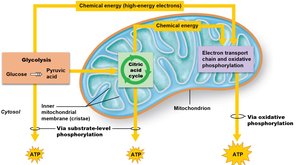
The primary goal of cellular respiration is to generate ATP from glucose. It involves several stages:
Glycolysis: Occurs in the cytosol; splits glucose into two pyruvate molecules. Produces ATP via substrate-level phosphorylation.
Citric acid cycle (Krebs cycle): Occurs in the mitochondrial matrix; completes the breakdown of glucose derivatives. Also produces ATP via substrate-level phosphorylation.
Electron transport chain (ETC): Located in the inner mitochondrial membrane; produces most ATP via oxidative phosphorylation. Oxygen is the final electron acceptor.
Key intermediates include pyruvate (converted to acetyl CoA), NADH, and FADH2. ATP synthase uses the proton gradient to generate ATP.

Key Concepts and Reactions
Phosphorylation: Addition of a phosphate group to a molecule, often to activate or deactivate enzymes.
Redox reactions: Involve the transfer of electrons; OILRIG (Oxidation Is Loss, Reduction Is Gain of electrons).
Pyruvate to Acetyl CoA: Pyruvate is converted to acetyl CoA before entering the citric acid cycle.
ATP synthase: Enzyme that synthesizes ATP using the proton motive force generated by the electron transport chain.
Summary Equation for Cellular Respiration
The overall equation for aerobic cellular respiration is:
Glucose is oxidized to carbon dioxide, and oxygen is reduced to water, releasing energy as ATP.
