 Back
BackEndocrine System Structure and Function Study Guide
Study Guide - Smart Notes
 Tailored notes based on your materials, expanded with key definitions, examples, and context.
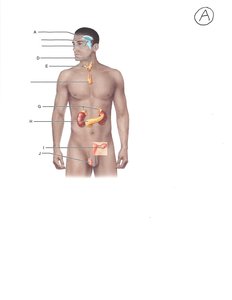
Q1. Identify the major endocrine glands labeled on the human body diagram.
Background
Topic: Endocrine System Anatomy
This question tests your knowledge of the locations and names of the major endocrine glands in the human body, which are essential for hormone production and regulation.
Key Terms:
Endocrine gland: A gland that secretes hormones directly into the bloodstream.
Hormone: A chemical messenger produced by glands that regulate various body functions.
Step-by-Step Guidance
Observe the diagram and note the labeled lines pointing to different organs or glands.
Recall the anatomical locations of the major endocrine glands (e.g., pituitary, thyroid, adrenal, pancreas, gonads).
Match each label to the correct gland based on its position in the body (e.g., the gland in the neck is likely the thyroid).
Review your textbook or class notes for diagrams of the endocrine system to confirm your choices.
Try solving on your own before revealing the answer!
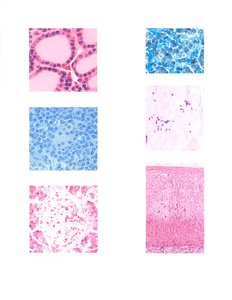
Q2. Match the endocrine gland to its histological (microscopic) appearance.
Background
Topic: Endocrine Histology
This question assesses your ability to recognize the microscopic structure of different endocrine glands, which is important for understanding their function and pathology.
Key Terms:
Histology: The study of the microscopic structure of tissues.
Follicle: A small secretory cavity, sac, or glandular structure, often seen in the thyroid gland.
Step-by-Step Guidance
Examine each histological image and look for distinguishing features (e.g., follicles, clusters of cells, staining patterns).
Recall the typical microscopic appearance of glands such as the thyroid (follicles), pancreas (islets), adrenal (cortex and medulla), and pituitary (anterior and posterior regions).
Match each image to the gland based on these features.
Use your lab manual or histology atlas for reference images if needed.
Try solving on your own before revealing the answer!
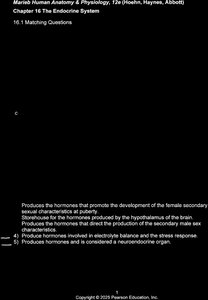
Q3. Match the endocrine gland to its primary hormone or function.
Background
Topic: Endocrine Gland Functions
This question tests your understanding of which hormones are produced by each gland and their main physiological effects.
Key Terms and Examples:
Pituitary gland: Produces growth hormone, prolactin, and others.
Thyroid gland: Produces thyroid hormones (T3, T4) that regulate metabolism.
Adrenal gland: Produces cortisol, aldosterone, and adrenaline.
Gonads (testes/ovaries): Produce sex hormones (testosterone, estrogen, progesterone).
Step-by-Step Guidance
Read each description of hormone function or effect carefully.
Recall which gland is responsible for each hormone or function (e.g., which gland produces hormones for stress response?).
Match each description to the correct gland using your knowledge of endocrine physiology.
Double-check your matches by reviewing hormone tables in your textbook.
Try solving on your own before revealing the answer!
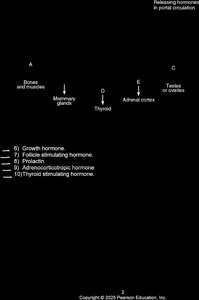
Q4. Match the pituitary hormone to its target organ or tissue.
Background
Topic: Pituitary Hormones and Targets
This question evaluates your ability to connect specific pituitary hormones to their target organs and the effects they produce.
Key Terms and Hormones:
Growth hormone (GH): Targets bones and muscles.
Prolactin (PRL): Targets mammary glands.
Thyroid-stimulating hormone (TSH): Targets the thyroid gland.
Adrenocorticotropic hormone (ACTH): Targets the adrenal cortex.
Follicle-stimulating hormone (FSH): Targets the gonads (testes/ovaries).
Step-by-Step Guidance
Review the list of pituitary hormones and their known target organs or tissues.
For each hormone, recall its primary function and which organ or tissue it acts upon.
Match each hormone to the correct target based on your knowledge.
Check your answers with a hormone-target chart if available.
Try solving on your own before revealing the answer!
