 Back
Endocrine System Study Guide – BIOL 2402
Study Guide - Smart Notes
 Tailored notes based on your materials, expanded with key definitions, examples, and context.
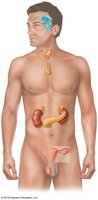
Q1. Label the endocrine structures on the diagram below:
Background
Topic: Endocrine System Anatomy
This question tests your ability to identify the major endocrine glands in the human body. Understanding the location and function of these glands is foundational for studying hormone regulation and physiological processes.
Key Terms:
Pituitary gland: Often called the "master gland," located at the base of the brain.
Pineal gland: Small gland in the brain that produces melatonin.
Thyroid gland: Located in the neck, regulates metabolism.
Parathyroid glands: Small glands on the posterior of the thyroid, regulate calcium.
Adrenal glands: Sit atop the kidneys, produce stress hormones.
Pancreas: Located behind the stomach, regulates blood sugar.
Ovaries/Testes: Gonads, produce sex hormones.
Step-by-Step Guidance
Start at the top of the diagram and identify the gland located in the brain region (pituitary and pineal glands).
Move to the neck area to locate the thyroid and parathyroid glands.
Look above each kidney for the adrenal glands.
Find the pancreas, which is situated behind the stomach and between the kidneys.
Identify the reproductive glands (testes in males, ovaries in females) in the lower pelvic region.
Try labeling each structure before checking your answers!
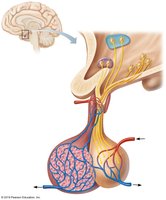
Q2. Label the endocrine structures on the diagram below:
Background
Topic: Pituitary Gland Anatomy
This question focuses on the detailed anatomy of the pituitary gland and its connection to the hypothalamus. Understanding this relationship is crucial for grasping how the brain regulates hormone release throughout the body.
Key Terms:
Hypothalamus: Brain region controlling the pituitary gland.
Infundibulum: The stalk connecting the hypothalamus to the pituitary gland.
Anterior pituitary (adenohypophysis): Produces and releases hormones.
Posterior pituitary (neurohypophysis): Stores and releases hormones made by the hypothalamus.
Step-by-Step Guidance
Identify the hypothalamus at the top of the diagram and trace its connection to the pituitary gland via the infundibulum.
Distinguish between the anterior and posterior lobes of the pituitary gland based on their position and structure.
Note the blood vessels and nerve fibers connecting the hypothalamus and pituitary gland.
Label each structure as you identify it, focusing on the flow of hormones from the hypothalamus to the pituitary.
Try labeling each part before checking your answers!
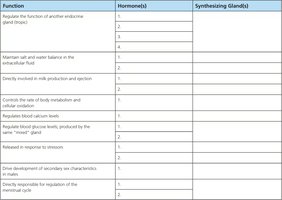
Q8. The table below lists the functions of many of the hormones you have studied. From the keys below, fill in the hormones responsible for each function, and the endocrine glands that produce each hormone.
Background
Topic: Hormone Function and Source Identification
This question tests your ability to match hormone functions with their names and the glands that produce them. This is essential for understanding endocrine regulation and feedback mechanisms.
Key Terms and Hormones:
ACTH: Adrenocorticotropic hormone
ADH: Antidiuretic hormone
Aldosterone: Mineralocorticoid from adrenal cortex
Cortisol: Glucocorticoid from adrenal cortex
Epinephrine: Adrenal medulla hormone
Estrogens, Progesterone, Testosterone: Gonadal hormones
FSH, LH, TSH, Prolactin: Anterior pituitary hormones
Glucagon, Insulin: Pancreatic hormones
PTH: Parathyroid hormone
T3/T4: Thyroid hormones
Oxytocin: Posterior pituitary hormone
Step-by-Step Guidance
Read each function in the table and recall which hormone(s) are responsible for that effect.
Use the hormone and gland keys provided to match each function with the correct hormone and synthesizing gland.
For example, for "Regulate blood glucose levels," think about which hormones (insulin, glucagon) are involved and which gland (pancreas) produces them.
Continue this process for each row, referencing your notes or textbook as needed.
Try matching each function to the correct hormone and gland before checking your answers!
