 Back
BackEndocrine System Study Guide – Structure Identification and Hormone Function
Study Guide - Smart Notes
 Tailored notes based on your materials, expanded with key definitions, examples, and context.
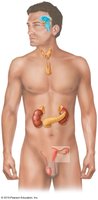
Q1. Label the endocrine structures on the diagram below:
Background
Topic: Endocrine System Anatomy
This question tests your knowledge of the major endocrine glands in the human body and their anatomical locations.
Key Terms:
Endocrine glands: Organs that secrete hormones directly into the bloodstream.
Hormones: Chemical messengers that regulate physiological processes.
Step-by-Step Guidance
Observe the diagram and identify the highlighted organs. Common endocrine glands to look for include the pituitary gland, thyroid gland, parathyroid glands, adrenal glands, pancreas, testes (in males), and possibly the pineal gland and thymus.
Recall the general anatomical locations of each gland. For example, the thyroid is in the neck, the pancreas is near the stomach, and the adrenal glands sit atop the kidneys.
Label each structure on the diagram, matching the organ to its correct anatomical position.
Double-check your labels by reviewing a textbook diagram or class notes to ensure accuracy.
Try solving on your own before revealing the answer!
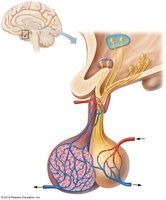
Q2. Label the endocrine structures on the diagram below:
Background
Topic: Hypothalamus and Pituitary Gland Anatomy
This question focuses on the detailed anatomy of the hypothalamus and pituitary gland, including their connections and blood supply.
Key Terms:
Hypothalamus: Brain region controlling the pituitary gland.
Pituitary gland: Master endocrine gland with anterior and posterior lobes.
Infundibulum: The stalk connecting the hypothalamus to the pituitary gland.
Portal system: Blood vessels connecting the hypothalamus and anterior pituitary.
Step-by-Step Guidance
Identify the hypothalamus at the base of the brain and the pituitary gland just below it.
Distinguish between the anterior and posterior lobes of the pituitary gland in the diagram.
Locate the infundibulum (pituitary stalk) connecting the hypothalamus to the pituitary.
Label any visible blood vessels, such as the hypophyseal portal veins and arteries, if shown.
Try solving on your own before revealing the answer!
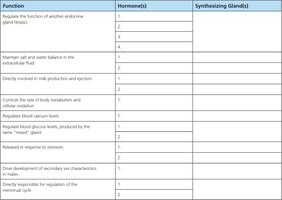
Q8. The table below lists the functions of many of the hormones you have studied. From the keys below, fill in the hormones responsible for each function, and the endocrine glands that produce each hormone.
Background
Topic: Hormone Functions and Glandular Sources
This question tests your ability to match hormones to their physiological functions and identify the glands that synthesize them.
Key Terms and Concepts:
Tropic hormones: Hormones that regulate other endocrine glands (e.g., TSH, ACTH).
Homeostasis: Maintenance of stable internal conditions, often regulated by hormones.
Hormone function: Each hormone has specific target tissues and effects (e.g., insulin lowers blood glucose).
Step-by-Step Guidance
Read each function listed in the table and recall which hormone(s) are responsible for that effect (e.g., "Regulate blood glucose levels" is associated with insulin and glucagon).
Use the provided hormone and gland keys to select the correct hormone(s) for each function.
For each hormone, identify the synthesizing gland (e.g., insulin is produced by the pancreas).
Fill in the table, ensuring that each function is matched with the correct hormone(s) and gland(s). Some functions may have more than one hormone or gland involved.
Try solving on your own before revealing the answer!
