 Back
BackEnergy and Cellular Metabolism: Structured Study Notes for ANP College Students
Study Guide - Smart Notes
 Tailored notes based on your materials, expanded with key definitions, examples, and context.
Introduction to Physiology
Definition and Scope
Physiology is the study of the normal functioning of living organisms and their component parts, including all chemical and physical processes. It seeks to understand both the 'why' (function) and the 'how' (mechanism) of biological phenomena.
Function: Explains why a process occurs (its purpose).
Mechanism: Describes how a process occurs (the steps involved).
Feedback Loops
Feedback loops are essential for maintaining homeostasis.
Negative Feedback: Stabilizes variables and is homeostatic.
Positive Feedback: Reinforces changes and is not homeostatic.
Feedforward Control: Allows the body to anticipate changes.
Molecular Interactions
Elements and Biomolecules
Three elements make up 90% of the human body: Oxygen, Carbon, and Hydrogen. The four major groups of biomolecules are:
Lipids: Fats and oils, hydrophobic, composed of a glycerol backbone and 1-3 fatty acids.
Carbohydrates: Sugars, hydrophilic, includes monosaccharides (fructose, glucose, galactose) and disaccharides (sucrose, maltose, lactose).
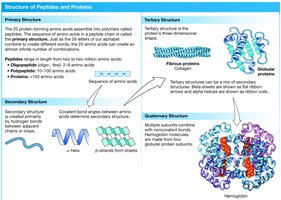
Proteins: Chains of amino acids with four structural levels.
Nucleotides: Store and transmit genetic information, participate in energy transfer (e.g., ATP, ADP, cyclic AMP).
Protein Structure
Proteins have four levels of structure:
Primary: Sequence of amino acids.
Secondary: Hydrogen bonds create folding (α-helix, β-sheets).
Tertiary: 3D shape formed by joining secondary structures.
Quaternary: Multiple tertiary structures combine.
pH and Acidity
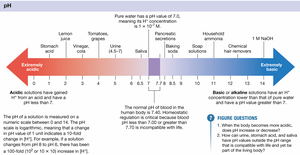
pH measures the concentration of hydrogen ions ([H+]) in a solution.
High [H+]: Low pH (acidic).
Low [H+]: High pH (basic).
Bases: Bind free H+ and release hydroxide ions (OH-), forming water.
Compartmentation: Cells and Tissues
Body Cavities
The three major body cavities are:
Cranial
Thoracic
Abdominopelvic
Cellular Structures
Ribosomes: Not organelles (lack membrane), function as inclusions, synthesize proteins.
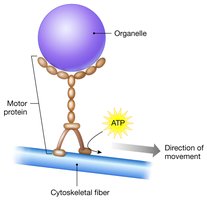
Motor Proteins: Create movement along cytoskeletal fibers using ATP.
Energy and Cellular Metabolism
Energy in Biological Systems
All living organisms require energy. Plants (autotrophs) trap radiant energy from the sun and store it in chemical bonds. Animals (heterotrophs) ingest plants or other animals to obtain energy.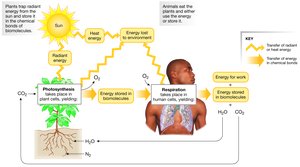
Trophic Levels and Energy Transfer
Energy transfer in food webs is inefficient:
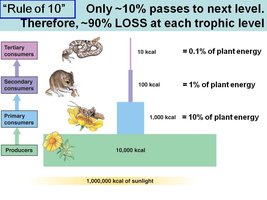
Primary Producers: Plants convert sunlight to chemical energy at ~1% efficiency.
Energy Transfer: Only ~10% of energy is transferred to the next trophic level; ~90% is lost as heat.
Energy Storage and Use
Animals extract energy from biomolecules via respiration, consuming oxygen and producing carbon dioxide and water. Excess energy is stored in glycogen and lipids.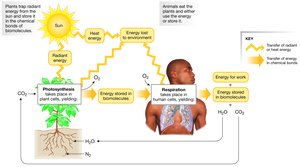
Types of Work
Energy is used for:
Chemical Work: Making and breaking chemical bonds.
Transport Work: Moving ions and molecules, creating concentration gradients.
Mechanical Work: Moving organelles, changing cell shape, muscle contraction.
Potential vs. Kinetic Energy
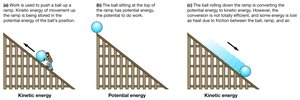
Potential Energy: Stored in concentration gradients and chemical bonds.
Kinetic Energy: Energy of motion.
Thermodynamics
First Law: Conservation of energy; total energy in a closed system is constant.
Second Law: Natural processes increase entropy (disorder); the human body is an open system requiring energy input to maintain order.
Chemical Reactions
Bioenergetics
Bioenergetics studies energy flow through biological systems. Chemical reactions transfer or use energy stored in reactant molecules.
Reactants: Starting materials.
Products: End materials.
Reaction Rate: Speed of reaction.
Free Energy: Potential energy in chemical bonds.
Types of Chemical Reactions
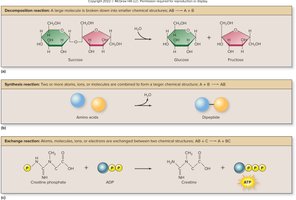
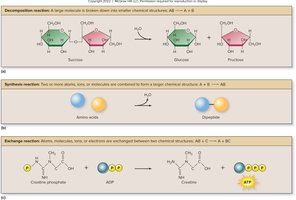
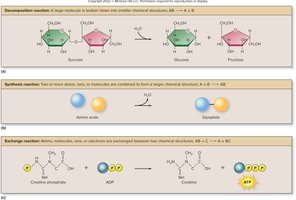
Decomposition: Large molecules broken into smaller ones ().
Synthesis: Small molecules combined to form larger ones ().
Exchange: Functional groups exchanged between molecules ().
Activation Energy
Activation energy is the initial input required to start a chemical reaction.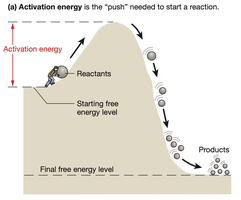
Exergonic and Endergonic Reactions
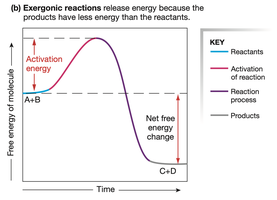
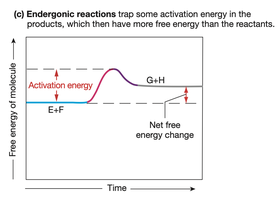
Exergonic: Release energy; products have lower free energy than reactants.
Endergonic: Store energy; products have higher free energy than reactants.
Coupled Reactions
Exergonic and endergonic reactions are often coupled, allowing energy released from one to drive another.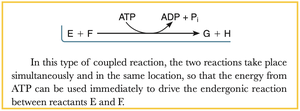
Enzymes
Role of Enzymes
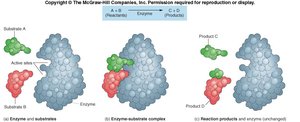
Enzymes are globular proteins that lower the activation energy of reactions, increasing reaction rates.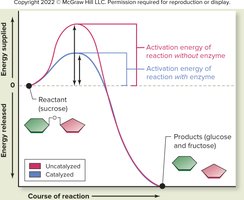
Enzyme Structure and Function
Enzymes have a unique 3D structure with an active site that temporarily forms an enzyme-substrate complex.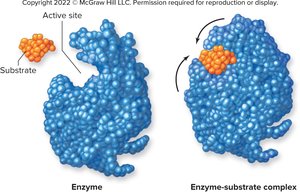
Enzyme Regulation
Enzymes can be activated, inactivated, or modulated by allosteric activators, which bind away from the active site and induce conformational changes.
Classification and Naming
Enzymes are named based on their substrate or function, often ending in '-ase' (e.g., glucokinase adds a phosphate group to glucose).
Types of Enzymatic Reactions
Oxidation-Reduction: Electron transfer between molecules.
Hydrolysis-Dehydration: Addition or removal of water.
Addition-Subtraction-Exchange: Functional groups added, removed, or exchanged.
Ligation: Joining two molecules using ATP.
Metabolism
Overview
Metabolism encompasses all chemical reactions in an organism, including energy extraction and molecule synthesis or breakdown.
Catabolism: Energy-releasing breakdown.
Anabolism: Energy-utilizing synthesis.
Intermediates: Molecules that are substrates for subsequent reactions.
Regulation of Metabolic Pathways
Cells regulate metabolism by controlling enzyme concentrations, producing modulators, using feedback inhibition, compartmentalizing enzymes, and maintaining ATP/ADP ratios.
ATP and Energy Transfer
ATP stores energy in high-energy phosphate bonds and transfers energy between reactions.
Aerobic Metabolism: Yields 30-32 ATP per glucose, requires oxygen.
Anaerobic Metabolism: Yields 2 ATP per glucose.
Aerobic Respiration Steps
Glycolysis: Occurs in cytosol, produces 2 ATP and 2 pyruvate.
Citric Acid Cycle: Produces NADH, FADH2, and 2 ATP.
Electron Transport Chain: Produces 26-28 ATP, uses O2 as final electron acceptor.
Fate of Pyruvate
With insufficient oxygen, pyruvate undergoes anaerobic respiration:
Humans: Produces lactic acid.
Yeast: Produces alcohol.
Protein Synthesis and Genetic Information
DNA, RNA, and Protein Synthesis
Proteins are synthesized based on instructions encoded in DNA. The process involves:
Transcription: DNA is transcribed to mRNA.
Translation: mRNA is translated into a protein chain by ribosomes.
Alternative Splicing
mRNA processing allows multiple proteins to be produced from one DNA sequence via alternative splicing.
Posttranslational Modification
Proteins undergo folding, cross-linking, cleavage, addition of groups, and assembly into polymers after translation.
Summary Table: Types of Chemical Reactions
Type | General Equation | Description |
|---|---|---|
Decomposition | Breaks down molecules | |
Synthesis | Combines molecules | |
Exchange | Exchanges functional groups |
