 Back
BackEssential Concepts in Human Biology: Organic Molecules, Cellular Structure, and Function
Study Guide - Smart Notes
 Tailored notes based on your materials, expanded with key definitions, examples, and context.
Organic Molecules and Biochemical Reactions
Dehydration Synthesis and Hydrolysis
Organic macromolecules are constructed and broken down by two fundamental biochemical processes: dehydration synthesis and hydrolysis. These reactions are central to the formation and degradation of carbohydrates, proteins, and nucleic acids.
Dehydration Synthesis: The process by which monomers are joined to form polymers, releasing a molecule of water for each bond formed. This reaction requires energy input.
Hydrolysis: The reverse process, where polymers are broken down into monomers by the addition of water, releasing energy.
Example: Formation and breakdown of polysaccharides from monosaccharides.
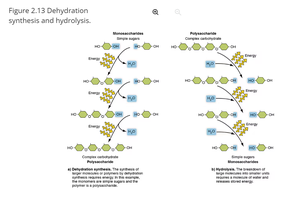
Additional info: These reactions are catalyzed by specific enzymes, which facilitate the making and breaking of covalent bonds in biological molecules.
Enzymes as Biological Catalysts
Enzymes are specialized proteins that accelerate biochemical reactions without being consumed in the process. They lower the activation energy required for reactions, making cellular metabolism efficient and regulated.
Active Site: The region of the enzyme where substrate molecules bind and undergo a chemical reaction.
Mechanism: Substrates bind to the enzyme, the enzyme changes shape to facilitate the reaction, and products are released.
Example: Enzymes catalyze dehydration synthesis and hydrolysis reactions in cells.
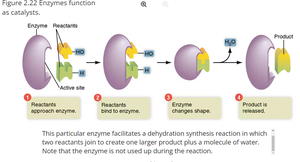
Additional info: Enzyme specificity is determined by the shape and charge of the active site, allowing only certain substrates to bind.
Nucleic Acids: Structure and Function
DNA Nucleotide Structure
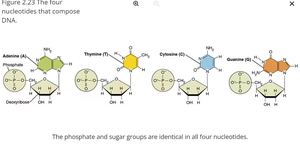
DNA is composed of four types of nucleotides, each consisting of a phosphate group, a five-carbon sugar (deoxyribose), and a nitrogenous base (adenine, thymine, cytosine, or guanine).
Nucleotide: The monomer unit of nucleic acids.
Phosphate and Sugar: Identical in all four nucleotides; the base varies.
Example: The sequence of nucleotides encodes genetic information.
Double Helical Structure of DNA
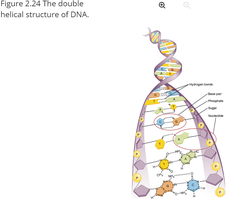
The DNA molecule forms a double helix, with two strands held together by hydrogen bonds between complementary base pairs. The structure is essential for replication and gene expression.
Base Pairing: Adenine pairs with thymine, cytosine pairs with guanine.
Phosphate-Sugar Backbone: Provides structural stability.
Example: The double helix allows for accurate copying of genetic material during cell division.
ATP: The Universal Energy Carrier
Structure and Function of ATP
Adenosine triphosphate (ATP) is the primary energy currency of the cell. It consists of adenosine (adenine base + ribose sugar) and three phosphate groups. The bonds between phosphate groups store significant potential energy.
Energy Release: Hydrolysis of ATP to ADP and inorganic phosphate releases energy for cellular work.
ATP Synthesis: Energy from food or stored molecules is used to reattach phosphate groups to ADP, regenerating ATP.
Example: ATP powers muscle contraction, active transport, and biosynthesis.
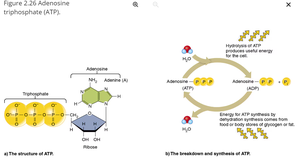
Additional info: The equation for ATP hydrolysis is:
Cell Structure and Function
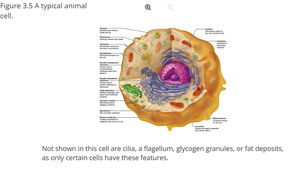
Overview of a Typical Animal Cell
Animal cells contain various organelles, each with specialized functions. The plasma membrane surrounds the cell, and the cytoplasm contains the organelles.
Nucleus: Contains genetic material and controls cellular activities.
Mitochondria: Powerhouse of the cell, site of ATP production.
Endoplasmic Reticulum (ER): Synthesizes proteins and lipids.
Golgi Apparatus: Packages and ships cellular products.
Lysosomes: Digest cellular waste.
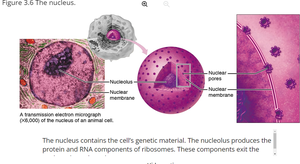
The Nucleus
The nucleus is the most prominent organelle, containing DNA and the nucleolus. The nuclear membrane regulates the passage of molecules between the nucleus and cytoplasm.
Nucleolus: Site of ribosome component synthesis.
Nuclear Pores: Allow selective transport of RNA and proteins.
Endoplasmic Reticulum (ER)
The ER is a network of membranes involved in the synthesis and transport of proteins and lipids. It is divided into rough ER (with ribosomes) and smooth ER (without ribosomes).
Rough ER: Synthesizes proteins for export or membrane insertion.
Smooth ER: Synthesizes lipids and detoxifies chemicals.
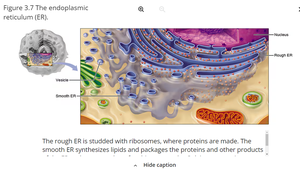
Additional info: Vesicles bud from the ER to transport materials to the Golgi apparatus for further processing.
Summary Table: Key Organic Molecules
Class | Monomer | Polymer | Main Function |
|---|---|---|---|
Carbohydrates | Monosaccharide | Polysaccharide | Energy storage, structural support |
Proteins | Amino acid | Polypeptide/protein | Enzymes, structure, transport |
Nucleic acids | Nucleotide | DNA/RNA | Genetic information storage |
Lipids | Fatty acid (not true polymer) | Triglyceride, phospholipid, steroid | Energy storage, membranes, hormones |
Additional info: Lipids are not true polymers, as they are not formed by repetitive monomer linkage.
