 Back
BackFluid and Electrolyte Balance: Structure, Regulation, and Clinical Imbalances
Study Guide - Smart Notes
 Tailored notes based on your materials, expanded with key definitions, examples, and context.
Fluid and Electrolyte Balance
Body Fluid Volumes and Distribution
Water is the most abundant compound in the human body, and its distribution is essential for physiological function. The average body water volume is based on a healthy, non-obese 70-kg male, with a total of approximately 40 liters. Body water is distributed among three main compartments:
Plasma: The liquid part of whole blood (about 3 L).
Interstitial Fluid (IF): Fluid that surrounds the cells (about 12 L).
Intracellular Fluid (ICF): Fluid located inside cells (about 25 L), which is the largest compartment.
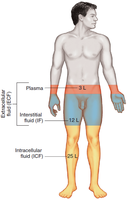
Variation in Total Body Water
The proportion of body weight made up of water varies with age, gender, and body composition:
Newborn infants: ~80% of body weight is water.
Adult males: ~60% of body weight is water.
Adult females: ~50% of body weight is water (due to higher fat content).
Obese individuals: Lower percentage of body water per kilogram due to higher adipose tissue, which contains less water.
Aging: Water content decreases as muscle (high in water) is replaced by fat (low in water).
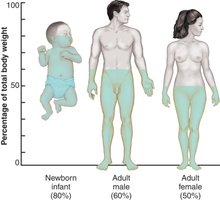
Additional info: Infants are more susceptible to fluid imbalance due to their high body water percentage. The percentage of body water decreases during childhood and stabilizes in adolescence, with sex differences becoming apparent.
Body Fluid Compartments
Body fluids are divided into two main compartments:
Extracellular Fluid (ECF): Includes plasma, interstitial fluid, and transcellular fluids (lymph, joint fluids, cerebrospinal fluid, eye humors).
Intracellular Fluid (ICF): The largest compartment, serving as a solvent for intracellular chemical reactions.
Sources of Fluid Intake and Output
Fluid balance is maintained by regulating intake and output:
Intake: Ingested liquids, water in food, and metabolic water (from cellular respiration).
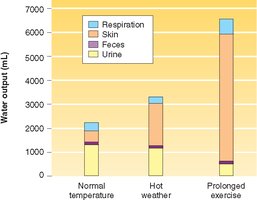
Output: Water vapor (respiration), sweat (skin), urine (kidneys), and feces (large intestine).
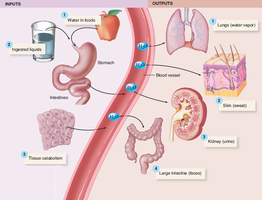
Key mechanisms for balancing fluid volumes:
Regulating fluid output
Regulating fluid input
Exchanging fluids between compartments
Regulation of Fluid Output
Organs responsible for fluid output include the lungs, skin, kidneys, and large intestine. The kidneys play a major role by adjusting urine volume in response to fluid intake. Hormones involved in this regulation include:
Antidiuretic Hormone (ADH): Released from the posterior pituitary when ECF volume is low, increasing kidney reabsorption of water and sodium, thus decreasing urine volume.
Aldosterone: Secreted by the adrenal cortex, increases sodium and water reabsorption in the kidneys, restoring ECF volume.
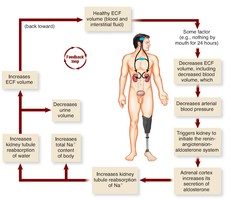
Additional info: Excess aldosterone can lead to hypervolemia (excess blood volume) and edema (excess interstitial fluid).
Regulation of Fluid Intake
Sensory receptors detect changes in ECF volume and concentration, sending signals to the hypothalamus, which triggers thirst. This mechanism helps restore fluid balance by increasing fluid intake. If intake is inadequate, the body compensates by reducing saliva and other secretions, but water loss continues through sweating and respiration.
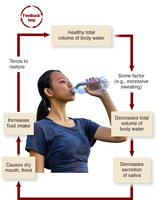
Additional info: Regulation of fluid output is more critical for homeostasis than intake adjustments.
Forces Moving Fluids Between Compartments
Fluid movement between compartments is influenced by:
Capillary blood pressure: Pushes fluid from blood to interstitial fluid (IF).
Blood plasma protein concentration: Creates osmotic pressure, pulling water into the plasma from IF.
Of the three main body fluids, IF volume varies the most, while plasma volume is tightly regulated to maintain circulation.
Fluid Imbalances
Common fluid imbalances include:
Dehydration: Total body fluid volume is lower than normal. IF volume shrinks first, followed by ICF and plasma if untreated. Causes include prolonged fluid output exceeding intake.
Overhydration: Total body fluid volume is higher than normal, often due to excessive intake or impaired output. Can lead to water intoxication, a potentially life-threatening condition due to electrolyte imbalance.
Testing for Dehydration
Loss of skin elasticity (turgor) is a clinical sign of dehydration. Skin that remains tented after being pinched indicates interstitial water loss. This test is less reliable in the elderly due to natural loss of turgor with aging.

Importance of Electrolytes in Body Fluids
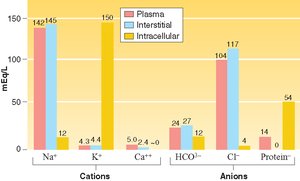
Electrolytes are compounds that dissociate in water to form ions, which carry electrical charges and are essential for physiological processes. Major electrolytes include sodium (Na+), potassium (K+), calcium (Ca2+), chloride (Cl-), and bicarbonate (HCO3-).
Nonelectrolytes: Organic substances (e.g., glucose) that do not dissociate in water.
Electrolytes: Dissociate into ions in water (e.g., NaCl).
Electrolyte composition varies between fluid compartments and is measured in milliequivalents (mEq).
Edema and Pitting Edema
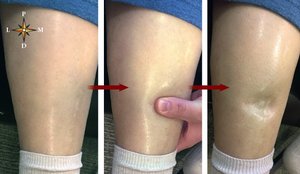
Edema is swelling caused by excess IF volume. Pitting edema is identified when depressions in the skin remain after pressure is applied, indicating significant fluid accumulation.
Sodium-Containing Internal Secretions
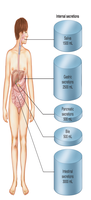
The body produces large volumes of sodium-containing secretions (e.g., saliva, gastric, pancreatic, bile, and intestinal secretions), which can total over 8000 mL per day. These secretions play a role in digestion and fluid balance.
Electrolyte Imbalances
Electrolyte imbalances result from disruptions in intake, output, absorption, or distribution of electrolytes. The most clinically significant imbalances involve sodium, potassium, and calcium.
Sodium Imbalance
Hypernatremia: Blood sodium > 145 mEq/L. Causes: overuse of salt, dehydration, prolonged diarrhea. Symptoms: CNS malfunction (headache, confusion, seizures, coma).
Hyponatremia: Blood sodium < 136 mEq/L. Causes: excessive ADH, sodium-free IV fluids, burns, diuretics. Symptoms: CNS malfunction.
Potassium Imbalance
Hyperkalemia: Blood potassium > 5.1 mEq/L. Causes: increased intake, tissue trauma, renal failure. Symptoms: muscle weakness, paralysis, cardiac arrest.
Hypokalemia: Blood potassium < 3.5 mEq/L. Causes: fasting, low-potassium diet, laxative/diuretic abuse, diarrhea, vomiting. Symptoms: muscle weakness, cardiac problems, GI motility issues.
Calcium Imbalance
Hypercalcemia: Blood calcium > 10.5 mg/dL. Causes: excessive intake/absorption, bone disease, hyperparathyroidism. Symptoms: decreased neuromuscular activity, fatigue, muscle weakness, cardiac issues.
Hypocalcemia: Blood calcium < 8.4 mg/dL. Causes: dietary deficiency, decreased absorption, renal insufficiency, hypoparathyroidism. Symptoms: increased neuromuscular irritability, cramping, twitching, abnormal cardiac rhythms.
Additional info: Calcium is the most abundant mineral in the body, essential for bone/teeth structure, heartbeat, nerve/muscle function, metabolism, blood coagulation, and enzyme reactions.
Summary Table: Major Electrolyte Imbalances
Electrolyte | Imbalance | Causes | Symptoms |
|---|---|---|---|
Sodium (Na+) | Hypernatremia / Hyponatremia | Salt intake, dehydration, ADH excess, IV fluids | CNS symptoms: headache, confusion, seizures, coma |
Potassium (K+) | Hyperkalemia / Hypokalemia | Intake, trauma, renal failure, diet, GI loss | Muscle weakness, paralysis, cardiac arrest |
Calcium (Ca2+) | Hypercalcemia / Hypocalcemia | Intake, absorption, bone disease, deficiency | Fatigue, muscle weakness, cardiac issues / cramping, twitching, arrhythmias |
