 Back
BackFluid, Electrolyte, and Acid-Base Balance: ANP College Study Guide
Study Guide - Smart Notes
 Tailored notes based on your materials, expanded with key definitions, examples, and context.
Fluid and Electrolyte Balance
Overview of Fluid Compartments
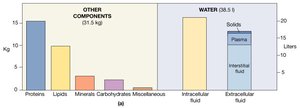
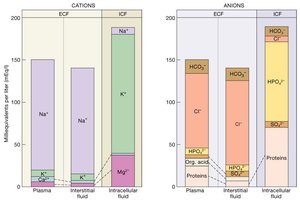
The human body maintains a delicate balance of fluids and electrolytes, which is essential for normal physiological function. Body fluids are distributed into two main compartments: extracellular fluid (ECF) and intracellular fluid (ICF). ECF includes interstitial fluid, plasma, and other body fluids, while ICF refers to the cytosol within cells.
ECF: Comprises plasma, interstitial fluid, and minor components such as lymph, cerebrospinal fluid, and synovial fluid.
ICF: Makes up about two-thirds of total body water, primarily within the cytosol of cells.
Fluid and Electrolyte Balance
Fluid balance is achieved when water intake equals water loss. Electrolyte balance occurs when ion intake matches ion loss. Acid-base balance is maintained when hydrogen ion (H+) gain is offset by loss.
Fluid balance: Maintains constant body water volume.
Electrolyte balance: Regulates ions such as sodium, potassium, and calcium.
Acid-base balance: Keeps pH within the narrow range of 7.35–7.45.
Major Electrolytes in Body Fluids
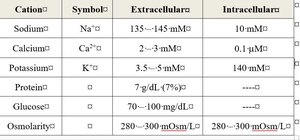
Electrolytes are ions that conduct electricity in solution. Their concentrations differ between ECF and ICF, which is crucial for cellular function.
Cation | Symbol | Extracellular | Intracellular |
|---|---|---|---|
Sodium | Na+ | 135–145 mM | 10 mM |
Calcium | Ca2+ | 2–3 mM | 0.1 μM |
Potassium | K+ | 3.5–5 mM | 140 mM |
Protein | — | 7 g/dL (7%) | — |
Glucose | — | 70–100 mg/dL | — |
Osmolarity | — | 280–300 mOsm/L | 280–300 mOsm/L |
Regulation of Fluids and Electrolytes
Homeostatic Mechanisms
Homeostatic mechanisms respond to changes in ECF, as there are no direct receptors for fluid or electrolyte balance. Water moves passively in response to osmotic gradients, and body content rises if intake exceeds outflow.
Regulation: Monitors plasma volume and osmotic concentration.
Water movement: Passive, driven by osmotic gradients.
Primary Regulatory Hormones
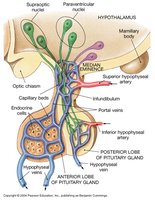
Three hormones play key roles in fluid and electrolyte regulation:
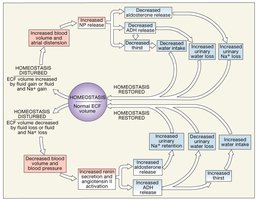
Antidiuretic hormone (ADH): Stimulates water conservation and activates the thirst center.
Aldosterone: Controls sodium absorption and potassium loss in the distal convoluted tubule (DCT).
Natriuretic peptides (ANP and BNP): Reduce thirst and block ADH and aldosterone release.
Fluid Movement and Water Balance
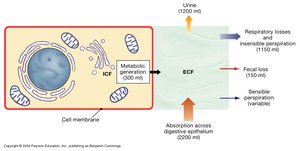
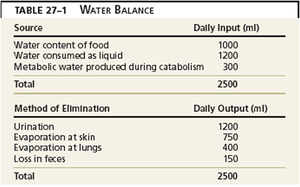
Fluid moves freely within the ECF compartment. Water losses are balanced by gains from eating, drinking, and metabolic generation.
Source | Daily Input (ml) |
|---|---|
Water content of food | 1000 |
Water consumed as liquid | 1200 |
Metabolic water produced during catabolism | 300 |
Total | 2500 |
Method of Elimination | Daily Output (ml) |
|---|---|
Urination | 1200 |
Evaporation at skin | 750 |
Evaporation at lungs | 400 |
Loss in feces | 150 |
Total | 2500 |
Fluid Shifts and Tonicity
Fluid Shifts Between ECF and ICF
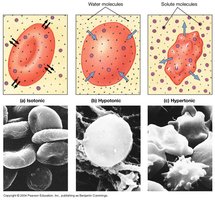
Water moves between ECF and ICF based on tonicity. If ECF is hypertonic, water moves from ICF to ECF; if ECF is hypotonic, water moves into cells.
Isotonic: No net gain or loss of water.
Hypotonic: Net gain of water into cell (hemolysis).
Hypertonic: Net water flow out of cell (crenation).
Electrolyte Balance
Sodium Balance
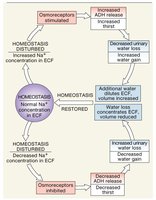
Sodium uptake is proportional to dietary intake, and losses occur through urine and perspiration. Homeostatic mechanisms correct large variations in sodium concentration.
Low sodium: ADH and aldosterone secreted.
High sodium: ANP secreted.
Potassium Balance
Potassium concentrations in ECF are low and less tightly regulated than sodium. Excretion increases as ECF concentrations rise, aldosterone is secreted, or pH rises. Retention occurs when pH falls, as K+ is exchanged for H+.
Acid-Base Balance
Importance of pH Control
The pH of ECF is tightly regulated between 7.35 and 7.45. Deviations can cause acidosis or alkalosis, affecting all body systems and potentially leading to coma, cardiac failure, or circulatory collapse.
Acidemia: pH below 7.35 (acidosis).
Alkalemia: pH above 7.45 (alkalosis).
Types of Acids in the Body
Volatile acids: Can leave solution and enter the atmosphere (e.g., carbonic acid).
Fixed acids: Do not leave solution (e.g., sulfuric and phosphoric acids).
Organic acids: By-products of aerobic metabolism (e.g., lactic acid).
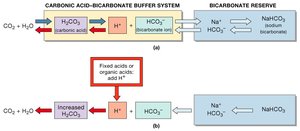
Key equation:
Buffer Systems
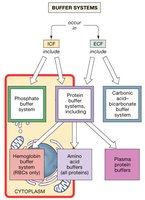
Buffer systems resist changes in pH. The three major systems are:
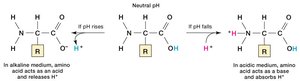
Protein buffer system: Amino acids act as weak acids or bases.
Hemoglobin buffer system: Buffers H+ in red blood cells.
Carbonic acid-bicarbonate buffer system: Buffers changes caused by organic and fixed acids.
Regulation of Acid-Base Balance
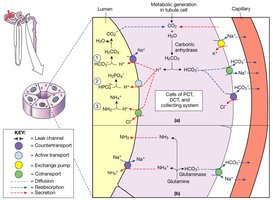
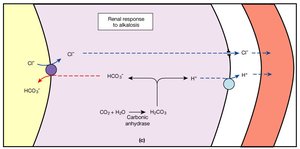
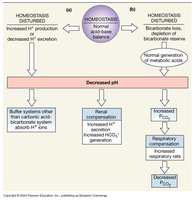
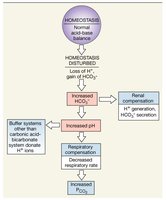
Acid-base balance is maintained by buffer systems, respiration, and renal function. The lungs regulate pH through changes in respiratory rate, affecting PCO2. The kidneys regulate pH through renal compensation, adjusting H+ and HCO3- excretion.
Acid-Base Disorders
Respiratory Acid-Base Disorders
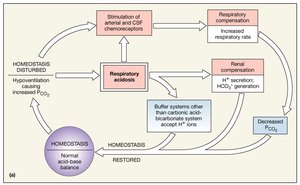
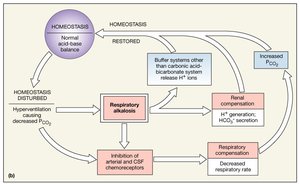
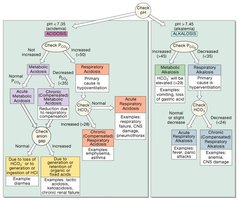
Respiratory disorders result from abnormal respiratory function, causing changes in CO2 levels in ECF.
Metabolic Acid-Base Disorders
Metabolic disorders are caused by generation of organic or fixed acids, or changes in bicarbonate ion concentration.
Metabolic acidosis: Depletion of bicarbonate reserve, inability to excrete H+, or excessive acid production.
Metabolic alkalosis: Elevated HCO3- concentrations, often due to repeated vomiting.
Detection of Acid-Base Disorders
Diagnostic blood tests measure blood pH, PCO2, and bicarbonate levels to distinguish between respiratory and metabolic disorders.
Summary Table: Key Fluid and Electrolyte Concepts
Concept | Definition | Example |
|---|---|---|
Fluid Balance | Water intake equals water loss | Urine output matches water consumed |
Electrolyte Balance | Ion intake equals ion loss | Sodium regulation by aldosterone |
Acid-Base Balance | H+ gain equals H+ loss | Buffering by bicarbonate system |
Additional info:
Metabolic water is produced during catabolism of nutrients, contributing to daily water balance.
Clinical conditions such as hyponatremia, hypernatremia, and dehydration are directly related to fluid and electrolyte imbalances.
Buffer systems are essential for maintaining pH stability in the body, with protein, hemoglobin, and carbonic acid-bicarbonate systems playing major roles.
