 Back
BackFluid, Electrolyte, and Acid-Base Balance: ANP Study Notes
Study Guide - Smart Notes
 Tailored notes based on your materials, expanded with key definitions, examples, and context.
Fluid, Electrolyte, and Acid-Base Balance
Introduction
Fluid, electrolyte, and acid-base balance are essential for maintaining homeostasis in the human body. These processes ensure that the internal environment remains stable, supporting cellular function and overall health.
Body Fluid Compartments
Major Compartments and Their Composition
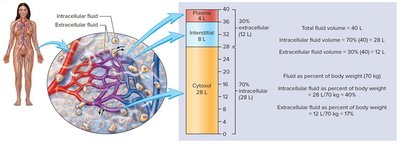
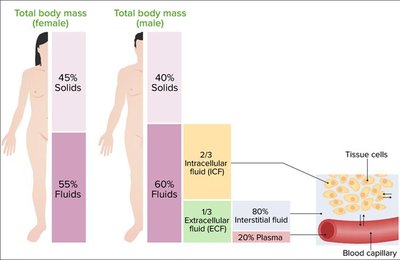
Intracellular Fluid (ICF): Fluid within cells, comprising about two-thirds of total body water.
Extracellular Fluid (ECF): Fluid outside cells, including interstitial fluid, plasma, and transcellular fluids. Makes up about one-third of total body water.
Dominant Ions: Sodium (Na+) is dominant in ECF, while Potassium (K+) is dominant in ICF.
Composition of Body Fluids
Water: The main component of body fluids.
Electrolytes: Charged particles such as Na+, K+, Ca2+, Cl-, HCO3-.
Non-electrolyte solutes: Glucose, urea, proteins, etc.
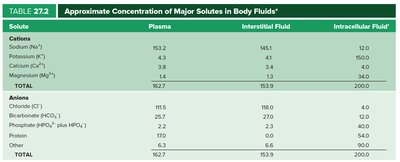
Approximate Concentration of Major Solutes in Body Fluids
Solute | Plasma | Interstitial Fluid | Intracellular Fluid |
|---|---|---|---|
Sodium (Na+) | 153.2 | 145.1 | 12.0 |
Potassium (K+) | 4.3 | 4.1 | 150.0 |
Calcium (Ca2+) | 3.8 | 3.4 | 1.4 |
Magnesium (Mg2+) | 1.4 | 1.3 | 34.0 |
Chloride (Cl-) | 115.5 | 118.0 | 4.0 |
Bicarbonate (HCO3-) | 25.7 | 27.0 | 8.0 |
Phosphate (PO43-) | 2.0 | 2.0 | 95.0 |
Protein | 61.0 | 6.0 | 54.0 |
Other | 6.7 | 6.9 | 94.0 |
Regulation of Water Balance
Water Gain and Loss
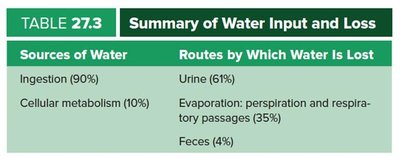
Water Intake: Mainly from ingestion (90%) and cellular metabolism (10%).
Water Loss: Occurs via urine (61%), evaporation (35%), and feces (4%).
Sources of Water | Routes by Which Water Is Lost |
|---|---|
Ingestion (90%) | Urine (61%) |
Cellular metabolism (10%) | Evaporation: perspiration and respiratory passages (35%) |
Feces (4%) |
Thirst Regulation
Thirst is the primary mechanism for regulating water intake. It is controlled by:
Hypothalamic osmoreceptors (detect increased osmolality)
Arterial and juxtaglomerular apparatus baroreceptors (detect blood pressure changes)
Dryness of the mouth
Distension of the stomach
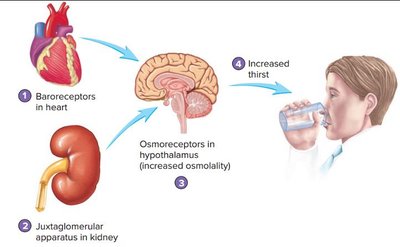
Regulation of Water Loss
Kidneys: Main route for water excretion.
Skin and Respiratory Passages: Water lost by evaporation (insensible and sensible perspiration).
Digestive Tract: Minimal water loss under normal conditions; increases with vomiting or diarrhea.
Regulation of Intracellular Fluid (ICF) Composition
Factors Affecting ICF Composition
Large proteins cannot exit the cell.
Ion transport creates concentration gradients (e.g., Na+, K+, Ca2+).
Electrical charge differences across the membrane.
Osmosis regulates water movement.
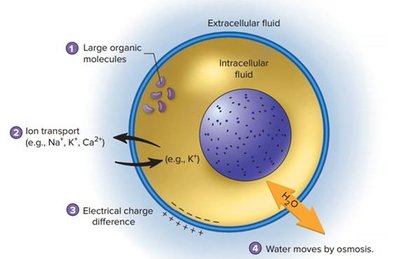
Electrolyte Regulation
Sodium (Na+)
Dominant extracellular ion; contributes to 90–95% of ECF osmotic pressure.
Regulated by ADH (osmolality), RAAS, and ANH (blood pressure).
Normal value: 135–145 mEq/L.
Major excretion via kidneys; minor via sweat.
Hyponatremia and Hypernatremia
Condition | Causes | Symptoms |
|---|---|---|
Hyponatremia | Inadequate intake, losses, excess water, hyperglycemia | Lethargy, confusion, seizures, coma, changes in blood volume |
Hypernatremia | High intake, saline solutions, aldosterone, water loss | Thirst, fever, restlessness, convulsions, edema |
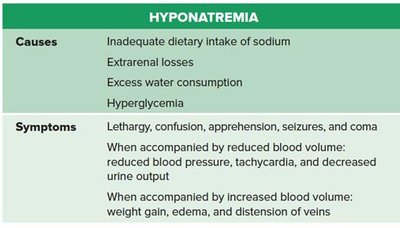
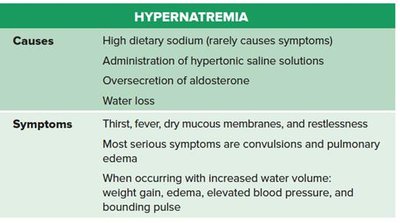
Potassium (K+)
Dominant intracellular ion; crucial for resting membrane potential (RMP).
Regulated by aldosterone; excess K+ secreted in distal convoluted tubule and collecting ducts.
Normal value: 3.5–5 mg/dL.
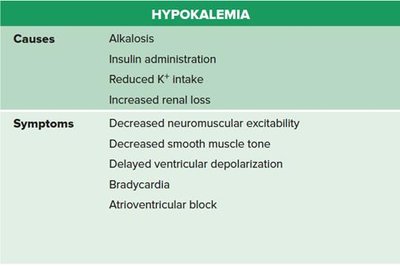
Hypokalemia and Hyperkalemia
Condition | Causes | Symptoms |
|---|---|---|
Hypokalemia | Alkalosis, insulin, reduced intake, renal loss | Decreased excitability, bradycardia, AV block |
Hyperkalemia | Cell trauma, reduced excretion | Neuromuscular irritability, muscle weakness, paralysis |

Calcium (Ca2+)
Extracellular concentration tightly regulated (8.6–10.3 mg/dL).
Regulated by kidneys, digestive tract, and bones.
Hypocalcemia: below normal; Hypercalcemia: above normal.
Chloride, Magnesium, and Phosphate Ions
Chloride (Cl-): Main extracellular anion; follows sodium regulation.
Magnesium (Mg2+): Mostly in bones; cofactor for enzymes; regulated by kidneys.
Phosphate (PO43-): Component of DNA, RNA, ATP; acts as buffer; regulated by PTH.
Magnesium and Phosphate Imbalances
Condition | Causes | Symptoms |
|---|---|---|
Hypomagnesemia | Malnutrition, alcoholism, renal dysfunction | Irritability, muscle weakness, tetany |
Hypermagnesemia | Renal failure, antacids | Nausea, muscle weakness, bradycardia |
Hypophosphatemia | Reduced absorption, hyperparathyroidism | Reduced metabolic rate, blood clotting |
Hyperphosphatemia | Renal failure, tissue destruction | Calcium phosphate deposits, symptoms of low Ca2+ |


Acid-Base Balance
Importance of pH Regulation
Hydrogen ion concentration affects enzyme activity and cellular function.
Normal blood pH: 7.35–7.45.
Acidosis: pH < 7.35; Alkalosis: pH > 7.45.

Buffer Systems
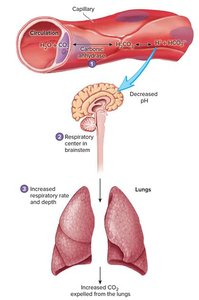
Carbonic Acid/Bicarbonate Buffer System:
Protein Buffer System: Hemoglobin and histone proteins act as buffers.
Phosphate Buffer System: Important for intracellular buffering.
Respiratory Regulation of Acid-Base Balance
Respiratory system adjusts pH by altering CO2 exhalation.
Increased H+ stimulates respiratory center to increase breathing rate (hyperventilation), reducing CO2 and raising pH.

Renal Regulation of Acid-Base Balance
Kidneys excrete H+ and reabsorb HCO3- to regulate pH.
Renal compensation is slower but more powerful than respiratory compensation.
Acid-Base Imbalances
Acidosis: Depression of the central nervous system.
Alkalosis: Hyperexcitability of the nervous system.
Classified as respiratory or metabolic based on the underlying cause.
Respiratory Acidosis and Alkalosis
Respiratory Acidosis: Increased CO2 (hypoventilation); kidneys compensate by excreting H+ and reabsorbing HCO3-.
Respiratory Alkalosis: Decreased CO2 (hyperventilation); kidneys compensate by reducing H+ excretion and HCO3- reabsorption.
Metabolic Acidosis and Alkalosis
Metabolic Acidosis: Accumulation of H+ or loss of HCO3-; respiratory compensation by hyperventilation.
Metabolic Alkalosis: Loss of H+ (e.g., excessive antacid use); respiratory compensation by hypoventilation.
