 Back
BackFunctional Anatomy of the Endocrine Glands – ANP Study Guidance
Study Guide - Smart Notes
 Tailored notes based on your materials, expanded with key definitions, examples, and context.
Q1. Both the endocrine and nervous systems are major regulating systems of the body; however, the nervous system has been compared to a text message, and the endocrine system to mailing a letter. Briefly explain this comparison.
Background
Topic: Communication and Regulation in the Body
This question is testing your understanding of how the nervous and endocrine systems transmit signals and regulate body functions, focusing on speed and mechanism of action.
Key Terms:
Nervous system: Uses electrical impulses and neurotransmitters for rapid communication.
Endocrine system: Uses hormones released into the bloodstream for slower, longer-lasting effects.
Step-by-Step Guidance
Consider how a text message is delivered quickly and directly to the recipient, similar to how the nervous system sends signals rapidly via neurons.
Think about how mailing a letter takes longer to reach its destination, but the message can affect the recipient for a longer period, similar to how hormones travel through the bloodstream and exert prolonged effects.
Reflect on the differences in speed, specificity, and duration of action between the two systems.
Try solving on your own before revealing the answer!
Q2. Define hormone.
Background
Topic: Hormones and Endocrine Function
This question is testing your ability to accurately describe what a hormone is and its role in the body.
Key Terms:
Hormone: A chemical messenger produced by endocrine glands, transported by the bloodstream to target cells.
Step-by-Step Guidance
Recall that hormones are secreted by endocrine glands.
Think about how hormones travel through the blood to reach distant target cells.
Consider the effects hormones have on regulating physiological processes.
Try solving on your own before revealing the answer!
Q3. Chemically, hormones belong chiefly to two molecular groups, the ________ and the ________.
Background
Topic: Chemical Classification of Hormones
This question is testing your knowledge of the main types of hormone molecules.
Key Terms:
Amino acid-based hormones
Steroid hormones
Step-by-Step Guidance
Recall the two primary chemical classes of hormones.
Think about examples of each type (e.g., peptide hormones, steroid hormones).
Try solving on your own before revealing the answer!
Q4. Define target cell.
Background
Topic: Hormone Action and Specificity
This question is testing your understanding of how hormones interact with specific cells in the body.
Key Terms:
Target cell: A cell that has receptors for a specific hormone and responds to that hormone.
Step-by-Step Guidance
Recall that not all cells respond to every hormone.
Think about the role of receptors in determining a cell's response.
Try solving on your own before revealing the answer!
Q5. If hormones travel in the bloodstream, why don’t all tissues respond to all hormones?
Background
Topic: Hormone Specificity and Receptor Interaction
This question is testing your understanding of why only certain cells respond to specific hormones.
Key Terms:
Receptors: Proteins on or in target cells that bind specific hormones.
Step-by-Step Guidance
Recall that hormones circulate throughout the body via the bloodstream.
Think about the necessity of specific receptors for hormone action.
Consider how only cells with the appropriate receptor can respond to a given hormone.
Try solving on your own before revealing the answer!
Q6. Identify the endocrine organ described by each of the following statements.
Background
Topic: Endocrine Gland Identification
This question is testing your ability to match descriptions to specific endocrine glands based on their location and function.
Key Terms:
Thyroid gland, pituitary gland, pancreas, testes, ovaries, thymus, pineal gland
Step-by-Step Guidance
Read each description carefully and recall the anatomical location and function of each gland.
Match the description to the correct gland using your knowledge of endocrine anatomy.
Review diagrams or charts if needed to reinforce your identification.
Try solving on your own before revealing the answer!
Q7. The table below lists the functions of many of the hormones you have studied. From the keys below, fill in the hormones responsible for each function, and the endocrine glands that produce each hormone.
Background
Topic: Hormone Function and Gland Identification
This question is testing your ability to associate hormone functions with their respective hormones and glands.
Key Terms:
Tropic hormones, salt and water balance, milk production, metabolism, calcium regulation, glucose regulation, stress response, sex characteristics, menstrual cycle
Step-by-Step Guidance
Review the list of hormone functions and recall which hormones are responsible for each.
Identify the gland that synthesizes each hormone.
Use the provided keys to match hormones and glands to their functions.
Try solving on your own before revealing the answer!
Q8. Although the pituitary gland is sometimes referred to as the master gland of the body, the hypothalamus exerts control over the pituitary gland. How does the hypothalamus control both anterior and posterior pituitary functioning?
Background
Topic: Hypothalamic-Pituitary Regulation
This question is testing your understanding of the mechanisms by which the hypothalamus regulates pituitary activity.
Key Terms:
Releasing hormones, inhibiting hormones, neurosecretory cells
Step-by-Step Guidance
Recall that the hypothalamus produces releasing and inhibiting hormones that act on the anterior pituitary.
Think about how the hypothalamus sends nerve impulses and releases neurohormones to control the posterior pituitary.
Consider the anatomical and functional connections between the hypothalamus and pituitary gland.
Try solving on your own before revealing the answer!
Q9. Indicate whether the release of the hormones listed below is stimulated by (A) another hormone; (B) the nervous system; or (C) humoral factors.
Background
Topic: Hormone Release Mechanisms
This question is testing your knowledge of the different stimuli that trigger hormone release.
Key Terms:
Hormonal, neural, and humoral stimuli
Step-by-Step Guidance
Review each hormone and recall what triggers its release (e.g., ACTH is released in response to another hormone).
Classify each hormone according to its stimulus: hormonal, neural, or humoral.
Try solving on your own before revealing the answer!
Q10. Name the hormone(s) produced in inadequate amounts that directly result in the following conditions.
Background
Topic: Hormone Deficiency and Clinical Manifestations
This question is testing your ability to link hormone deficiencies to specific clinical conditions.
Key Terms:
Tetany, diabetes insipidus, diabetes mellitus, dwarfism
Step-by-Step Guidance
Recall the clinical signs and symptoms associated with each condition.
Identify the hormone(s) whose deficiency causes each condition.
Try solving on your own before revealing the answer!
Q11. Name the hormone(s) produced in excessive amounts that directly result(s) in the following conditions.
Background
Topic: Hormone Excess and Clinical Manifestations
This question is testing your ability to link hormone excess to specific clinical conditions.
Key Terms:
Acromegaly, hyperthyroidism, hyperparathyroidism
Step-by-Step Guidance
Recall the clinical signs and symptoms associated with each condition.
Identify the hormone(s) whose excess causes each condition.
Try solving on your own before revealing the answer!
Q12. Choose a response from the key below to name the hormone(s) produced by the cell types listed.
Background
Topic: Cellular Anatomy of Endocrine Glands
This question is testing your knowledge of which cell types produce specific hormones in the endocrine glands.
Key Terms:
Parafollicular cells, follicular cells, beta cells, alpha cells, acidophil cells, basophil cells, zona fasciculata, zona glomerulosa, parathyroid cells
Step-by-Step Guidance
Review the cell types and their locations in the endocrine glands.
Recall which hormones are produced by each cell type.
Use the key to match cell types to their hormone products.
Try solving on your own before revealing the answer!
Q13. Pituitary gland tumors can secrete excess amounts of growth hormone. Describe the signs and symptoms that these tumors cause in an adult experiencing hypersecretion of the growth hormone.
Background
Topic: Pathophysiology of Endocrine Disorders
This question is testing your understanding of the effects of excess growth hormone in adults.
Key Terms:
Acromegaly, hypersecretion, pituitary tumors
Step-by-Step Guidance
Recall the normal effects of growth hormone in adults.
Think about how excess growth hormone affects bone and soft tissue.
Consider the clinical signs and symptoms associated with acromegaly.
Try solving on your own before revealing the answer!
Q14. Tumors of the adrenal medulla, called pheochromocytomas, cause hypersecretion of catecholamines. Describe the expected signs and symptoms of this tumor.
Background
Topic: Pathophysiology of Adrenal Disorders
This question is testing your understanding of the effects of excess catecholamine secretion.
Key Terms:
Pheochromocytoma, catecholamines, adrenal medulla
Step-by-Step Guidance
Recall the normal effects of catecholamines (epinephrine and norepinephrine).
Think about how excess catecholamines affect cardiovascular and metabolic functions.
Consider the clinical signs and symptoms associated with pheochromocytoma.
Try solving on your own before revealing the answer!
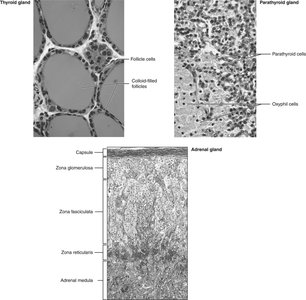
Q15. Identify the endocrine glands, and name all structures indicated by a leader line.
Background
Topic: Microscopic Anatomy of Endocrine Glands
This question is testing your ability to identify endocrine glands and their microscopic structures.
Key Terms:
Thyroid gland, parathyroid gland, adrenal gland, follicle cells, colloid-filled follicles, parathyroid cells, oxyphil cells, capsule, zona glomerulosa, zona fasciculata, zona reticularis, adrenal medulla
Step-by-Step Guidance
Examine the provided microscopic images and identify the labeled structures.
Recall the histological features of each gland and their functional zones or cell types.
Match the leader lines to the correct anatomical structures.
Try solving on your own before revealing the answer!
