 Back
BackGlial Cells and Myelination in the Nervous System
Study Guide - Smart Notes
 Tailored notes based on your materials, expanded with key definitions, examples, and context.
Glial Cells in the Nervous System
Overview of Glia
Glial cells are non-neuronal cells in the central and peripheral nervous systems that provide structural and functional support to neurons. Once thought to serve only as 'glue,' glia are now recognized for their critical roles in maintaining homeostasis, forming myelin, and participating in signal transmission and repair.
Glia outnumber neurons by approximately 1–4 to 1 in the human brain.
They communicate with neurons and each other, providing biochemical and metabolic support.
Types of Glial Cells
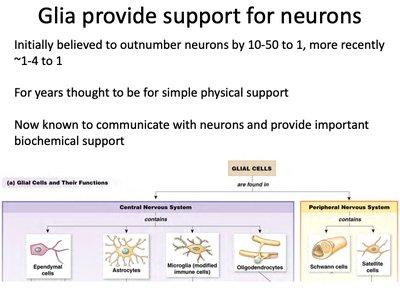
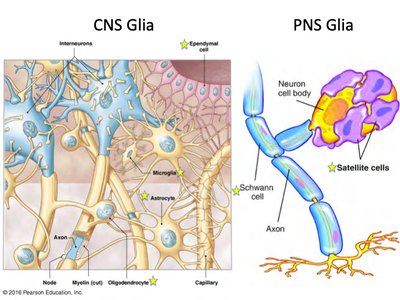
There are six main types of glial cells, divided between the central nervous system (CNS) and peripheral nervous system (PNS):
CNS Glia | PNS Glia |
|---|---|
Oligodendrocytes | Schwann Cells |
Astrocytes | Satellite Cells |
Microglia | |
Ependymal Cells |
Myelin and Myelin-Forming Glia
Structure and Function of Myelin
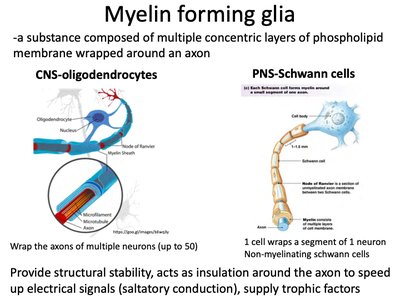
Myelin is a multilayered phospholipid membrane that wraps around axons, providing electrical insulation and increasing the speed of action potential conduction (saltatory conduction). Myelin is essential for rapid and efficient neural signaling.
In the CNS, oligodendrocytes form myelin sheaths around multiple axons (up to 50).
In the PNS, Schwann cells myelinate individual axon segments.
Importance of Myelin
Provides structural stability to axons.
Acts as insulation, speeding up electrical signal transmission.
Supplies trophic (growth) factors to neurons.
Demyelination and Multiple Sclerosis (MS)
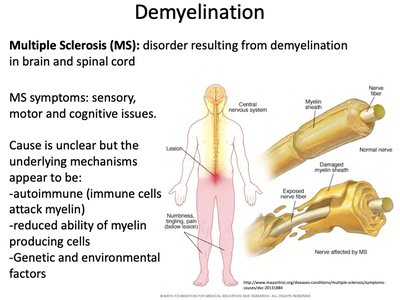
Multiple Sclerosis (MS) is a disorder characterized by the loss of myelin in the brain and spinal cord, leading to impaired neural signaling. Symptoms include sensory, motor, and cognitive deficits.
Causes include autoimmune attack on myelin, reduced myelin production, and genetic/environmental factors (e.g., low vitamin D exposure).
MS can result in paralysis or numbness due to failed nerve conduction.
Astrocytes
Structure and Functions
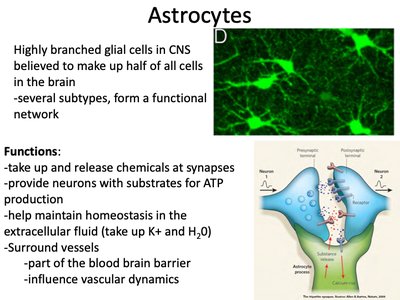
Astrocytes are highly branched glial cells in the CNS, making up about half of all brain cells. They form a functional network and have several critical roles:
Regulate chemical composition of the extracellular fluid (e.g., K+ and H2O balance).
Take up and release neurotransmitters at synapses.
Provide neurons with substrates for ATP production.
Form part of the blood-brain barrier, controlling substance entry into brain tissue.
Influence blood vessel diameter and vascular dynamics.
Microglia
Immune Function in the CNS
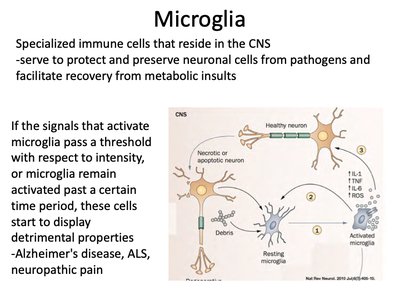
Microglia are specialized immune cells in the CNS that protect neurons from pathogens and clear debris through phagocytosis. They are essential for maintaining neural health but can contribute to neurodegenerative diseases if chronically activated.
Remove damaged cells and foreign invaders.
Release reactive oxygen species (ROS) when activated, which can cause oxidative stress and contribute to diseases like ALS and Alzheimer's.
Ependymal Cells
Role in Cerebrospinal Fluid (CSF) Circulation
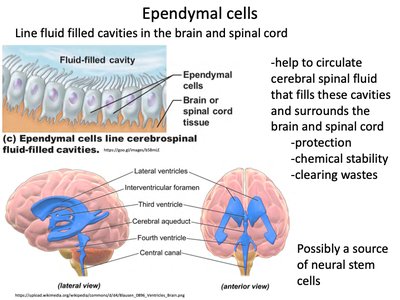
Ependymal cells line the fluid-filled cavities (ventricles) of the brain and spinal cord. They help circulate cerebrospinal fluid, which cushions the CNS, maintains chemical stability, and removes waste.
May serve as a source of neural stem cells.
Contribute to the protection and homeostasis of the CNS environment.
Schwann Cells and Peripheral Nerve Regeneration
Regeneration in the PNS
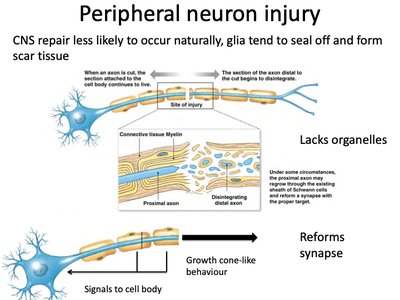
Unlike the CNS, the peripheral nervous system (PNS) has a limited ability to regenerate damaged axons, largely due to the activity of Schwann cells.
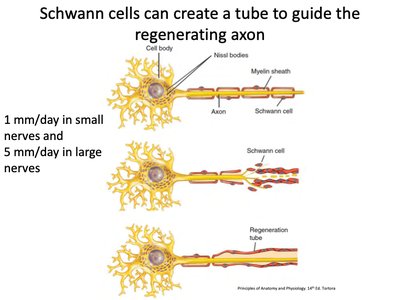
Schwann cells can divide and form a regeneration tube to guide the regrowth of axons.
Regeneration rate: ~1 mm/day in small nerves, up to 5 mm/day in large nerves.
Peripheral Neuron Injury and Repair
Peripheral neurons can reform synapses after injury if the damage is not too severe. In contrast, CNS repair is limited due to glial scar formation, which inhibits synaptic reformation.
Glial cells in the CNS often form scar tissue at injury sites, preventing axon regrowth.
PNS axons can regrow through Schwann cell guidance.
Summary Table: Glial Cell Types and Functions
Glial Cell | Location | Main Functions |
|---|---|---|
Oligodendrocytes | CNS | Form myelin, structural support, increase signal velocity |
Astrocytes | CNS | Maintain homeostasis, blood-brain barrier, support neurons |
Microglia | CNS | Immune defense, phagocytosis, remove debris |
Ependymal Cells | CNS | Line ventricles, circulate CSF, possible stem cells |
Schwann Cells | PNS | Form myelin, guide axon regeneration |
Satellite Cells | PNS | Support sensory neuron cell bodies |
