 Back
BackGuided Study Notes for ANP Chapter 3: Cells – The Living Units
Study Guide - Smart Notes
 Tailored notes based on your materials, expanded with key definitions, examples, and context.
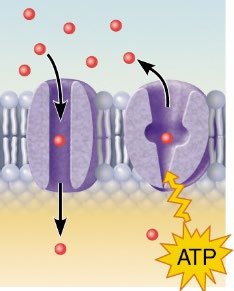
Q1. What function of a membrane protein is illustrated below?
Background
Topic: Membrane Transport – Active Transport
This question is testing your understanding of how membrane proteins facilitate the movement of substances across the plasma membrane, specifically through active transport mechanisms.
Key Terms and Concepts:
Active Transport: The movement of molecules across a membrane from a region of lower concentration to a region of higher concentration, requiring energy (usually ATP).
ATP (Adenosine Triphosphate): The energy currency of the cell, used to power active transport.
Membrane Protein: Proteins embedded in the plasma membrane that facilitate transport of substances.
Step-by-Step Guidance
Observe the image: It shows a membrane protein moving molecules across the membrane, with ATP being used.
Recall that active transport requires energy input, often in the form of ATP, to move substances against their concentration gradient.
Identify the direction of movement: Substances are moving from an area of lower concentration to higher concentration, which is characteristic of active transport.
Consider the role of the protein: It acts as a pump, using ATP to change shape and transport molecules across the membrane.
Try solving on your own before revealing the answer!
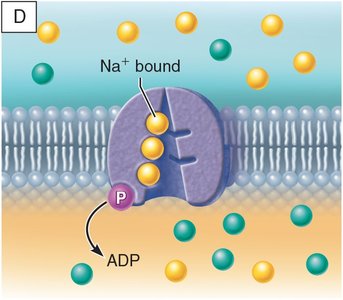
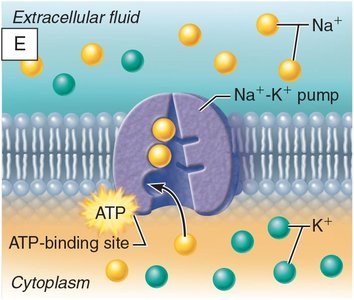
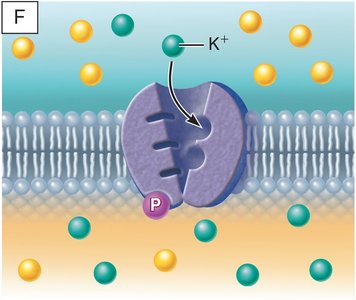
Q2. Write the letters for each step of the sodium-potassium pump in order from start to finish.
Background
Topic: Sodium-Potassium Pump – Primary Active Transport
This question is testing your ability to sequence the steps involved in the operation of the sodium-potassium pump, a classic example of primary active transport in cells.
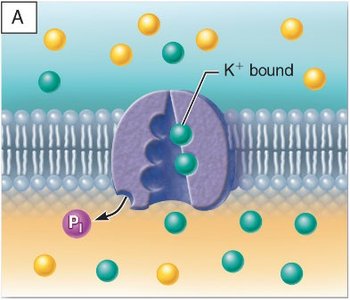
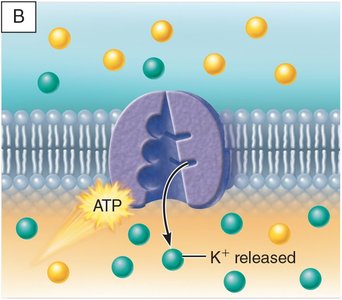
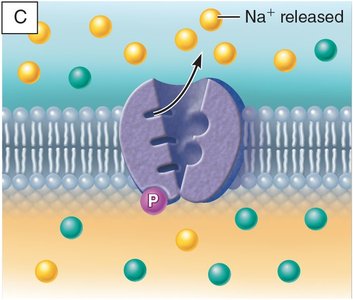
Key Terms and Concepts:
Sodium-Potassium Pump: A membrane protein that moves sodium (Na+) out of the cell and potassium (K+) into the cell, using ATP.
Primary Active Transport: Direct use of ATP to transport molecules against their concentration gradients.
ATP Hydrolysis: The breakdown of ATP to ADP and inorganic phosphate, releasing energy.
Step-by-Step Guidance
Review each image (A–F) and note the sequence of events: binding of ions, ATP hydrolysis, conformational changes, and release of ions.
Identify which step shows potassium binding, which shows sodium binding, and which steps show release of these ions.
Determine where ATP is used and how the pump changes shape to move ions across the membrane.
Arrange the steps logically, starting with the initial binding of sodium or potassium and ending with the completion of the cycle.
Try solving on your own before revealing the answer!
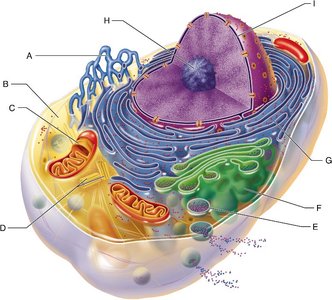
Q3. Identify each of the structures indicated (A–I) for the generalized cell.
Background
Topic: Cell Structure – Organelles
This question is testing your ability to recognize and name the major organelles and structures within a typical eukaryotic cell.
Key Terms and Concepts:
Organelles: Specialized structures within cells that perform distinct functions (e.g., mitochondria, Golgi apparatus, endoplasmic reticulum).
Nucleus: The control center of the cell, containing genetic material.
Cytoplasm: The fluid and organelles outside the nucleus.
Step-by-Step Guidance
Examine the diagram and locate each labeled structure (A–I).
Recall the appearance and function of each organelle (e.g., mitochondria, rough ER, Golgi apparatus).
Match each label to the correct organelle or cell structure based on its location and shape in the diagram.
Review your textbook or notes for descriptions and functions of each structure to confirm your choices.
Try solving on your own before revealing the answer!
