 Back
BackHuman Development, Birth, and Heredity: ANPH 8101 Study Notes
Study Guide - Smart Notes
 Tailored notes based on your materials, expanded with key definitions, examples, and context.
Human Development
Embryonic and Fetal Development
Human development progresses through distinct embryonic and fetal stages, each characterized by specific anatomical and physiological changes. By the end of the embryonic period, all major organ systems are present in rudimentary form, and the fetus continues to mature throughout gestation.
Embryonic Period: Head nearly as large as the body; all major brain regions present; liver disproportionately large; all four limbs present; cardiovascular system fully functional; crown-to-rump length: 22mm.
9-12 Weeks: Head dominant, body elongating; brain enlarges; skin layers visible; nails on digits; facial features forming; liver secretes bile; glands of endodermal origin developed; blood formed in bone marrow; notochord degenerates, ossification accelerates; sex detectable; crown-to-rump length: 36mm.
13-16 Weeks: Cerebellum prominent; sensory organs differentiated; eyes and ears in characteristic positions; blinking and sucking motions; face looks human; body outgrows head; elastic fibers in lungs; bones distinct, joint cavities apparent; quickening occurs; crown-to-rump length: 140mm.
17-20 Weeks: Eyelashes and eyebrows present; fetal position assumed; limbs in final proportions; crown-to-rump length: 190mm.
21-30 Weeks: Substantial weight increase; survival possible at 27-28 weeks, but temperature regulation and surfactant production immature; myelination of spinal cord begins; skin wrinkled and red; tooth enamel forming; blood formation increases in bone marrow, decreases in liver; distal limb bones ossify; crown-to-rump length: 280mm.
30-40 Weeks (Term): Skin whitish pink; fingernails and toenails present; fat deposited in subcutaneous tissue; testes in scrotum (males); crown-to-rump length: 350-360mm.
Effects of Pregnancy on the Mother
Pregnancy induces significant anatomical, metabolic, and physiological changes in the mother to support fetal development and prepare for birth.
Anatomical Changes: Increased vascularity of reproductive organs (Chadwick’s sign); breasts enlarge and darken; uterus expands, displacing abdominal organs; center of gravity shifts, causing lordosis and backaches; pelvic ligaments relax due to hormone relaxin; typical weight gain is about 13 kg (29 lbs); nutritional needs increase by only 300 calories daily.
Metabolic Changes: Placenta secretes human placental lactogen (HPL), stimulating breast maturation and promoting glucose-sparing effects; human chorionic thyrotropin (HCT) increases maternal metabolism.
Physiological Changes:
Gastrointestinal: Excessive salivation, nausea (morning sickness), heartburn, constipation.
Urinary: Increased urine production, frequent and urgent urination due to bladder compression.
Respiratory: Nasal congestion, increased vital capacity and respiratory rate, decreased residual volume, dyspnea.
Cardiovascular: Blood volume increases by 25-40%; blood pressure and pulse rise; cardiac output increases; impaired venous return may cause varicose veins.
Parturition (Birth)
Initiation of Labor
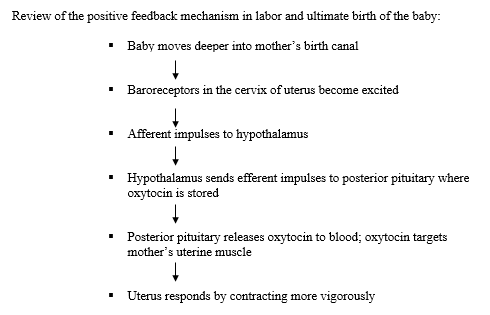
Labor is initiated by hormonal changes, primarily involving estrogen, oxytocin, and prostaglandins, which stimulate uterine contractions. A positive feedback mechanism amplifies these contractions, leading to birth.
Estrogen: Increases oxytocin receptors in the uterus and antagonizes progesterone.
Oxytocin and Prostaglandins: Produced by fetal and maternal hypothalamus and placenta, stimulate strong uterine contractions.
Positive Feedback: Greater contractile force leads to more oxytocin release, further increasing contractions.
Stages of Labor
Dilation Stage: From onset of labor to full cervical dilation (10cm); contractions begin in upper uterus and move downward; amnion ruptures (“breaking the water”); lasts 6-12 hours or longer.
Expulsion Stage: From full dilation to delivery; crowning occurs; episiotomy may be performed; umbilical cord clamped and cut; typically 50 minutes in first birth, 20 minutes in subsequent births.
Placental Stage: Delivery of placenta within 15 minutes after birth; uterine contractions prevent hemorrhage and detach placenta.
Adjustments of the Infant to Extrauterine Life
First Breath and Neonatal Period
After birth, the infant must rapidly adapt to life outside the womb, including breathing, thermoregulation, and independent nutrition.
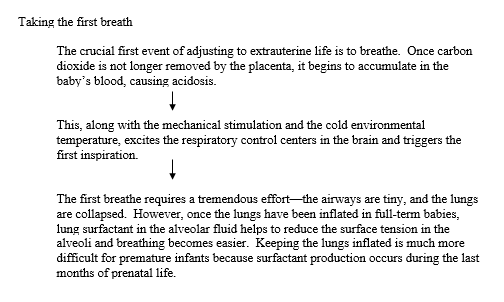
First Breath: Triggered by accumulation of carbon dioxide, mechanical stimulation, and cold environment; requires significant effort due to collapsed lungs; surfactant in alveolar fluid reduces surface tension, aiding lung inflation.
Neonatal Period: First four weeks after birth; infant assessed using Apgar rating (heart rate, respiration, color, muscle tone, reflexes); score of 8-10 indicates healthy baby.
Transitional Period
Infants undergo a transitional period of 6-8 hours post-birth, marked by alternating activity and sleep as they stabilize physiological functions.
First 30 minutes: Awake, alert, active, sucking motions.
Heart rate increases, respirations rapid and irregular, body temperature falls.
Followed by sleep, then a second period of activity with gagging and regurgitation.
Stabilization with regular waking periods dictated by hunger.
Lactation
Milk Production and Let-Down Reflex
Lactation is regulated by hormonal and neural mechanisms, ensuring milk production and ejection for infant nutrition.
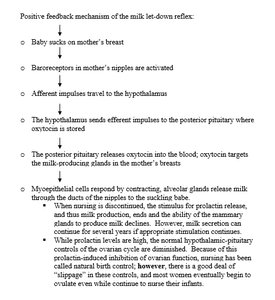
Hormonal Regulation: Estrogen, progesterone, and lactogen stimulate prolactin-releasing hormone; prolactin initiates milk production; oxytocin triggers milk let-down reflex.
Colostrum: Initial secretion, rich in protein, vitamin A, minerals, and IgA antibodies; provides immune protection for the infant’s digestive tract.
Continual Milk Production: Depends on nipple stimulation by infant sucking; oxytocin causes ejection of milk from mammary glands.
Heredity
Chromosomes and Genetic Inheritance
Human heredity is governed by the transmission of chromosomes and genes from parents to offspring, determining traits and genetic variation.
Chromosome Number: Diploid number (46 chromosomes, 23 pairs); 2 sex chromosomes (X and Y), 44 autosomes.
Alleles: Paired genes on homologous chromosomes; alleles may be identical (homozygous) or different (heterozygous).
Dominant and Recessive Alleles: Dominant alleles mask recessive ones; dominant represented by capital letter, recessive by lowercase.
Punnett Square: Used to predict genotypes and phenotypes from parental alleles; probability calculations for trait inheritance.
Genotype and Phenotype
The genotype is an individual's genetic makeup, while the phenotype is the observable expression of those genes as traits.
Genotype: Homozygous or heterozygous for gene pairs.
Phenotype: Physical or functional manifestation of genotype.
Sources of Genetic Variation
Meiosis and fertilization generate genetic diversity, which is essential for evolution and adaptation in populations.
Meiosis: Produces gametes with unique genetic combinations.
Fertilization: Combines genetic material from two parents.
Variation: Provides raw material for natural selection.
Example: Punnett Square Calculation
For two heterozygous parents (Tt x Tt):
Probability of TT (homozygous dominant): 25%
Probability of Tt (heterozygous): 50%
Probability of tt (homozygous recessive): 25%
Equation:
Additional info: The notes expand on the physiological and genetic mechanisms underlying human development, birth, and lactation, providing context for exam preparation in anatomy and physiology.
