 Back
BackImmunity and the Lymphatic System: Structure and Function
Study Guide - Smart Notes
 Tailored notes based on your materials, expanded with key definitions, examples, and context.
Immunity
Overview of Immunity
Immunity is the body's ability to resist or eliminate potentially harmful foreign materials or abnormal cells. The immune system is essential for defending against pathogens, removing cellular debris, and destroying mutant cells. However, inappropriate immune responses can lead to allergies, autoimmune diseases, or tissue rejection.
Primary defensive cells: Neutrophils, eosinophils, basophils, B lymphocytes, T lymphocytes, and macrophages.
Major targets: Pathogenic bacteria and viruses.
Defense methods: Phagocytosis, chemical secretion, antibody production, and memory cell formation.
Types of Immunity
Innate Immunity: First line of defense, non-specific, attacks anything non-self, may damage uninfected cells.
Adaptive (Acquired) Immunity: Specific, has memory, involves B and T lymphocytes, provides long-term protection (e.g., immunity after chickenpox).
Key Immune Cells
Neutrophils: Highly mobile phagocytes that engulf and destroy unwanted materials.
Eosinophils: Secrete chemicals to destroy parasitic worms; involved in allergic reactions.
Basophils: Release histamine and heparin; involved in inflammation and allergies.
B lymphocytes: Produce antibodies for humoral immunity.
T lymphocytes: Responsible for cell-mediated immunity; include cytotoxic, helper, memory, and regulatory T cells.
Monocytes/Macrophages: Phagocytic specialists; present antigens to lymphocytes.
Mast cells: Promote inflammation; found in connective tissue.
Dendritic cells: Antigen-presenting cells; trigger adaptive immunity.
Natural Killer (NK) cells: Destroy infected or abnormal cells non-specifically.
Pathogens
Bacteria: Non-nucleated, single-celled organisms; cause disease by releasing toxins or enzymes.
Viruses: Nucleic acids in a protein coat; require host cells to replicate.
The Lymphatic System
Functions of the Lymphatic System
The lymphatic system maintains fluid balance, absorbs dietary fats, and provides immune defense. It returns excess interstitial fluid and proteins to the bloodstream, filters lymph, and houses immune cells.
Fluid recovery: Returns leaked plasma and proteins to the blood.
Immunity: Filters lymph and houses lymphocytes and macrophages.
Lipid absorption: Lacteals in the intestine absorb dietary fats (chyle).
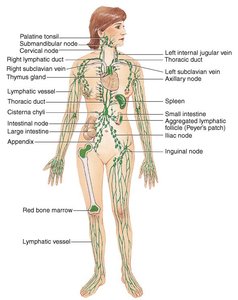
Structure and Distribution of Lymphatic Vessels
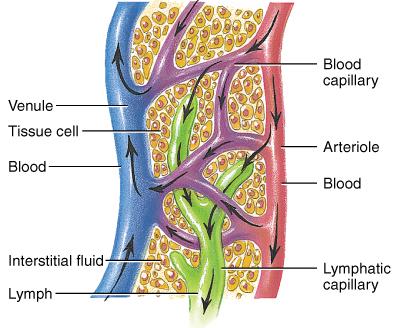
Lymphatic vessels form a one-way system that transports lymph toward the heart. The system begins with lymphatic capillaries, which are highly permeable and found throughout most tissues except the CNS, bone, cartilage, bone marrow, epidermis, and teeth.
Lymphatic capillaries: Loosely joined endothelial cells form flaplike mini-valves; anchored by filaments to surrounding tissue.
One-way flow: Flaps open when interstitial pressure is high, allowing fluid entry; close to prevent backflow.
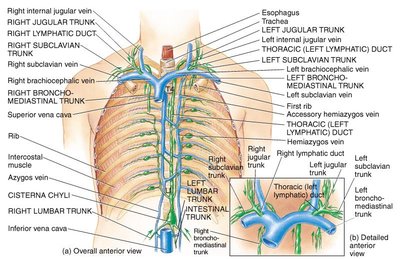
Lymphatic Drainage and Major Ducts
Lymphatic trunks: Larger vessels formed from converging lymphatic vessels.
Right lymphatic duct: Drains right upper limb, right side of head and thorax.
Thoracic duct: Drains the rest of the body; begins at the cisterna chyli.
Venous return: Both ducts empty into the junction of the internal jugular and subclavian veins.
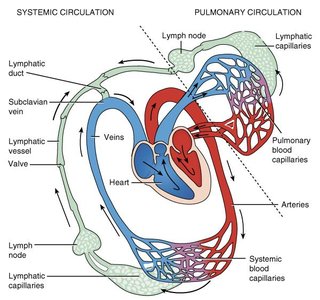
Relationship to the Cardiovascular System
The lymphatic system is closely linked to the cardiovascular system, returning lymph to the bloodstream and maintaining blood volume.
Lymph Transport Mechanisms
Mechanisms: Skeletal muscle contraction, thoracic pressure changes during breathing, arterial pulsations, and smooth muscle contractions in vessel walls.
Flow rate: Lymph transport is slow and sporadic; about 3L/day returns to the blood.
Edema: Blockage or removal of lymphatics can cause localized swelling.
Lymph Nodes
Lymph nodes filter lymph and are sites of immune cell activation. They are small, kidney-shaped organs found in clusters along lymphatic vessels, especially in the inguinal, axillary, and cervical regions.
Structure: Surrounded by a capsule, divided by trabeculae, with a stroma of reticular fibers.
Function: Filter lymph, destroy pathogens, and mount immune responses.
Regions: Cortex (with follicles and germinal centers for B cell proliferation) and medulla (with macrophages and medullary cords).
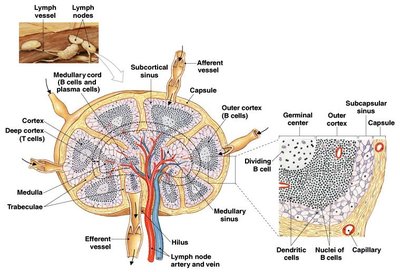
Circulation in the Lymph Nodes
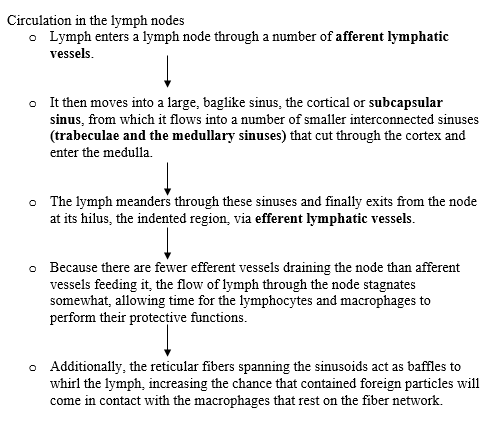
Lymph enters via afferent vessels, passes through sinuses (subcapsular, trabecular, medullary), and exits via efferent vessels at the hilus.
Fewer efferent than afferent vessels slow lymph flow, allowing time for immune surveillance.
Reticular fibers act as baffles, increasing contact between lymph and macrophages.
Other Lymphoid Organs
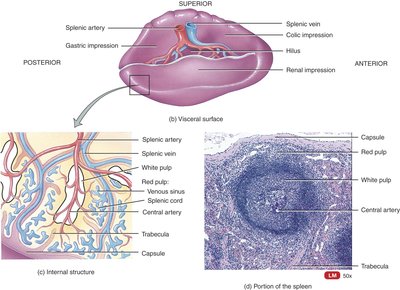
Spleen: Largest lymphoid organ; removes old blood cells, stores platelets, filters blood, and provides immune surveillance. Contains red pulp (erythrocytes) and white pulp (lymphocytes and macrophages).
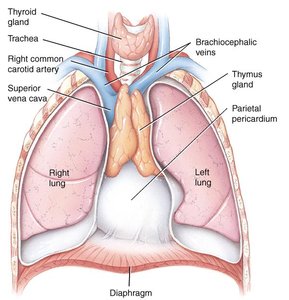
Thymus gland: Site of T-lymphocyte maturation; most active in childhood, atrophies with age. Contains cortex (dense lymphocytes, B cells, germinal centers) and medulla (fewer lymphocytes, Hassal's corpuscles).
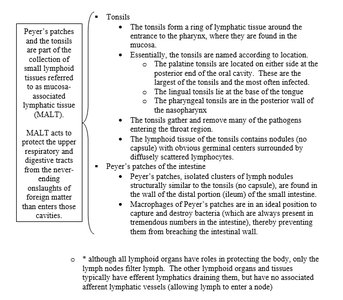
Tonsils and Peyer's patches: Part of mucosa-associated lymphoid tissue (MALT); protect respiratory and digestive tracts from pathogens.
Summary Table: Key Lymphoid Organs and Functions
Organ | Main Function(s) | Key Features |
|---|---|---|
Lymph Node | Filters lymph, immune surveillance | Cortex (B cells), Medulla (macrophages) |
Spleen | Filters blood, removes old RBCs, immune response | Red pulp (RBCs), White pulp (lymphocytes) |
Thymus | T cell maturation | Active in childhood, atrophies with age |
Tonsils | Protects pharynx | MALT, lymphoid follicles |
Peyer's patches | Protects intestines | MALT, lymphoid nodules |
Key Terms and Definitions
Virulence: The ability of a microorganism to cause disease, often measured by fatality rates or tissue invasion.
Tolerance: The immune system's prevention of attacks on the body's own tissues.
Chyle: Milky lymph from the intestines, rich in absorbed fats.
Immunocompetent: The ability of lymphocytes to recognize and respond to specific antigens.
Additional info:
Adaptive immunity's memory is the basis for vaccination effectiveness.
Removal of the spleen (splenectomy) is compensated by the liver and bone marrow.
