Back
BackInfectious Diseases Affecting the Genitourinary System: Anatomy, Physiology, and Pathology
Study Guide - Smart Notes
 Tailored notes based on your materials, expanded with key definitions, examples, and context.
Genitourinary Tract Anatomy and Defenses
Overview of the Genitourinary Tract
The genitourinary tract consists of two closely related organ systems: the urinary tract and the genital (reproductive) system. These systems are responsible for waste removal, regulation of body fluids, and reproduction. Understanding their structure and innate defenses is essential for recognizing how infections develop and are prevented.
Urinary tract: Removes metabolic wastes, regulates body processes, forms urine, and transports it out of the body.
Genital system: Primarily functions in reproduction, with distinct male and female anatomical features.
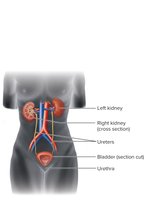
Urinary Tract Anatomy
Kidneys: Filter blood and remove metabolic wastes.
Ureters: Tubes that transport urine from kidneys to the bladder.
Bladder: Stores urine until excretion.
Urethra: Conducts urine to the exterior; in males, also serves as the terminal organ of the reproductive tract.
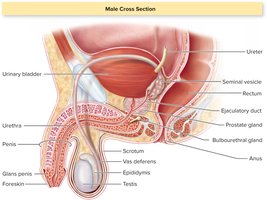
Male Reproductive System Anatomy
The male reproductive system produces, maintains, and transports sperm cells and male sex hormones. It includes both internal and external organs.
Testes: Produce sperm and hormones.
Epididymides: Coiled tubes for sperm maturation.
Vas deferens: Transports sperm to the ejaculatory duct.
Prostate gland: Contributes fluid to semen.
Scrotum and penis: External structures housing the testes and urethra.
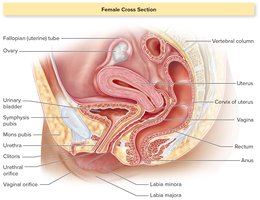
Female Reproductive System Anatomy
The female reproductive system is specialized for ovum production, fertilization, and fetal development. It includes internal and external structures.
Ovaries: Produce eggs and hormones.
Fallopian tubes: Transport eggs from ovaries to uterus.
Uterus: Site of fetal development.
Cervix: Lower part of the uterus, common site of infection.
Vagina: Muscular canal connecting cervix to external body.
Innate Defenses of the Genitourinary Tract
Flushing action of urine: Physically removes microbes from the urinary tract.
Desquamation: Shedding of epithelial cells with attached microbes.
Acidic pH: Inhibits microbial growth, especially in the vagina (pH 4.2–5 during reproductive years).
Lysozyme: Enzyme that breaks down bacterial cell walls.
Lactoferrin: Binds iron, limiting bacterial growth.
Secretory IgA: Provides specific immune protection against previously encountered pathogens.
Additional info: The composition of normal biota and the effectiveness of these defenses vary with age, hormonal status, and anatomical differences between sexes.
Normal Biota of the Genitourinary Tract
Microbial Flora
The lower urinary tract and external genitalia are colonized by diverse microbiota, which play a role in preventing pathogenic infections.
Lower urethra: Contains a well-established microbiota; upper urinary tract is less colonized.
Female genital tract: Dominated by Lactobacillus species during reproductive years, which maintain acidic pH and inhibit pathogens.
Male genital tract: Colonized by Pseudomonas and Staphylococcus species; more diverse in uncircumcised males.
Candida albicans: Present at low levels; overgrowth leads to yeast infection.
Urinary Tract Infections (UTIs)
Types and Clinical Features
UTIs are common infections of the urinary tract, often caused by normal biota from the gastrointestinal tract.
Cystitis: Infection of the bladder; symptoms include pain, frequent urination, dysuria, cloudy urine, and hematuria.
Pyelonephritis: Infection of the kidneys; presents with back pain and high fever, can cause permanent kidney damage.
Urethritis: Infection limited to the urethra.
Causative Agents and Epidemiology
Escherichia coli: Responsible for 80% of community-acquired UTIs.
Other agents: Staphylococcus saprophyticus, Klebsiella pneumoniae, Proteus mirabilis.
Catheter-associated UTIs (CA-UTIs): Common in healthcare settings; minimizing catheter use reduces risk.
Transmission: Not person-to-person; usually from GI tract to urinary tract, more common in women due to anatomical proximity of urethra and anus.
Treatment and Resistance
Nitrofurantoin (Macrobid): Commonly used antibiotic.
Phenazopyridine (Pyridium): Used for symptom relief; turns urine orange-red.
Antibiotic resistance: Many E. coli strains are resistant to penicillins.
Leptospirosis
Etiology and Transmission
Leptospirosis is a zoonotic infection caused by Leptospira interrogans, a spirochete bacterium. It is transmitted through contact with animal urine, often via contaminated water.
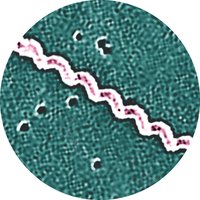
Reservoirs: Wild and domesticated animals.
Transmission: Through skin abrasions or mucous membranes in contact with contaminated urine or water.
Clinical Features
Leptospiremic phase: High fever, chills, headache, muscle aches, conjunctivitis, vomiting.
Immune phase: Milder fever, headache, possible meningitis, kidney and liver involvement (Weil’s syndrome).
Treatment: Early administration of doxycycline, penicillin G, or ceftriaxone is effective.
Sexually Transmitted Infections (STIs) of the Genitourinary Tract
STI Epidemiology
STIs are a major public health concern, with increasing rates of chlamydia, gonorrhea, and syphilis in recent years.
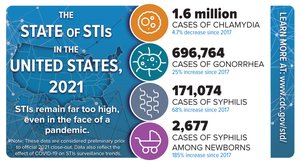
Chlamydia: 1.6 million cases (2021)
Gonorrhea: 696,764 cases (2021)
Syphilis: 171,074 cases (2021)
Congenital syphilis: 2,677 cases (2021)
Gonorrhea
Gonorrhea is caused by Neisseria gonorrhoeae, a gram-negative diplococcus. It is transmitted through sexual contact and can infect both the urinary and reproductive tracts.
Males: Urethritis, painful urination, yellowish discharge, possible infertility due to scarring.
Females: Mucopurulent or bloody discharge, painful urination, risk of pelvic inflammatory disease (PID), infertility, and ectopic pregnancy.
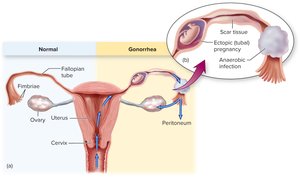
Neonates: Risk of eye infection (ophthalmia neonatorum) and blindness; prophylactic antibiotic eye drops are standard at birth.
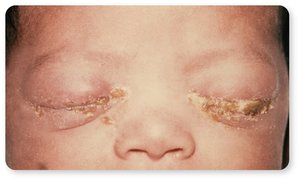
Diagnosis: Culture, catalase and oxidase tests, NAATs.
Treatment: Dual therapy for gonorrhea and chlamydia due to frequent coinfection; antibiotic resistance is a growing concern.
Chlamydia
Chlamydia is the most common reportable infectious disease in the U.S., caused by Chlamydia trachomatis, an obligate intracellular bacterium.
Males: Urethritis, discharge, painful urination, possible epididymitis.
Females: Cervicitis, discharge, salpingitis, high risk of PID, often asymptomatic.
Infants: Risk of conjunctivitis and pneumonia if exposed during birth.
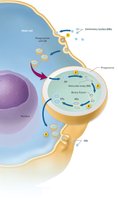
Diagnosis: PCR, ELISA, NAATs.
Treatment: Doxycycline or azithromycin; treat all sexual partners and retest after 3–4 months.
Vaginitis and Vaginosis
Vaginitis is inflammation of the vagina, often with itching, burning, and discharge. Vaginosis is a similar condition but without significant inflammation.
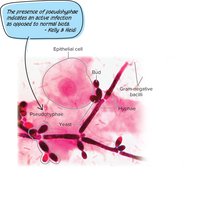
Candida albicans: Dimorphic fungus; overgrowth causes vulvovaginal candidiasis (yeast infection).
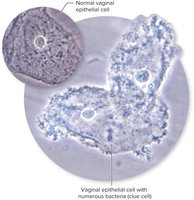
Gardnerella species: Cause bacterial vaginosis, characterized by fishy odor and clue cells on microscopy.
Trichomonas vaginalis: Protozoan causing frothy discharge, often asymptomatic in males.
Genital Ulcer Diseases
Three major infectious causes of genital ulcers are syphilis, chancroid, and genital herpes. These conditions increase susceptibility to HIV infection.
Syphilis: Caused by Treponema pallidum, a spirochete. Progresses through primary (chancre), secondary (rash, systemic symptoms), and tertiary (gummas, cardiovascular, neurological) stages. Can be transmitted congenitally.
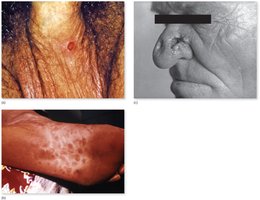
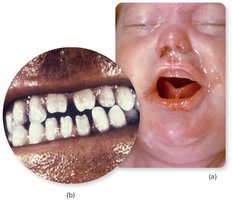
Congenital syphilis: Causes severe birth defects, including nasal discharge and Hutchinson's teeth.
Diagnosis: Dark-field microscopy, serology (RPR, immunoassays), NAATs.
Treatment: Penicillin G is the drug of choice.
Chancroid: Caused by Haemophilus ducreyi; presents as painful soft chancre and swollen lymph nodes.
Genital herpes: Caused by HSV-1 or HSV-2; presents as painful vesicles, can be latent and recurrent, risk of neonatal herpes.
Wart Diseases
Genital warts are primarily caused by human papillomavirus (HPV), with some types associated with cancer.
HPV: Over 100 types; types 16, 18, 31, 33, and 35 are linked to cervical and anal cancer.
Prevention: Vaccination is highly effective; regular Pap smears for cervical cancer screening.
Molluscum contagiosum: Caused by a poxvirus; produces wart-like lesions, can be sexually transmitted.
Group B Streptococcus (GBS) Neonatal Disease
GBS colonizes 10–40% of females and can cause life-threatening infections in newborns, including meningitis and pneumonia. Screening and prophylactic antibiotics during labor reduce risk.
Summary Table: Major Infectious Diseases of the Genitourinary System
Disease | Causative Agent | Key Features | Transmission | Prevention/Treatment |
|---|---|---|---|---|
UTI | E. coli, S. saprophyticus, others | Pain, dysuria, urgency, hematuria | GI tract to urinary tract | Nitrofurantoin, hygiene |
Gonorrhea | Neisseria gonorrhoeae | Discharge, PID, neonatal eye infection | Sexual contact | Dual antibiotic therapy |
Chlamydia | Chlamydia trachomatis | Often asymptomatic, PID, neonatal conjunctivitis | Sexual, vertical | Doxycycline/azithromycin |
Syphilis | Treponema pallidum | Chancre, rash, gummas, congenital defects | Sexual, vertical | Penicillin G |
Genital Herpes | HSV-1, HSV-2 | Painful vesicles, latency, neonatal risk | Sexual, perinatal | Acyclovir, not curative |
HPV | Human papillomavirus | Warts, cervical/anal cancer | Sexual, autoinoculation | Vaccine, Pap smear |
Leptospirosis | Leptospira interrogans | Fever, kidney/liver damage | Contact with animal urine | Doxycycline, penicillin G |
Summary Diagrams