 Back
Back190 Ch 7 Inside the Cell: Structure and Function of Prokaryotic and Eukaryotic Cells
Study Guide - Smart Notes
 Tailored notes based on your materials, expanded with key definitions, examples, and context.
Inside the Cell
Introduction
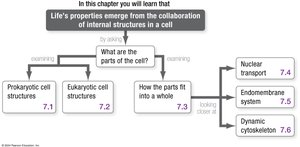
This chapter explores the internal structures of cells, emphasizing how the collaboration of these structures underlies the properties of life. It covers the differences between prokaryotic and eukaryotic cells, the organization and function of cellular components, and the dynamic systems that maintain cellular function.
Prokaryotic Cell Structures and Their Functions
Overview of Prokaryotic Cells
Prokaryotes include Bacteria and Archaea, which lack a membrane-bound nucleus.
All prokaryotic cells contain proteins, nucleic acids, carbohydrates, and a plasma membrane.
Prokaryotic cells are more structurally complex than previously thought, as revealed by transmission electron microscopy.
Key Structures in Prokaryotic Cells
Chromosome: Usually a single, circular DNA molecule associated with proteins, located in a region called the nucleoid.
Plasmids: Small, circular DNA molecules that carry genes beneficial for survival.
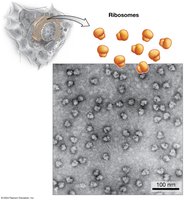
Ribosomes: Macromolecular machines composed of RNA and protein, responsible for protein synthesis.
Cytoskeleton: Protein filaments that maintain cell shape and are essential for cell division.
Internal Membranes: Found in photosynthetic species, these membranes contain pigments and enzymes for photosynthesis.
Organelles: Some prokaryotes have membrane-bound compartments for specialized functions (e.g., storing ions, orienting the cell with magnetite crystals).
Cell Wall: Provides structural support and shape; in bacteria, primarily composed of peptidoglycan.
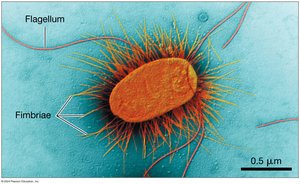
External Structures: Flagella (for movement) and fimbriae (for attachment to surfaces).
Eukaryotic Cell Structures and Their Functions
General Features of Eukaryotic Cells
Eukaryotes include protists, fungi, plants, and animals.
They are generally larger and more complex than prokaryotic cells.
Contain numerous membrane-bound organelles that compartmentalize cellular functions.
Major Eukaryotic Organelles and Structures
Nucleus: Surrounded by a double membrane (nuclear envelope) with pores; contains DNA and the nucleolus (site of ribosome assembly).
Ribosomes: Sites of protein synthesis; can be free in the cytosol or bound to the endoplasmic reticulum (ER).
Endoplasmic Reticulum (ER):
Rough ER (RER): Studded with ribosomes; synthesizes proteins for secretion or membrane insertion.
Smooth ER (SER): Lacks ribosomes; involved in lipid synthesis and detoxification.
Golgi Apparatus: Processes, sorts, and ships proteins and lipids received from the ER.
Lysosomes: Contain hydrolytic enzymes for digestion and recycling of macromolecules (mainly in animal cells).
Vacuoles: Storage organelles in plants and fungi; roles include storing water, ions, pigments, and defensive compounds.
Peroxisomes: Centers for oxidation reactions; contain catalase to detoxify hydrogen peroxide.
Mitochondria: Sites of ATP production; have their own DNA and ribosomes, supporting the endosymbiosis theory.
Chloroplasts: Found in plants and algae; sites of photosynthesis, also with their own DNA and ribosomes.
Cytoskeleton: Network of protein fibers that provides structural support, organizes organelles, and facilitates movement.
Cell Wall: Present in plants, fungi, and algae; provides structural support and protection.
Integration of Cell Parts and Their Functions
Structure-Function Relationship
The structure of each organelle is closely related to its function.
Cells with specialized functions (e.g., fat storage, contraction) have unique organelle compositions and morphologies.
Nuclear Transport
Transport Across the Nuclear Envelope
The nuclear envelope separates the nucleus from the cytoplasm and contains nuclear pore complexes for selective transport.
Proteins destined for the nucleus contain a nuclear localization signal (NLS), a specific amino acid sequence that directs their import.
Import and export through nuclear pores is highly regulated and essential for gene expression and ribosome assembly.
The Endomembrane System: Manufacturing, Shipping, and Recycling
Secretory Pathway and Protein Targeting
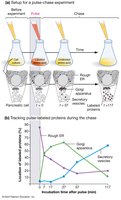
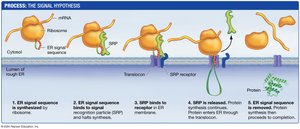
Proteins synthesized in the RER are transported to the Golgi apparatus for processing and sorting.
The signal hypothesis explains how proteins are directed to the ER by a signal sequence recognized by the signal recognition particle (SRP).
Proteins are packaged into vesicles for delivery to their final destinations, including lysosomes, the plasma membrane, or secretion outside the cell.
Protein Sorting and Vesicle Transport
Proteins receive molecular tags (e.g., mannose-6-phosphate) in the Golgi apparatus that direct them to specific organelles.
Vesicles bud from the Golgi and are transported to their destinations, where they fuse with target membranes.
Lysosomal Recycling Pathways
Cells recycle materials via three main pathways:
Receptor-mediated endocytosis: Uptake of specific molecules via receptor binding and vesicle formation.
Phagocytosis: Engulfment of large particles or cells.
Autophagy: Degradation of the cell's own damaged organelles or macromolecules.
The Dynamic Cytoskeleton
Types of Cytoskeletal Elements
Actin Filaments (Microfilaments): Smallest; involved in cell shape, movement, and division. Composed of actin protein subunits.
Intermediate Filaments: Provide mechanical support; include keratins and nuclear lamins.
Microtubules: Largest; hollow tubes made of tubulin dimers. Involved in organelle movement, chromosome separation, and cell motility.
Microtubule-Based Transport
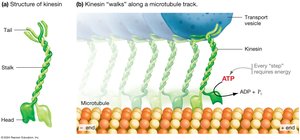
Microtubules serve as tracks for vesicle transport within the cell.
Kinesin is a motor protein that "walks" along microtubules, transporting vesicles using energy from ATP hydrolysis.
Flagella and Cilia
Flagella: Long, whip-like structures for cell movement; differ in structure and movement between prokaryotes and eukaryotes.
Cilia: Short, hair-like projections; move fluid over cell surfaces or propel single cells.
Both structures are built from microtubules arranged in a "9+2" pattern in eukaryotes.
Movement is powered by the motor protein dynein, which causes bending of the axoneme.
Summary Table: Major Eukaryotic Cell Components
Organelle/Structure | Main Function | Key Features |
|---|---|---|
Nucleus | Information storage, ribosome assembly | Double membrane, nuclear pores, nucleolus |
Ribosomes | Protein synthesis | Free or bound to ER, no membrane |
Rough ER | Protein synthesis and processing | Studded with ribosomes |
Smooth ER | Lipid synthesis, detoxification | No ribosomes |
Golgi Apparatus | Protein modification, sorting, shipping | Stacked cisternae |
Lysosomes | Digestion and recycling | Acid hydrolases, low pH |
Vacuoles | Storage, digestion | Large in plants/fungi |
Peroxisomes | Oxidation reactions | Contain catalase |
Mitochondria | ATP production | Double membrane, own DNA |
Chloroplasts | Photosynthesis | Three membranes, own DNA |
Cytoskeleton | Structural support, movement | Actin, intermediate filaments, microtubules |
Cell Wall | Support, protection | Plants, fungi, algae only |
Additional info: The content above integrates and expands upon the provided material, ensuring a comprehensive, self-contained study guide suitable for ANP college students. All images included are directly relevant to the adjacent explanations.
