 Back
Introduction to Anatomy & Physiology: Structured Study Notes
Study Guide - Smart Notes
 Tailored notes based on your materials, expanded with key definitions, examples, and context.
Introduction to Anatomy & Physiology
Overview of Anatomy and Physiology
Anatomy and physiology are foundational sciences for understanding the structure and function of the human body. Anatomy is the study of body structures, while physiology focuses on how those structures function. Both disciplines are closely related, as form often determines function.
Gross Anatomy: Study of large, visible structures (e.g., organs).
Microscopic Anatomy: Study of structures only visible with magnification (e.g., cells, tissues).
Regional Anatomy: Examines all structures in a specific area.
Systemic Anatomy: Studies structures within a specific organ system.
Physiology: Investigates the chemistry and physics of body functions, often focusing on homeostasis (maintenance of stable internal conditions).
Example: The structure of the hand (anatomy) allows for grasping and manipulation (physiology).
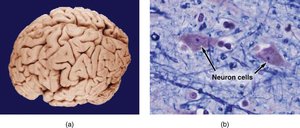
Variation in Anatomy & Physiology
Human anatomy and physiology can vary between individuals due to genetics, age, sex, and environmental factors. Common variations include differences in muscle presence, organ orientation, and number of vertebrae.
Palmaris longus: Variable muscle in the forearm.
Dextrocardia: Heart oriented to the right side.
Parathyroid glands: Variation in number and location.
Vertebral column: Variation in vertebrae number and distribution.
Structural Organization of the Human Body
Hierarchy of Organization
The human body is organized in a hierarchical manner, from the simplest chemical level to the complex organism level. Understanding this hierarchy is essential for studying anatomy and physiology.
Chemical Level: Atoms and molecules (e.g., water, proteins).
Organelle Level: Specialized structures within cells (e.g., mitochondria).
Cellular Level: Basic unit of life (e.g., muscle cell).
Tissue Level: Groups of similar cells performing a function (e.g., muscle tissue).
Organ Level: Structures composed of multiple tissue types (e.g., heart).
Organ System Level: Groups of organs working together (e.g., urinary system).
Organism Level: The complete living individual.
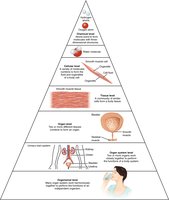
Example: The urinary system includes kidneys, ureters, bladder, and urethra, all working together to remove waste.
Language of Anatomy
Anatomical Position
The anatomical position is the standard reference for describing body locations: standing upright, feet parallel, arms at sides, palms facing forward. This position ensures consistency and precision in anatomical descriptions.
Prone: Lying face down.
Supine: Lying face up.
Regional Terms
Specific terms are used to describe regions of the body, increasing precision in communication. For example, "brachium" refers to the upper arm, while "antebrachium" refers to the forearm.
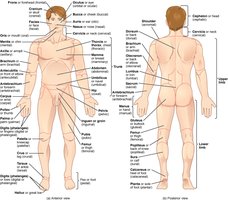
Directional Terms
Directional terms describe the location of structures relative to others. These terms are essential for accurate anatomical communication.
Anterior (ventral): Toward the front.
Posterior (dorsal): Toward the back.
Superior (cranial): Above or toward the head.
Inferior (caudal): Below or toward the tail.
Lateral: Toward the side.
Medial: Toward the midline.
Proximal: Nearer to the trunk or point of attachment.
Distal: Farther from the trunk or point of attachment.
Superficial: Closer to the surface.
Deep: Farther from the surface.
Contralateral: On opposite sides.
Ipsilateral: On the same side.
Body Sections & Planes
Anatomical Planes
Anatomical planes are imaginary lines used to divide the body for study and medical imaging. Understanding these planes is crucial for interpreting scans and sections.
Sagittal Plane: Divides body into right and left sides.
Midsagittal (median): Directly down the middle.
Parasagittal: Unequal right and left sides.
Frontal (coronal) Plane: Divides body into anterior and posterior portions.
Transverse Plane: Divides body into upper and lower portions (cross sections).
Oblique Plane: Cuts at an angle (not shown in image).
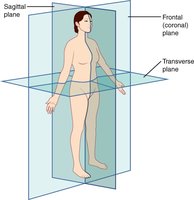
Body Cavities
Major Body Cavities
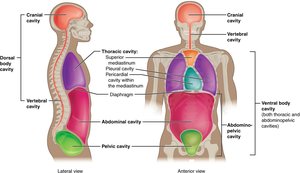
The body contains large cavities that house and protect internal organs. These cavities are divided into dorsal and ventral compartments, each with subdivisions.
Dorsal Cavity:
Cranial cavity: Contains the brain.
Vertebral (spinal) cavity: Contains the spinal cord.
Ventral Cavity:
Thoracic cavity: Contains lungs (pleural cavities) and heart (pericardial cavity).
Abdominopelvic cavity:
Abdominal cavity: Digestive organs.
Pelvic cavity: Reproductive organs.
Abdominal Regions and Quadrants
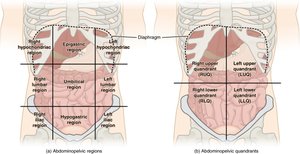
For clinical purposes, the abdominal cavity is divided into nine regions or four quadrants to localize symptoms or findings.
Nine Regions: More detailed, used for anatomical study.
Four Quadrants: Simpler, commonly used in medicine.
Body Cavity | Organ Example(s) |
|---|---|
Cranial | Brain |
Abdominal | Stomach |
Pelvic | Bladder |
Pleural | Lung |
Vertebral | Spinal cord |
Pericardial | Heart |
Summary Table: Hierarchy of Organization
Level | Definition |
|---|---|
Atom | Smallest unit of matter |
Molecule | Two or more atoms bonded together |
Organelle | Specialized structure within a cell |
Cell | Basic unit of life |
Tissue | Group of similar cells performing a function |
Organ | Structure composed of multiple tissue types |
Organ System | Group of organs working together |
Organism | Complete living individual |
Key Equations
Homeostasis (Conceptual Equation)
Homeostasis is often described as a dynamic equilibrium:
Additional info:
Directional terms and regional terms are foundational for later study of organ systems.
Understanding anatomical planes is essential for interpreting medical imaging (e.g., MRI, CT scans).
Body cavities provide protection and allow organ movement and expansion.
