 Back
BackIntroduction to the Endocrine System: Hormones, Mechanisms, and Pathologies
Study Guide - Smart Notes
 Tailored notes based on your materials, expanded with key definitions, examples, and context.
Introduction to the Endocrine System
Overview of Endocrinology
The endocrine system is a major regulatory system in the body, responsible for controlling metabolism, internal environment, reproduction, growth, and development through the action of hormones. Endocrinology is the study of hormones, which are chemical messengers secreted into the blood by specialized epithelial cells.
Hormones act on target cells by controlling enzymatic reactions, transport of ions/molecules, and gene expression.
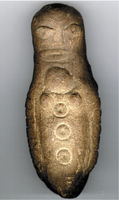
Knowledge of hormones dates back to ancient times, with early evidence seen in art and animal castration practices.
Classic Identification of Endocrine Glands
Endocrine glands were classically identified by removing, replacing, or creating excess of the suspected gland and observing anatomical, behavioral, or physiological changes.
Removal induces hormone deficiency; replacement therapy eliminates deficiency.
Excess hormone is created by implanting extra glands or administering extracts.
Not all hormones originate from discrete glands; some are secreted by scattered endocrine cells.
Hormone Definition and Secretion
What Makes a Chemical a Hormone?
The term "hormone" means to excite or arouse. Traditionally, hormones are chemicals secreted by cells into the blood for transport to distant targets, exerting effects at very low concentrations.
Hormones can be secreted by endocrine glands, isolated endocrine cells, neurons (neurohormones), and immune cells (cytokines).
Secretion is the movement of substances from inside a cell to extracellular fluid or the external environment.
Ectohormones are secreted into the external environment; pheromones are specialized ectohormones affecting other organisms of the same species.
Hormone Transport and Action
Hormones are transported via blood to distant target cells and act in very low concentrations. They are often stored in advance in the parent endocrine cell.
Candidate hormones are suspected hormones, often called "factors" (e.g., growth factors).
Hormones act by binding to target cell receptors, initiating biochemical responses.
Hormone action must be terminated by degradation in the kidneys and liver.
Classification of Hormones
Hormone Classification Schemes
Hormones can be classified by their source, regulation by the brain, receptor type, or chemical class. The three main chemical classes are:
Peptide/protein hormones: Linked amino acids.
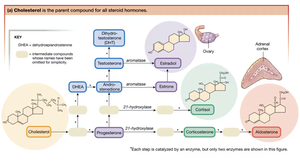
Steroid hormones: Derived from cholesterol.
Amino acid-derived (amine) hormones: Modified single amino acids (tryptophan or tyrosine).
Peptide/Protein Hormones
Peptide hormones are synthesized as large inactive proteins (preprohormones), processed to prohormones, and then to active hormones via post-translational modification. They are water-soluble and transported easily in extracellular fluid.
Peptide hormones are lipophobic and bind to surface membrane receptors.
Cellular responses are rapid, often involving cAMP second messenger systems.
Actions include opening/closing membrane channels and modulating metabolic enzymes.
Steroid Hormones
Steroid hormones are synthesized from cholesterol in specific organs (adrenal cortex, gonads, skin, placenta). They are lipophilic, diffuse easily across membranes, and are synthesized as needed.
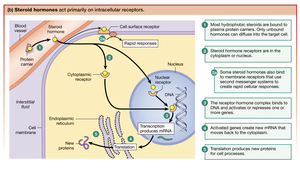
Transported in blood bound to protein carriers, which protect from degradation and extend half-life.
Only unbound steroid hormones can enter target cells.
Cellular Mechanism of Action of Steroid Hormones
Steroid hormone receptors are typically intracellular (cytoplasm or nucleus). The hormone-receptor complex acts as a transcription factor, altering gene expression and protein synthesis (genomic effect). Some steroid hormones also have membrane receptors for rapid, nongenomic responses.
Lag time exists between hormone-receptor binding and biological effects.
Cannot mediate rapid reflex pathways.
Amino Acid-Derived (Amine) Hormones
Amine hormones are derived from tryptophan (e.g., melatonin) or tyrosine (catecholamines and thyroid hormones). Catecholamines act via membrane receptors, while thyroid hormones act via intracellular receptors.
Catecholamines: Epinephrine, norepinephrine, dopamine.
Thyroid hormones: Combine two tyrosine molecules with iodine atoms.
Control of Hormone Release
Reflex Pathways and Feedback
Hormone release can be triggered by specific stimuli or occur continuously. Reflex pathways involve stimulus, sensor, input signal, integration, output signal (hormone/neurohormone), target, and response.
Endocrine cells can act as both sensor and integrating center in simple reflexes.
Negative feedback is common, where the response turns off the reflex.
Nervous System Involvement
The nervous system and endocrine system overlap structurally and functionally. Neurohormones are released into the blood by neurons, with major groups including catecholamines, hypothalamic neurohormones (posterior and anterior pituitary).
Pituitary gland: Anterior (true endocrine gland) and posterior (neural tissue extension).
Posterior Pituitary Neurohormones
The posterior pituitary stores and releases two neurohormones: oxytocin and vasopressin (antidiuretic hormone, ADH).
Oxytocin: Controls milk ejection and uterine contractions; important in social, sexual, and maternal behaviors.
Vasopressin: Regulates water balance in kidneys.
Anterior Pituitary Hormones
The anterior pituitary secretes six hormones: prolactin, thyrotropin (TSH), adrenocorticotropin (ACTH), growth hormone (GH), follicle-stimulating hormone (FSH), and luteinizing hormone (LH).
Hypothalamic neurohormones control their release via releasing or inhibiting hormones.
Trophic hormones control secretion of other hormones.
Portal System
The hypothalamic-hypophyseal portal system connects the hypothalamus and anterior pituitary, allowing concentrated hormone delivery and avoiding dilution.
Feedback Loops in Hypothalamic-Pituitary Pathways
Feedback in these pathways is complex, involving three integrating centers. Long-loop negative feedback is dominant, where peripheral gland hormones suppress secretion of anterior pituitary and hypothalamic hormones.
Short-loop and ultra-short-loop feedback also occur.
Hormone Interactions
Types of Hormone Interactions
Cells and tissues are often controlled by multiple hormones simultaneously. Three main types of interactions:
Synergism: Combined effect greater than additive.
Permissiveness: One hormone requires another to exert its effect.
Antagonism: Opposing actions, either by competitive inhibition or functional antagonism.
Endocrine Pathologies
Patterns of Endocrine Pathology
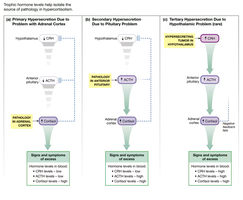
Endocrine pathologies arise from hormone excess, deficiency, or abnormal responsiveness of target tissues.
Hormone excess: Hypersecretion, often due to tumors or exogenous substances.
Hormone deficiency: Hyposecretion, often due to gland atrophy.
Abnormal responsiveness: Altered receptor interactions or signal transduction pathways.
Diagnosis of Endocrine Pathologies
Diagnosis depends on the complexity of the reflex pathway. Primary pathology arises in the last endocrine gland, secondary in the anterior pituitary.
Hormone Evolution
Evolutionary Conservation
Hormone structure and function are highly conserved across species, with some hormones from other organisms retaining biological activity in humans. Studying conserved portions of hormone molecules provides insight into their function.
