 Back
BackMembrane Transport: Diffusion, Osmosis, and Protein-Mediated Transport
Study Guide - Smart Notes
 Tailored notes based on your materials, expanded with key definitions, examples, and context.
Membrane Transport
Diffusion
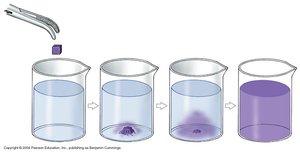
Diffusion is a fundamental process by which particles move from areas of higher concentration to areas of lower concentration, driven by their thermal energy. This movement continues until the concentration gradient is eliminated.
Definition: Diffusion is the passive movement of molecules down their concentration gradient.
Factors Affecting Diffusion: Temperature (higher temperature increases rate), molecule size (smaller molecules diffuse faster), and concentration gradient (larger gradient increases rate).
Biological Importance: Essential for delivery of oxygen and nutrients and removal of waste products in capillaries.
Example: Oxygen diffuses from blood plasma into cells.
Selective Permeability of Cell Membranes
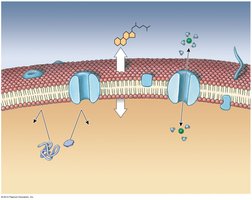
Cell membranes are selectively permeable, allowing certain substances to cross while restricting others. This property is crucial for maintaining cellular homeostasis.
Freely Permeable: Allows all substances to pass.
Impermeable: Allows no substances to pass.
Selectively Permeable: Allows only specific substances to pass, based on size, charge, and solubility.
Lipid-soluble molecules: Diffuse freely across the membrane.
Water and ions: Require channel proteins to cross.
Large molecules: Require carrier mechanisms.
Osmosis and Tonicity
Osmosis
Osmosis is the diffusion of water across a selectively permeable membrane, typically mediated by aquaporins. Water moves in response to solute concentration gradients, following the solute transport.
Definition: Osmosis is the passive movement of water from areas of low solute concentration to areas of high solute concentration.
Mechanism: Water follows solute movement, requiring no direct energy input.
Osmolarity: The total concentration of all solute particles in a solution, measured in Osm/L or mOsm/L.
Calculation:
Example: 1 mM NaCl yields 2 mOsm/L because it dissociates into Na+ and Cl-.
Tonicity and Effects on Cells
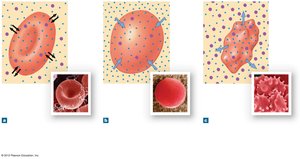
Tonicity describes the effect of osmotic gradients on cell volume. Animal cells are sensitive to changes in tonicity due to their inability to withstand excessive swelling or shrinking.
Isotonic: No net water movement; cell volume remains unchanged (300 mOsm/L).
Hypotonic: Net water movement into the cell; cell swells and may burst (<300 mOsm/L).
Hypertonic: Net water movement out of the cell; cell shrinks (>300 mOsm/L).
Clinical Relevance: IV fluids must be isotonic to prevent hemolysis or crenation of red blood cells.
Protein-Mediated Transport Across Plasma Membranes
Types of Protein-Mediated Transport
Polar substances and ions require protein-mediated transport to cross the cell membrane. These mechanisms are highly regulated and exhibit specificity, competition, and saturation.
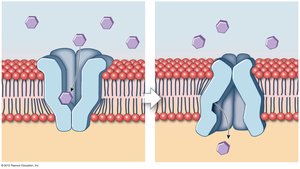
Facilitated Diffusion: Passive transport via channel or carrier proteins, down the concentration gradient.
Active Transport: Requires ATP to move substances against their concentration gradient.
Secondary Active Transport: Uses the gradient of one ion (often Na+) to drive the transport of another molecule.
Co-transporters: Symport (same direction) and antiport (opposite direction).
Facilitated Diffusion: Ion Channels and Carrier Proteins
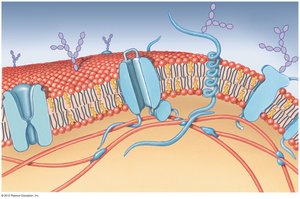
Ion channels and carrier proteins enable the selective and regulated movement of ions and molecules across the membrane.
Ion Channels: Provide hydrophilic pores for ion diffusion; exhibit saturable kinetics and specificity.
Carrier Proteins: Undergo conformational changes to transport molecules; subject to competitive inhibition.
Example: Glucose transporters can be inhibited by galactose due to competition.
Active Transport: The Sodium-Potassium Pump (Na+-K+ ATPase)
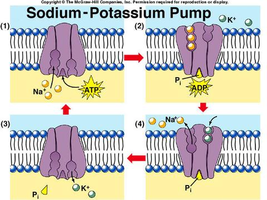
The Na+-K+ pump is a primary active transport mechanism that maintains high intracellular K+ and low intracellular Na+ concentrations, essential for cell function.
Mechanism: Uses ATP to transport 3 Na+ out and 2 K+ into the cell.
Importance: Maintains membrane potential, supports secondary active transport, and is vital for neuronal and muscle function.
Electrogenic: Contributes to the negative resting membrane potential.
Equation:
Vesicular Transport: Endocytosis, Exocytosis, and Transcytosis
Endocytosis
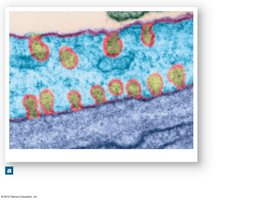
Endocytosis is the process by which cells internalize large particles or quantities of substances. It includes receptor-mediated endocytosis, pinocytosis, and phagocytosis.
Receptor-Mediated Endocytosis: Specific ligands bind to membrane receptors, forming coated vesicles that are internalized.
Pinocytosis: Uptake of fluid and dissolved substances.
Phagocytosis: Uptake of large particles via pseudopodia.
Exocytosis and Transcytosis
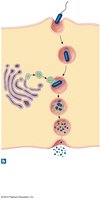
Exocytosis is the process by which cells expel materials, while transcytosis involves the transport of substances across a cell by a combination of endocytosis and exocytosis.
Exocytosis: Fusion of vesicles with the plasma membrane to release contents outside the cell.
Transcytosis: Sequential endocytosis and exocytosis, important in endothelial cells for moving substances across barriers.
Summary Table: Types of Membrane Transport
Transport Type | Driving Force | Protein Involved | Examples |
|---|---|---|---|
Simple Diffusion | Concentration Gradient | None | O2, CO2 |
Facilitated Diffusion | Concentration Gradient | Channel/Carrier Proteins | Ions, Glucose |
Active Transport | ATP | Pumps | Na+/K+ ATPase |
Secondary Active Transport | Ion Gradient | Co-transporters | Na+-Glucose Symport |
Vesicular Transport | ATP | Vesicle Proteins | Endocytosis, Exocytosis |
